
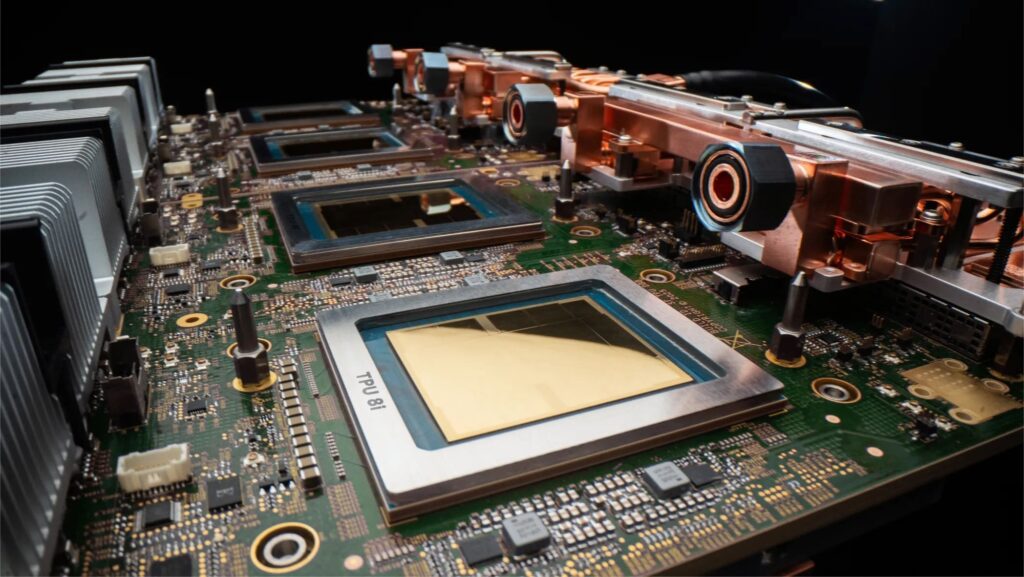
The next major Google chip for mobile devices is once again under suspicion even before its official announcement. A new leak suggests that the Tensor G6, the System on Chip (SoC) expected to power upcoming Pixel 11 devices, might include a surprising component: a PowerVR CXT-48-1536 GPU, an architecture originally introduced by Imagination Technologies in 2021.
This information should be treated as a leak, not as an official specification. Google has not yet confirmed the final configuration of the Tensor G6. Nevertheless, the data fits a trend seen since the first generations of the Tensor series: the company prioritizes AI features, computational photography, security, and Pixel experience over competing directly with Qualcomm, Apple, or MediaTek in raw graphics performance.
The issue is that this strategy is beginning to show some clear limits. In a generation where premium smartphones boast demanding gaming, emulation, video editing, local AI interfaces, and other graphics-intensive tasks, deploying a GPU that’s several years old can raise reasonable doubts. Not because a 2021 architecture is useless, but because the market in 2026 already operates at a different scale in terms of performance, efficiency, and drivers.
A GPU with a history in the era of mobile AI
According to Android Authority, the new leak reinforces previous reports indicating a shift towards the PowerVR CXT architecture in the Tensor G6. The specific GPU would be the CXT-48-1536, part of the IMG CXT family announced by Imagination Technologies in November 2021, supporting ray tracing through its Photon architecture. At that time, the CXT-48-1536 RT3 core was presented as an advanced solution for ray tracing in mobile devices.
The most notable aspect is the significant time gap. If the Pixel 11 arrives in 2026 with this GPU, Google would be integrating a technology introduced about five years earlier. This doesn’t necessarily mean the design is exactly the same as the 2021 version, as graphical IP can be adapted to different manufacturing nodes, clock frequencies, and configurations. However, it does suggest a conservative choice compared to more recent solutions.
The comparison with the Tensor G5 doesn’t help much either. That chip, associated with the Pixel 10 family, is believed to have used an IMG DXT-48-1536 GPU, which is theoretically more modern. Android Authority points out that if the Tensor G6 ends up incorporating a CXT architecture, it might not deliver a significant graphical performance improvement over its predecessor. For a brand already criticized for sustained performance and graphics driver support in its Tensor chips, this is a concerning prospect.
Google might have several reasons for this approach. A more contained GPU could help reduce chip size, control costs, improve margins, or allocate more space and power budget to CPU, NPU, ISP, modem, security, and AI-specific blocks. Many of Pixel’s standout features—photography, voice, translation, image processing, and local AI tasks—do not rely solely on the GPU.
The risk is that users don’t always perceive these priorities. Buyers of premium smartphones expect everything to work well: photos, battery life, AI, display, video, and gaming. If the GPU lags behind the competition, Google will need to compensate through optimization, stable drivers, and a highly refined experience.
A more promising CPU, a more questionable GPU
The same set of leaks offers some positive news for Google. The Tensor G6 could adopt more recent Arm Cortex C1 cores, including a C1-Ultra at 4.11 GHz, four C1-Pro cores at 3.38 GHz, and two more C1-Pro cores at 2.65 GHz, according to 9to5Google. The leaked configuration would feature seven cores, arranged in a 1+4+2 scheme, instead of the typical eight cores found in many high-end mobile chips.
This combination suggests that Google is investing in a more modern CPU while maintaining a balanced approach elsewhere on the chip. The Tensor architecture has never been solely about benchmark performance. Since the original Tensor, Google has championed designing chips for specific Pixel experiences—particularly on-device AI, computational photography, and security.
The rumored new Titan M3 security co-processor also aligns with this philosophy. Titan coprocessors are dedicated to strengthening key protection, biometric data, and sensitive security functions. For Google, this security layer is as integral to Pixel’s identity as the camera or AI capabilities.
However, the market does not wait. Qualcomm has significantly improved the sustained performance of its Snapdragon chips, MediaTek has elevated its high-end Dimensity series, and Apple continues to lead with its A-series chips in both CPU and GPU performance. If the Tensor G6 arrives with a veteran GPU, the Pixel 11 might end up in a peculiar position: very competent in AI features but less attractive to users seeking top-tier graphics power.
Why this matters beyond gaming
Focusing solely on gaming would be an oversimplification. The GPU also impacts smooth interfaces, multimedia processing, image and video editing, visual effects, rendering, augmented reality, and some AI or parallel computing workloads. Even if Google delegates many AI tasks to the NPU, the GPU remains a key part of overall device performance.
Software support also plays a crucial role. A well-maintained older GPU can outperform a newer one with immature drivers. But if update history, API compatibility, or performance in demanding games are lacking, the user experience can suffer. In Android, with its diversity of hardware, choosing a less common GPU can add another layer of complexity for developers.
The potential use of PowerVR isn’t inherently negative. Imagination Technologies has been developing graphics IP for years, for mobile, automotive, and embedded devices. The CXT family was notable for introducing advanced ray tracing in mobile form. The question is not whether PowerVR can be a good technology, but whether this specific generation is suitable for a premium phone in 2026.
This decision can also be viewed as part of a broader strategy. Google does not sell Pixel phones solely based on benchmark scores; it aims to deliver a device where hardware, Android, camera, AI, and services work seamlessly together. For many users, that integration may be sufficient. But in a highly competitive market, every technical compromise amplifies.
If the leak is confirmed, the Tensor G6 will be a curious mix: a modern CPU, focus on AI and security, but potentially a GPU based on technology five years old. For some users, this may not be decisive. For others—gamers, mobile creators, and those scrutinizing specifications—it could be another sign that Google is still hesitant to compete at the high end with the same weapons as its rivals.
Until Google officially unveils the Tensor G6 and the Pixel 11, everything remains speculative. But the discussion is already open: can a premium device rely on a GPU that’s five years old if it offers better AI, security, and efficiency in return? The answer will depend less on technical specs and more on how Google can demonstrate, in real-world use, that its decisions do not feel like cuts or compromises.
Frequently Asked Questions
What GPU might the Google Tensor G6 use?
Leaks point to a PowerVR CXT-48-1536, an architecture introduced by Imagination Technologies in 2021.
Does this mean the Pixel 11 will have poor graphics performance?
Not necessarily. It will depend on clock speeds, manufacturing node, drivers, optimization, and final configuration. However, the choice raises questions compared to more recent mobile GPUs.
What CPU improvements could the Tensor G6 bring?
The leak mentions newer Arm C1 cores, with a setup of seven cores: one C1-Ultra and multiple C1-Pro cores.
Why would Google opt for an older GPU?
It could be to reduce chip size, control costs, improve efficiency, or prioritize other blocks such as NPU, camera, security, and AI functions.
