
Elon Musk often tries to build what he cannot buy at the scale he needs. He did so with reusable rockets when SpaceX couldn’t find the right speed or cost in the market. He did it with giant batteries and factories when Tesla needed to secure supply for electric vehicles. Now he wants to apply a similar logic to semiconductors with Terafab, a project that has not yet produced a single chip but has already started to generate conversations in one of the most concentrated and challenging industries in the world.
The idea, according to Musk and as reported by international media, involves establishing an advanced chip manufacturing infrastructure in Texas linked to Tesla, SpaceX, and xAI. The declared goal is to ensure capacity for autonomous vehicles, humanoid robots Optimus, AI data centers, and even chips designed for space environments. It’s not a conventional factory but an integrated approach combining design, manufacturing, advanced packaging, and testing under one umbrella.
However, it’s important to separate ambition from reality. Today, Terafab is a planning project with many unresolved details: schedule, full funding, governance, suppliers, actual capacity, and economic return. Musk has a long track record of announcements that transform sectors, but also of timelines that extend or promises that are not delivered as initially presented. In semiconductors, this caution is even more necessary.
Why Terafab matters before it exists
The chip industry is going through a strange period. Artificial intelligence has skyrocketed demand for GPUs, accelerators, HBM memory, advanced packaging, wafers on cutting-edge nodes, and related energy capacity. TSMC continues to dominate the most advanced manufacturing, Samsung is trying to strengthen its position, and Intel seeks to make its foundry business a credible alternative for large clients.
In this context, Terafab sends a strong signal: major compute consumers don’t want to depend on a supply chain that is already strained. Tesla needs chips for autonomous driving and robots. xAI needs infrastructure to train and serve models. SpaceX might require rugged components for orbital systems and, if its plans for advanced space data centers move forward, for even more demanding scenarios. The combined demand from Musk’s companies is hard to quantify, but the message is clear: they don’t want to wait their turn in a queue dominated by NVIDIA, Apple, AMD, Qualcomm, Amazon, Microsoft, Google, and other giants.
Musk has positioned Terafab as a response to this shortage. Reuters reported that SpaceX and Tesla plan two advanced chip factories in Austin: one focused on Tesla vehicles and Optimus, and another on chips for AI satellites or space data centers. Musk also stated that current global production would only meet a small fraction of their future needs.
The most striking figure is the target of producing one terawatt of computing capacity annually. This is an uncommon measure in semiconductors, where nodes, wafers per month, chips, performance per watt, or packaging capacity are more typical. It expresses scale but doesn’t allow for direct comparison with a conventional factory without knowing what chips will be produced, on which node, their performance, and how exactly that capacity will be measured.
| Element of Terafab | What has been announced |
|---|---|
| Related companies | Tesla, SpaceX, and xAI |
| Intended location | Austin, Texas |
| First step | Research fab at Giga Texas |
| Estimated cost of research fab | About $3 billion, according to Musk |
| Initial production planned | A few thousand wafers per month for testing ideas |
| Cited technology | Intel 14A process |
| Final declared goal | Up to 1 TW of capacity annually |
| Intended uses | Vehicles, Optimus, AI, space chips, and data centers |
Intel sees a needed opportunity
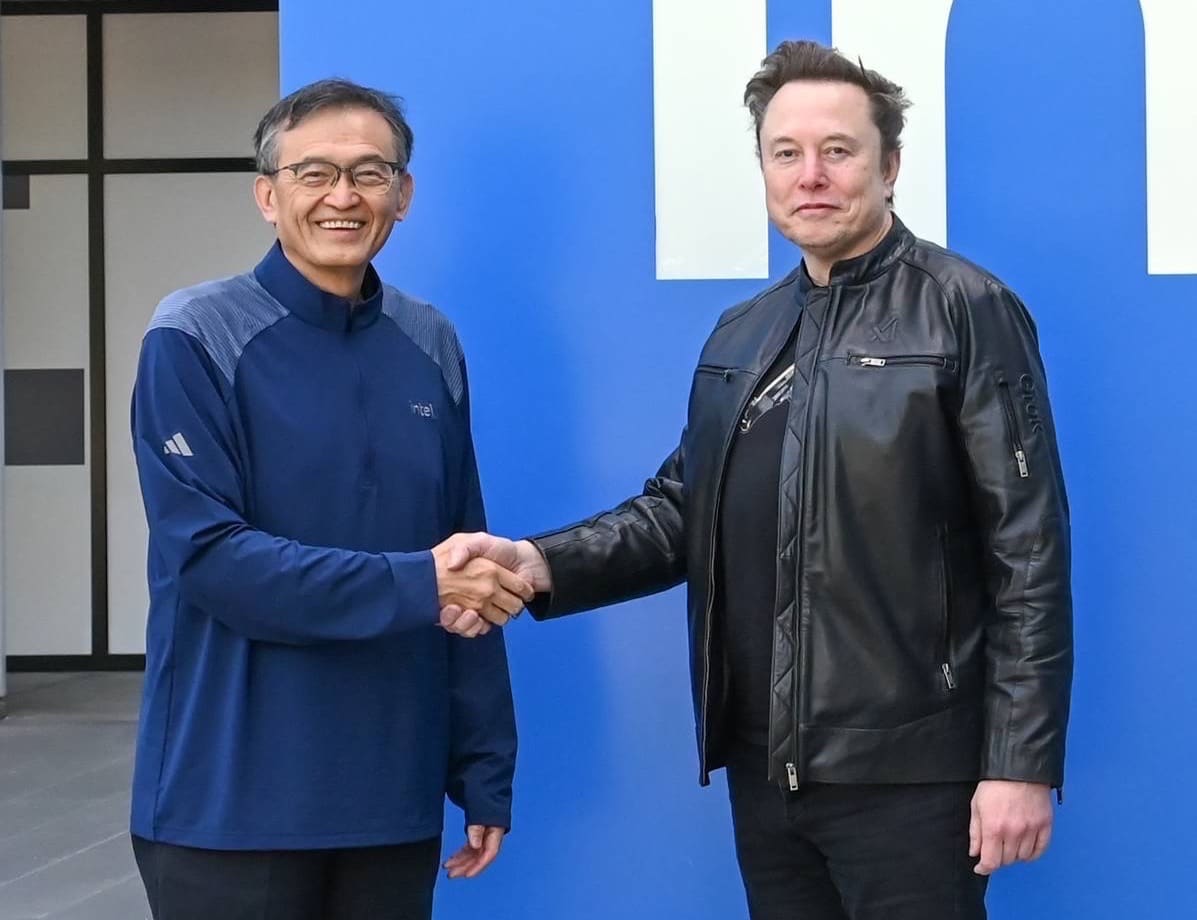
One of the most significant points is Intel’s entry. Musk mentioned during Tesla’s earnings call that the plan includes using Intel’s 14A process for Terafab chips. For Intel, this would be much more than an impressive customer—it could serve as a crucial validation of its foundry business and advanced technology.
The 14A process is key to this narrative. Intel presents it as an advanced generation with technologies like RibbonFET and back-side energy distribution. If Terafab ends up using 14A significantly, Musk could give Intel what it has been seeking for some time: a prominent external client with media visibility and long-term volume needs.
The relationship also has a geopolitical dimension. The US aims to restore advanced semiconductor manufacturing capabilities on its soil. Terafab, if it progresses, would align with this agenda—more local manufacturing, less dependence on Taiwan, greater integration among end customers, chip design, foundries, and packaging. But political alignment alone isn’t enough. Manufacturing cutting-edge chips requires EUV equipment, specialized materials, gases, masks, talent, intellectual property, statistical control, high yields, and a supply chain that can’t be improvised.
eeNews Europe pointed out a practical limit: equipment. High-NA EUV lithography tools from ASML have long lead times and enormous costs. A single TWINSCAN EXE:5200 system can be around $350 million, with limited availability. Even with capital, acquiring these machines, installing, qualifying, and running them efficiently takes years.
This is the key difference between a gigafactory for batteries and a cutting-edge chip factory. In batteries, Tesla could integrate complex industrial processes but operated in a less barrier-heavy environment. In semiconductors, only a few companies possess decades of expertise and an almost irreplaceable network of suppliers.
What could change even if Terafab takes years
The paradox of Terafab is that it could disrupt the industry even before starting production. The mere possibility of Tesla, SpaceX, and xAI seeking a more integrated supply chain pressures current suppliers. Major industry players like Samsung, TSMC, Micron, Intel, Applied Materials, Lam Research, Tokyo Electron, ASML, and others know that large AI clients are trying to secure capacity by any means: long-term contracts, direct investments, cloud agreements, in-house manufacturing, and semi-vertical projects.
This movement also reinforces a broader trend: the boundaries between chip designers, end customers, and infrastructure operators are blurring. Historically, a company designed software, another designed chips, a third manufactured them, and another operated data centers. AI is pushing big tech to control more layers. Google has TPUs, Amazon has Trainium and Inferentia, Microsoft works with its own silicon, Meta develops accelerators, OpenAI secures gigawatts of infrastructure, and Tesla has been designing chips for autonomous driving for years. Terafab would be the most extreme expression of this trend.
For Musk, the motivation is clear. If autonomous cars, humanoid robots, Grok, satellites, and orbital data centers are part of the same ecosystem, the chip stops being just a purchased component and becomes a strategic constraint. Whoever controls supply can iterate faster, tailor hardware to software, and reduce reliance on suppliers also serving competitors.
The risks are equally significant. Building a silicon factory isn’t just about vision. It demands operational discipline, years of learning, billions of dollars, and near-obsessive execution. Reuters’ own analysis reminds us that key questions remain unanswered: who will pay for equipment, who will operate the factory, and when will it actually start production. Moreover, estimates cited by Reuters suggest it could cost trillions of dollars to reach a scale comparable to one terawatt of annual compute—far beyond an initial $25 billion investment.
Therefore, Terafab should be viewed less as an imminent factory and more as a strategic declaration. Musk is signaling to the market that the IA chip shortage won’t be solved by simply buying more from current suppliers. He aims to change negotiations, attract Intel, mobilize suppliers, and convince investors that vertical integration can again be an advantage.
The industry is already responding because it understands the message. If Terafab fails, it will be seen as just another overambitious project. If it moves forward, even partially, it could accelerate a reorganization of advanced manufacturing in the US. And if Musk manages to bring some of the same impact he achieved with rockets or batteries into chips, the effect would extend far beyond Tesla.
Right now, there are no chips, volumes aren’t confirmed, and the schedule is uncertain. But in semiconductor manufacturing, critical decisions are made years before the first wafer leaves the line. Terafab has already achieved something: forcing the industry to imagine what could happen if one of the largest future demanders of compute decided that simply buying chips isn’t enough.
Frequently Asked Questions
What is Terafab?
It’s a project announced by Elon Musk to develop an advanced chip manufacturing infrastructure linked to Tesla, SpaceX, and xAI, focusing on AI, robotics, autonomous vehicles, and space applications.
Does Terafab currently manufacture chips?
No. It is presently a planning project. Musk has mentioned a research fab at Giga Texas and a broader vision, but there is no confirmed commercial production yet.
What role would Intel play?
Musk indicated that Terafab would use Intel’s 14A process. For Intel, this could be a major validation of its foundry business and advanced tech.
Why isn’t it enough to just buy chips from TSMC, Samsung, or NVIDIA?
Because demand from AI, autonomous vehicles, robotics, and potential space systems might exceed existing capacity or require designs that don’t match current offerings. Terafab aims to reduce that dependency, though its execution will be extremely complex.
