
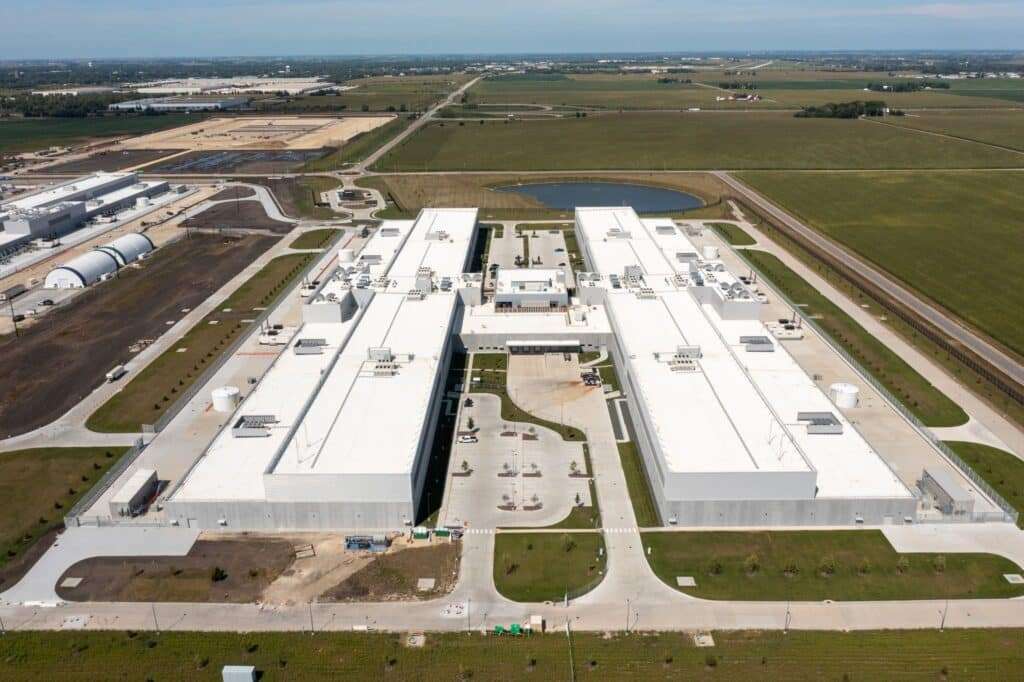
Meta has once again highlighted one of the major paradoxes in the tech industry: while it ramps up its investments in data centers, servers, and cloud agreements to support its AI strategy, it is also preparing new layoffs under the guise of efficiency. The company closed the first quarter of 2026 with rising revenues, high margins, and a progressively aggressive infrastructure spending plan.
Led by Mark Zuckerberg, the group reported revenues of $56.311 billion between January and March, a 33% increase compared to the same period last year. Net profit reached $26.773 billion, although this figure was boosted by an exceptional tax benefit of $8.030 billion. Advertising remains Meta’s core revenue driver, but its strategic focus is shifting towards another key area: the computing capacity needed to train, deploy, and serve AI models globally.
More investment in servers, data centers, and cloud agreements
Meta raised its capital expenditure forecast for 2026 to a range between $125 billion and $145 billion, up from the previous range of $115 billion to $135 billion. The company attributes this adjustment mainly to rising component costs and, to a lesser extent, higher data center expenses to ensure capacity for future operations.
In the first quarter, capex totaled $19.84 billion, primarily driven by purchases of servers, data centers, and network infrastructure. Susan Li, Meta’s CFO, explained to investors that the company is investing aggressively to meet its infrastructure needs and maintain strategic flexibility over the coming years.
Meta isn’t just expanding its own capacity; it’s also entering multi-year cloud agreements, set to begin operation between 2026 and 2027. According to Li, these cloud contracts and infrastructure purchase agreements resulted in a $107 billion increase in contractual commitments during the quarter.
| Indicator Q1 2026 | Data |
|---|---|
| Revenue | $56.311 billion |
| Year-over-year growth | 33% |
| Costs and expenses | $33.439 billion |
| Operating profit | $22.872 billion |
| Operating margin | 41% |
| Quarterly capex | $19.84 billion |
| Forecasted capex for 2026 | $125B–$145B |
| Cash and cash equivalents | $81.18 billion |
| Long-term debt | $58.75 billion |
| Employees at quarter end | 77,986 |
The increase isn’t surprising given Meta’s recent trajectory. At the start of 2026, the company created Meta Compute, a division aimed at expanding AI data center ambitions with the goal of developing tens of gigawatts of computational capacity over the next decade. Since then, it has advanced projects in Oklahoma, Texas, and Wisconsin, alongside strengthening its presence through agreements with cloud providers and specialized operators.
Meta is also diversifying its hardware. Zuckerberg confirmed that Meta is deploying over a gigawatt of proprietary silicon developed with Broadcom, in addition to incorporating a significant amount of AMD chips to complement new NVIDIA-based systems. The message is clear: Meta wants more capacity, but also more control over cost, energy efficiency, and dependency on external suppliers.
Layoffs amid infrastructure expansion
The other side of the story is the workforce. Meta ended the quarter with 77,986 employees, representing a 1% increase compared to a year earlier, though about a 1% decrease from the previous quarter based on market reports. The company has not disclosed the scope of planned layoffs for May, but Li told investors that Meta remains committed to operating efficiently and has internally announced a reduction in its employee base.
This combination may seem contradictory: more data centers, more servers, more cloud commitments, and fewer workers. However, it reflects a broader trend among major tech companies. They are reallocating capital from mature or less strategic areas toward AI, infrastructure, and automation. Cost savings may not be immediate, but the message to investors is that spending is focused on what is considered the future of the business.
Meta had already undergone significant layoffs in 2022 and 2023, branded as the “year of efficiency.” Now, the dynamics are different. The company has a highly profitable ad business, but it is competing in an AI race that requires massive investments before any returns are clear. Maintaining a 41% operating margin amid soaring infrastructure costs means cutting, containing, or reordering expenses elsewhere in the organization.
The Family of Apps division continues to fund expansion. Facebook, Instagram, Messenger, and WhatsApp generated $55.909 billion in revenue in the quarter, with $26.9 billion in operating profit. Reality Labs, on the other hand, once again posted a loss: $4.028 billion in operating loss on just $402 million in revenue. Meta remains committed to augmented reality, virtual reality, and immersive computing, but AI has become its most urgent and visible priority.
AI forces blind planning
The most revealing comment from Meta’s financial leadership isn’t just about capex but also about uncertainty. Li acknowledged that Meta is engaged in a “very dynamic” planning process because its experience so far has been underestimating its computing needs, despite significantly increasing capacity.
This summarizes the current sector situation: major platforms don’t know precisely how much infrastructure they will need in two or three years but fear falling short. In AI, arriving late in capacity terms can mean losing product momentum, limiting models, increasing service costs, or depending on third parties under worse conditions. That’s why commitments are made earlier, land is reserved in advance, and supply contracts are signed sooner.
This also explains the shift toward debt. As of March, Meta held $81.18 billion in cash and liquid assets, alongside $58.75 billion in long-term debt. After earnings release in late April, the company issued another $25 billion in bonds across six tranches, maturing between 2031 and 2066. While Meta has sufficient liquidity, the scale of its investments necessitates a mix of internal resources, debt, and multi-year commitments.
The market responded cautiously. Sector reports indicated that Meta’s stock fell more than 8%, not because revenues are weak, but because the costs of the AI race are growing faster than many investors anticipated. The question isn’t whether Meta can invest—it can. The real concern is how much capital will be needed before AI yields returns comparable to its advertising business.
Meta argues that this spending will enable it to deliver “superintelligent personal assistants” to billions of users, enhance content and ad relevance, create agents for consumers and businesses, and strengthen its position against OpenAI, Google, Microsoft, Apple, Amazon, and other competitors. It’s an infrastructure bet, but also a strategic control move: possessing proprietary capacity allows for faster iteration, better negotiations, and less reliance on third parties.
The paradox will persist for months. Meta can grow, generate substantial profits, invest more than ever, and also lay off staff simultaneously. AI isn’t reducing tech spending; it’s shifting it toward data centers, chips, energy, networks, and specialized talent. For workers, this means increased pressure. For infrastructure operators, it’s a historic demand. For investors, it’s an uncomfortable question: how much must be spent today to avoid missing out on the next dominant platform.
Frequently Asked Questions
How much will Meta invest in infrastructure in 2026?
Meta expects capital expenditures between $125 billion and $145 billion in 2026, mainly for servers, data centers, networks, and AI-related capacity.
Why is Meta planning layoffs if its revenues are growing?
The company cites efficiency reasons. In practice, it is reallocating resources toward AI and infrastructure while controlling costs elsewhere.
What role do data centers play in Meta’s strategy?
They are essential for training and deploying AI models, servicing agents, improving advertising systems, and supporting new AI-based products at scale.
Will Meta rely solely on NVIDIA for its AI chips?
No. While deploying NVIDIA systems, Meta is also using AMD chips and over a gigawatt of proprietary silicon developed with Broadcom.
