
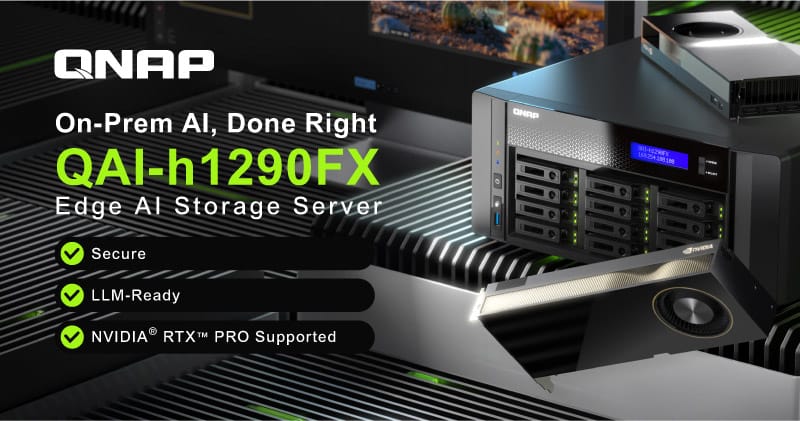
QNAP has introduced the QAI-h1290FX, a storage and computing server designed to run AI workloads within the organization itself, without necessarily relying on external cloud services. The proposal targets a growing market: organizations looking to utilize large language models, RAG search, and generative AI applications, while keeping their data under local control.
The system combines all-flash NVMe storage, enterprise-grade AMD EPYC processors, high-speed networking, and options for GPU acceleration with NVIDIA RTX cards. It’s not just a conventional NAS with some AI features added; it aims to unify storage, virtualization, containers, and GPU resources on a single machine to accelerate local deployment of private LLMs. QNAP targets IT teams, developers, research departments, and companies needing low latency, data privacy, and operational control.
Private AI without Sending Data to the Cloud
The main appeal of the QAI-h1290FX lies in a concept increasingly valued by many companies: not all data needs to leave the organization to leverage AI. Contracts, internal documentation, files, knowledge bases, technical manuals, HR information, or customer data can be too sensitive to process without control on external platforms.
QNAP envisions this server as a way to deploy internal assistants, RAG-based document search engines, and content generation tools within the company perimeter. RAG search, or augmented retrieval generation, allows a model to respond using company documents as context—a useful approach for querying contracts, reports, internal policies, technical documentation, or corporate knowledge bases.
The QAI-h1290FX comes with preloaded AI tools like AnythingLLM, OpenWebUI, and Ollama, designed to facilitate the deployment of workflows with local models. The company also indicates they are integrating applications like Stable Diffusion, ComfyUI, n8n, and vLLM, expanding use cases into image generation, task automation, and more specialized inference deployments.
The difference from a custom-built GPU workstation is in the integration. QNAP aims to reduce the effort needed to install tools, configure containers, allocate GPU resources, and prepare fast storage for models and data. Oliver Lam, the company’s product director, summarizes this goal by stating they want users to run AI models “right out of the box,” maintaining data control without dependence on the cloud.
All-Flash, GPU, and ZFS for Demanding Workloads
The technical specs show a machine built for intensive workloads. The QAI-h1290FX features twelve SSD U.2 NVMe bays, with compatibility for SATA SSDs as well, allowing configurations focused on performance, capacity, or cost. In local AI tasks, fast storage is more critical than it might seem: models, vector indexes, processed documents, images, and databases can generate high, sustained read/write loads.
The chosen CPU is an AMD EPYC 7302P, a 16-core, 32-thread processor sufficient for virtualization, auxiliary services, containers, task orchestration, data preprocessing, and parallel workloads. GPU acceleration is optional but key for more ambitious use cases. QNAP mentions support for NVIDIA RTX PRO 6000 Blackwell Max-Q Workstation GPUs, with up to 96 GB of GPU memory, along with compatibility with CUDA, TensorRT, and the Transformer Engine.
| Feature | Contribution to Local AI Deployment |
|---|---|
| 12 U.2 NVMe/SATA SSD Bays | Fast storage for models, indexes, and internal data |
| AMD EPYC 7302P | Enterprise-class CPU for virtualization and parallel workloads |
| Optional NVIDIA RTX PRO GPU | Acceleration for inference, image generation, and deep learning |
| QuTS hero with ZFS | Data integrity, snapshots, and inline deduplication |
| Container Station | Running AI applications in containers |
| Virtualization Station | VMs with direct GPU passthrough |
| 2x 25 GbE and 2x 2.5 GbE ports | High-speed connectivity for enterprise networks |
| PCIe scalable to 100 GbE | Network scalability for higher demands |
| QNAP JBOD compatibility | Expanding capacity for large-scale AI data |
The QuTS hero OS, based on ZFS, adds relevant enterprise features: data integrity, snapshots, inline deduplication, and protection mechanisms against corruption. For a server hosting internal documentation, models, embeddings, and AI results, safeguarding data is essential.
GPU support in containers and VMs is also critical. Container Station offers native GPU access for containerized applications, while Virtualization Station supports direct GPU passthrough for virtual machines. This enables environment segmentation, resource allocation per project, and running multiple AI workflows on a single platform without interference.
Use Cases: From Internal Assistants to IT Automation
The QAI-h1290FX is aimed at various scenarios. The first is an internal AI assistant— a local chat interface that responds with internal documentation, company policies, manuals, procedures, or training materials. For support, legal, HR, or operations teams, this can be a practical way to reduce repetitive queries without exposing sensitive information externally.
The second is enterprise RAG search, which involves connecting language models with internal documents to generate responses with context. Companies can use this to locate clauses in contracts, review long reports, build technical knowledge bases, or accelerate document reviews. Proper permission management and source control are key: not all users should access all documents just because the system is local.
The third case involves creative teams. With tools like Stable Diffusion or ComfyUI, the server can run image generation workflows within the organization. This can be useful for design, marketing, visual prototyping, or content creation, especially when sensitive materials shouldn’t be uploaded to public platforms.
The fourth scenario pertains to IT automation. The planned integration with n8n could enable inference tasks, alert generation, document processing, or internal workflows to connect with other systems. In this context, the value depends on the team’s maturity: AI automation can save time but requires controls to prevent errors, excessive access, or unmonitored actions.
Moreover, QNAP presents this product as part of its Edge AI Storage Server strategy—a category combining storage, virtualization, and compute resources for running AI applications close to where the data is generated. The company highlights use cases such as LLM inference, small language models, generative AI, smart manufacturing, retail, video surveillance, and edge analytics.
A Response to the Rise of Local AI
The launch of the QAI-h1290FX comes at a time when many organizations are reconsidering how to use AI without sharing all their data with external services. Cloud solutions will remain important, especially for large models, rapid scaling, and managed services. But local deployment becomes more attractive when privacy, latency, recurring costs, regulatory compliance, or full environment control are priorities.
QNAP’s challenge will be convincing businesses that an integrated platform can be simpler and more cost-effective than piecing together an AI infrastructure. Hardware alone doesn’t address model quality, data governance, or workflow maintenance. But it can lower the barriers for organizations wanting to experiment or deploy private AI use cases without building an entire architecture from scratch.
The QAI-h1290FX is especially suitable for midsize companies, labs, educational centers, engineering teams, creative departments, or IT groups needing a closed, manageable, and powerful platform for local projects. It’s not meant to replace large GPU clusters, but it’s not designed for that either. Its niche is at the edge: near data, with fast storage, professional GPU, and ready-to-go tools.
QNAP’s trend-forward approach highlights a clear reality: enterprise AI deployment won’t be confined to large public clouds or hyperscale data centers alone. There will also be a layer of local servers, appliances, and edge platforms running private models, internal automation, and document searches. The QAI-h1290FX aims to occupy exactly that space.
Frequently Asked Questions
What is the QNAP QAI-h1290FX?
It’s an edge AI storage and compute server designed to run private LLMs, RAG searches, generative AI applications, containers, and virtual machines within the organization.
Does it need cloud connection to operate?
Not necessarily. It’s intended for local deployments, so data and applications can stay within the organization.
What AI tools does it include?
QNAP states it includes tools like AnythingLLM, OpenWebUI, and Ollama, with additional applications like Stable Diffusion, ComfyUI, n8n, and vLLM being integrated.
What types of organizations can benefit?
It is suitable for entities needing private AI, low latency, data control, and fast storage for internal assistants, document search, image generation, research, IT automation, or RAG workflows.
