
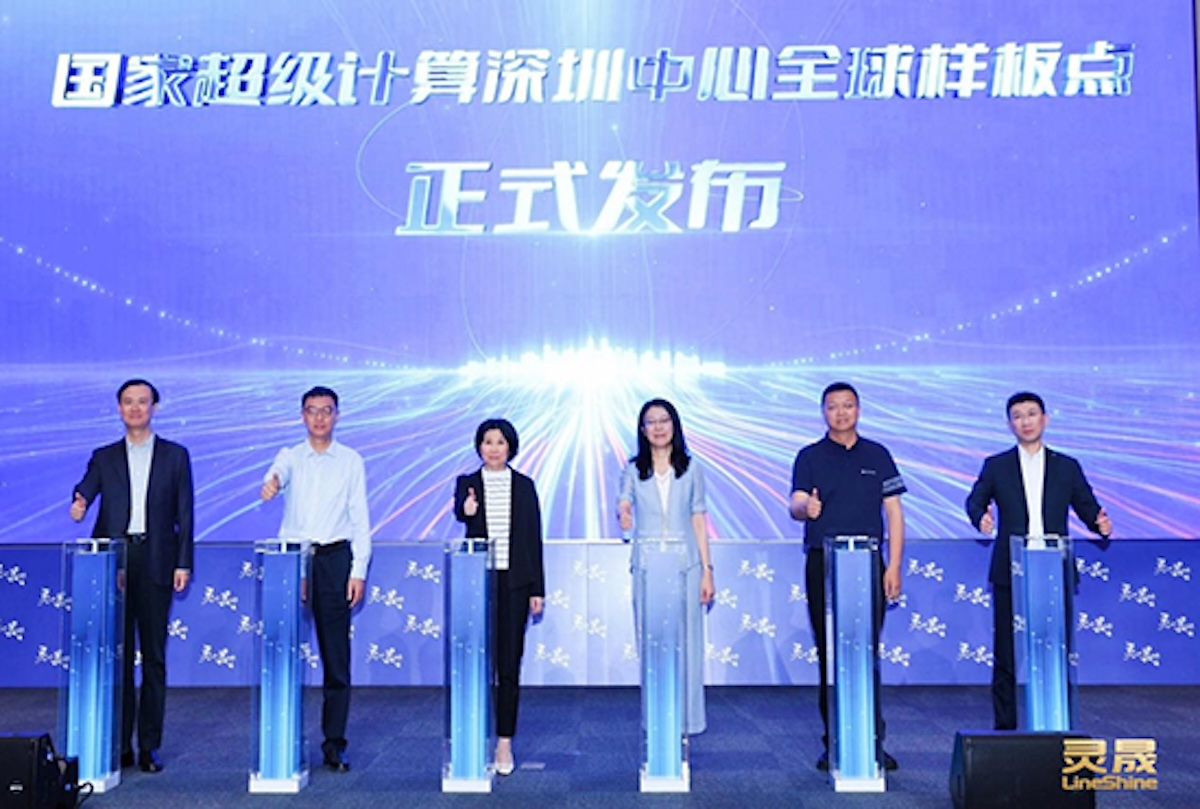
China has showcased in Shenzhen the progress of Lingsheng, a supercomputer of exascale class that aims to strengthen the country’s technological autonomy in high-performance computing, artificial intelligence, and scientific simulation. The system, installed at the Shenzhen National Supercomputing Center, was presented during a gathering connecting industrial applications, universities, research centers, and companies.
The announcement comes at a time of intense technological competition between China and the United States. U.S. restrictions on the export of advanced chips have limited Chinese access for years to the latest GPUs and accelerators. Beijing, however, has responded with investments in domestic semiconductors, national architectures, and large-scale computing infrastructure. Lingsheng fits into this strategy: it not only seeks to add computational power but also demonstrate that China can build a complete platform with hardware and software under local control.
A national technology-based exascale system
According to information published by the Shenzhen National Supercomputing Center, Lingsheng relies on high-performance national CPUs, high-bandwidth integrated on-chip memory, fast interconnection networks, high-performance storage, and large-scale liquid cooling. The platform is described as a “three-in-one” computing system, capable of supporting scientific computation, engineering, and artificial intelligence.
Local official media have described Lingsheng as the world’s first supercomputer with a sustained performance exceeding 2 EFLOPS FP64. If confirmed with comparable and verifiable metrics, this would place it among the most powerful publicly known systems. Nevertheless, it is prudent to interpret this figure carefully: performance announced by a center or government agency does not always equate to a validated ranking entry such as TOP500, which uses concrete benchmarks like HPL to rank supercomputers.
This difference is significant. As of November 2025, TOP500 ranked El Capitan, Frontier, and Aurora— all in U.S. Department of Energy laboratories— as the top three systems. JUPITER in Germany crossed the 1 EFLOPS threshold and became the first validated European exascale system. If China chooses not to publish all technical details of Lingsheng or does not subject it to comparable testing, its impact will be felt domestically but be harder to verify externally.
The presentation emphasizes the idea of “controllable autonomy,” a common phrase in Chinese tech policy. It’s not just about having a fast machine; the goal is to reduce dependence on foreign processors, networks, software, and accelerators— especially when access to NVIDIA, AMD, or Intel components might be constrained by export controls.
Nine application areas: from meteorology to petroleum
The Shenzhen National Supercomputing Center introduced Lingsheng as an open platform for scientific and industrial applications. During the event, results were shown in nine fields: remote sensing, materials, bioinformatics, meteorology, drug development, oil exploration, AI, life sciences, and electromagnetic simulation.
In remote sensing, Chinese teams have trained large-scale models and reconstructed eight years of global imagery, with applications in remote interpretation, territorial surveillance, and precipitation forecasting. In materials science, the system has been used for first-principles calculations involving 100 million atoms and an 81% parallel scalability, which is significant for simulations of batteries, semiconductors, and new materials.
In bioinformatics, researchers demonstrated virtual screening of compounds at an extremely high scale, combining artificial intelligence and reinforcement learning to accelerate discovery processes. In meteorology, simulations of the Earth system with a global resolution of 1 kilometer and 30-day forecasts completed in less than two hours were highlighted, a workload demanding both high computing power and efficient node-to-node communication.
The petroleum sector also presents industrial implications. The adaptation of GeoEast software to Lingsheng reportedly achieved performance 1.88 times greater than an NVIDIA A100 for seismic imaging tasks, with 57% memory bandwidth utilization, according to representatives from China National Petroleum Corporation. This concrete comparison is notable, although detailed testing scenarios would be needed to fully assess its significance.
In AI, efforts focused on adapting to an architecture based on CPUs, with development of operators, graph planning, and multi-token prediction. In life sciences, optimizations of AlphaFold2 inference workflows—using mixed-precision computing, vectorization, memory reuse, and multiprocessing—were discussed. In electromagnetic simulation, a three-dimensional full-wave tool capable of operating on tens of millions of cores was introduced.
Exascale computing without Western GPUs: the political message
The significance of Lingsheng is not only its announced power but also the message China intends to send: even under restrictions, it can continue developing advanced supercomputing with domestically produced components and tailored software architectures.
Over recent years, the Chinese industry has accelerated the development of CPUs, accelerators, interconnects, and programming tools. Part of this progress is evident in mobile devices, servers, AI chips, and HPC systems. While not eliminating limitations— especially in advanced lithography and access to certain manufacturing equipment— this trend demonstrates that sanctions have driven China to invest more aggressively in internal alternatives.
Lingsheng also highlights a global trend: the boundary between supercomputing and artificial intelligence is blurring. Large systems are no longer solely designed for traditional scientific simulation; they now also need to train models, perform inference, process massive datasets, accelerate drug discovery, model climate systems, simulate new materials, and solve industrial problems. Supercomputing is becoming a strategic infrastructure, akin to energy, networks, or semiconductor fabrication facilities.
For Shenzhen, this project also has a regional dimension. The city aims to strengthen its role in the Greater Bay Area, a key hub for China’s tech industry. The supercomputing center aspires to serve as a nexus connecting universities, companies, government agencies, and industrial sectors that require advanced computing but cannot build such a machine independently.
The key question remains: how much of this theoretical performance will translate into real-world use? An exascale supercomputer only delivers value if applications are adapted, users have access, workflows are stable, and software fully exploits the architecture. In HPC, raw power is impressive, but practical performance depends on memory, networking, storage, compilers, libraries, parallel programming, and technical support.
China has presented Lingsheng as a symbol of technological independence and scientific ambition. The next step is to demonstrate that this power can support rigorous research, industrial processes, and AI with reliable and comparable results. In the global race for computing, the machine itself matters— but the ecosystem surrounding it is even more crucial.
Frequently Asked Questions
What is Lingsheng?
Lingsheng is a Chinese exascale-class supercomputer installed at the Shenzhen National Supercomputing Center, aimed at scientific computing, engineering, and artificial intelligence.
What is the performance of the Lingsheng supercomputer?
Local official sources describe it as a system with sustained performance exceeding 2 EFLOPS FP64. Other references estimate around 1.9 EFLOPS, though its international standing depends on publicly verifiable benchmarks.
What will Lingsheng be used for?
Its applications include remote sensing, materials science, bioinformatics, meteorology, pharmaceuticals, oil exploration, AI, life sciences, and electromagnetic simulation.
Why is this important for China?
Because it strengthens China’s goal of developing advanced computing infrastructure with domestic technology amidst restrictions on access to high-end chips by the U.S.
