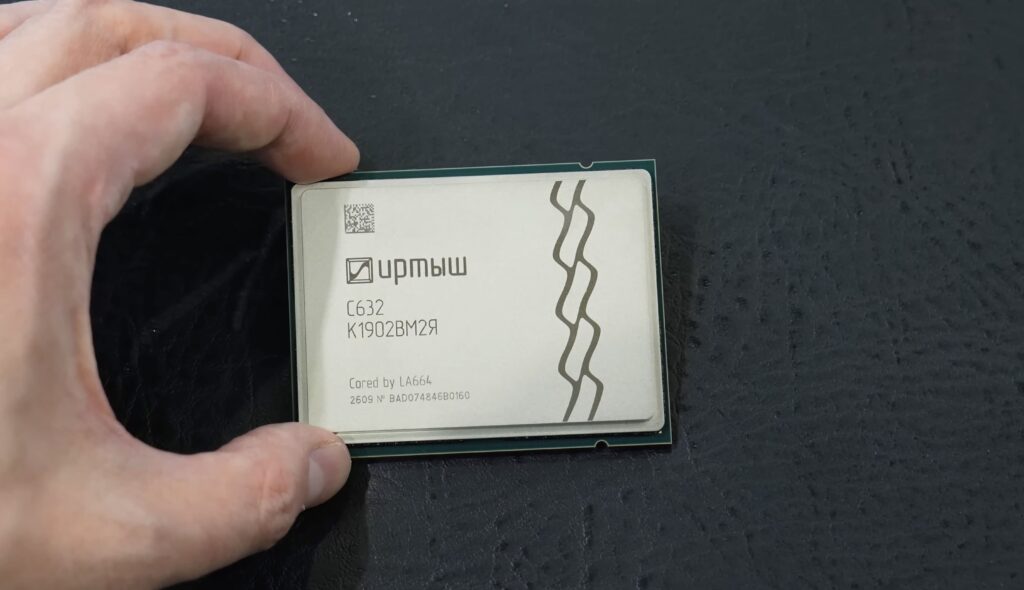
The demonstration won’t worry Intel, AMD, or console manufacturers. It also doesn’t turn the Irtysh processor into a realistic gaming platform. But it does send a powerful message: a system based on a Russian-Chinese CPU, outside the dominant x86 and ARM ecosystems, running The Witcher 3 on Linux with Steam, Proton, and binary translation.
The setup was shown at ExpoElectronica 2026 in Moscow and garnered attention because it used an Irtysh C632 processor paired with an AMD Radeon RX 9060 XT graphics card. According to the demonstration reported by PRO Hi-Tech and shared by VideoCardz, the game ran between 22 and 32 FPS at Ultra quality and between 25 and 38 FPS at low quality, apparently at 1080p. The limited difference between the two settings suggests that the bottleneck wasn’t the GPU but the CPU, instruction translation, or the software stack used.
The key point isn’t the high performance—it’s that the game ran on an architecture—LoongArch—developed by Chinese company Loongson, not on a conventional x86 processor. This requires additional layers to enable a Windows and x86-targeted game to work in a Linux environment on a different architecture. That’s where Steam, Proton, Wine, and likely binary translation tools like Box64 come in, which already added LoongArch support in 2024, as noted by VideoCardz.
A modest result, but technically interesting
From a traditional PC gaming perspective, achieving 22 to 38 FPS with a Radeon RX 9060 XT seems disappointing. That GPU should perform much better on a modern x86 system. But the full picture changes when considering the entire setup: a complex Windows game running on Linux, on a LoongArch CPU, with binary translation and an exotic architecture for Western consumer software.
The slight improvement moving from Ultra to Low quality is particularly telling. When lowering graphics settings only minimally increases FPS, it suggests the true limit lies elsewhere—likely in the CPU and the overhead of translating instructions in real time. This isn’t just about raw power; it’s also about the maturity of the compiler, drivers, libraries, binary translation, and overall software stack optimization.
This makes the demonstration more of a viability proof than a performance comparison. Irtysh isn’t presented as a gaming alternative but as a signal that Russia and China are exploring alternative pathways around dominant architectures.
What is Irtysh and why is LoongArch important?
Irtysh is a family of processors pushed by Tramplin Electronics, a Russian company that launched a line of CPUs aimed at servers, sovereign data centers, and high-performance environments. The family includes models like the Irtysh C616, with 16 cores; the C632, with 32 cores and 64 threads; and an upcoming C664 with 64 cores and 128 threads. These chips are based on Chinese LoongArch technology and utilize LA664 cores.
It’s important to clarify: Irtysh doesn’t appear to be a Russian-designed architecture from scratch. Technical reports indicate its specs closely match Loongson’s LS3C6000 series processors, leading Tom’s Hardware to describe them as potentially rebadged or adapted Chinese designs.
This doesn’t diminish the significance. On the contrary: it contextualizes it. Russia, under severe technological sanctions, faces challenges accessing modern Intel and AMD CPUs. China has been developing its own x86/ARM alternative with LoongArch for years. The collaboration or technology reuse suggests a broader trend: building less dependent supply chains on Western vendors, though still not as mature.
The LA664 core isn’t a minor core
A common misconception is that all non-x86 architectures are low-power microcontrollers or niche designs. That’s not the case with LoongArch’s LA664.
Loongson’s official documentation for the 3A6000 describes the LA664 cores as 64-bit, super-scalar, LoongArch-compatible, supporting 128 and 256-bit vector instructions, out-of-order execution with 6 agreement rails, four integer units, four vector units, and four memory access units.
Independent analyses, such as Chips and Cheese’s review of the Loongson 3A6000, characterize LA664 as a out-of-order core with substantial execution resources and reordering capabilities. While it probably can’t match the latest AMD or Intel cores in all scenarios, it’s clearly more than a simple low-end microcontroller, positioning it above basic Chinese CPUs and making it a credible platform for complex software.
So, the accurate comparison isn’t with a high-end Ryzen or Core i9 running games natively but with an emerging architecture trying to run demanding Western software layers. In that context, getting around 30 FPS in The Witcher 3 is more symbolic and technical than practical.
Binary translation remains the main hurdle
For LoongArch, the biggest challenge isn’t manufacturing more powerful CPUs but developing a mature software ecosystem. x86 has dominated PC software for decades. ARM has grown thanks to mobile, cloud, and Apple Silicon. LoongArch, however, faces significant disadvantages: fewer native applications, less optimized software, and limited real-world testing in consumer environments.
That’s why binary translation is crucial—it allows software designed for other architectures to run, but at a penalty. In gaming, where milliseconds matter, this penalty can be decisive. Performance depends not only on the CPU but also on graphics drivers, kernels, Vulkan support, Wine, Proton, libraries, schedulers, and translation tools.
In this case, the Radeon RX 9060 XT didn’t seem to hit its limit. The minimal FPS difference between Ultra and Low quality suggests the GPU was waiting on the CPU or translation layer. On a standard x86 system, this GPU would likely deliver much higher performance in The Witcher 3.
Tech sovereignty with significant limitations
From a geopolitical perspective, it’s clear why Russia needs alternatives due to sanctions and reliance on foreign technology. China aims to reduce dependence on x86, ARM, and US restrictions. LoongArch fits into this strategic context.
But sovereignty isn’t total independence. Irtysh depends on Chinese IP, outside manufacturing, and supply chains not fully controlled by Moscow. Still, for countries with limited access to advanced Western processors, having a domestically designed or semi-proprietary platform based on LoongArch can suffice for public servers, administrative systems, industrial environments, and critical infrastructure deployments.
The key challenge is manufacturing capacity. Russia lacks a semiconductor industry comparable to China, Taiwan, Korea, or the USA. Therefore, while they can design, adapt, and integrate chips, they remain dependent on external foundries for modern nodes. International coverage indicates Irtysh is a way to circumvent reliance on x86 hardware under sanctions, rather than a sign of full technological independence.
A server CPU, not a gaming CPU
It’s also worth noting that the Irtysh C632 is a 32-core, 64-thread processor designed for servers and enterprise workloads. It’s not intended to compete with gaming-oriented CPUs like Ryzen 7, Core i7, or gaming consoles. Its primary markets are sovereign data centers, corporate systems, public infrastructure, where technology provenance is as important as raw performance.
The demo running The Witcher 3 therefore functions more as a showcase than a practical gaming solution. A well-known game helps visually demonstrate that complex software can run on this platform. But Irtysh’s main target isn’t desktop gaming but reducing dependence on Western hardware in critical applications.
The real question isn’t whether Irtysh can run The Witcher 3 at 30 FPS but whether LoongArch can build a sufficiently robust ecosystem to run databases, web servers, virtualization tools, light AI workloads, public administration software, and enterprise applications reliably and efficiently.
Lessons for sysadmins and developers
This demonstration offers an important insight: architecture performance isn’t solely about silicon. It’s also about the operating system, compilers, libraries, drivers, and compatibility layers.
A processor can have advanced cores, vector instructions, and out-of-order execution, but if the software isn’t optimized for its ISA, its potential remains untapped. This is especially true in gaming but also applies to servers, databases, virtualization, encryption, compression, and AI inference.
In alternative architectures, the ecosystem’s maturity can be as critical as hardware. Apple Silicon showed this clearly with full control over OS and tools, facilitating rapid optimization and broad adoption. LoongArch and Irtysh face a tougher path: convincing developers, governments, and companies to port and support software for a less globally prevalent platform.
A small step with a lot of context behind it
The sight of The Witcher 3 running on an Irtysh processor may seem anecdotal, but it encapsulates broader trends: technological fragmentation, digital sovereignty efforts, sanctions impact, China’s CPU development, and the challenge of competing with decades of x86 dominance.
It’s not a performance revolution nor a threat to PC gaming, nor a sign Russia has caught up with the West in semiconductors. But it’s a reminder that technological warfare also plays out in alternative architectures, compatibility layers, compilers, Linux ecosystems, and processors that might not reach consumers but could operate in servers, government bodies, or critical infrastructure.
Irtysh doesn’t suggest LoongArch is ready to dominate desktops; rather, it underscores that even under sanctions, with minority architectures, and through binary translation, some countries and companies are forging their own paths. These routes are still slow and limited but already capable of running modern games at speeds unthinkable years ago.
Frequently Asked Questions
What is the Irtysh processor?
Irtysh is a processor family developed by Russian company Tramplin Electronics, based on Chinese LoongArch technology from Loongson. It’s mainly aimed at servers, sovereign data centers, and enterprise environments, not gaming.
What performance did it achieve in The Witcher 3?
According to PRO Hi-Tech and VideoCardz reports, the system with an Irtysh C632 and Radeon RX 9060 XT achieved 22-32 FPS at Ultra quality and 25-38 FPS at low quality under Linux with Steam, Proton, and binary translation.
Why is performance so low despite the Radeon RX 9060 XT?
Because the bottleneck seems to be the CPU and the translation layer. The game is designed for Windows and x86, but ran on LoongArch through binary translation. The small FPS difference between high and low settings points to a CPU or translation limitation rather than GPU power.
Is Irtysh truly a Russian CPU?
It’s more accurate to describe it as a Russian-Chinese CPU or a Russian platform based on Chinese technology. Reports indicate Irtysh processors use Loongson LA664 cores, closely resembling known Chinese chips.
Can LoongArch compete with x86 or ARM?
Technically, LoongArch has made significant progress, and LA664 cores are not simple low-power designs. Yet, surpassing x86 or ARM requires a complete ecosystem—compilers, native software, drivers, enterprise support, and years of adoption. It’s still early days.