

McKinsey has once again stirred up the debate about the future of work with its new Skill Change Index, a metric that attempts to measure how much various skills are exposed to automation over the next five years. The chart, which is already gaining momentum in business and tech circles, ranks thousands of skills on a scale from 0 to 100, placing the most exposed at the top. But the core discussion isn’t just about the index itself, but about how we interpret it.
The most common quick interpretation is also the simplest: AI will handle routine tasks, leaving humans to focus on leadership, negotiation, or management. However, McKinsey’s own report is much more nuanced. The firm argues that the work of the future will be a partnership between people, agents, and robots, and that value creation won’t rely solely on automating isolated tasks but on redesigning entire workflows. In other words, the real message isn’t just “what disappears,” but “what changes, where value is created, and what new combinations of humans and machines become possible.”
The Skill Change Index doesn’t measure layoffs; it measures exposure to change
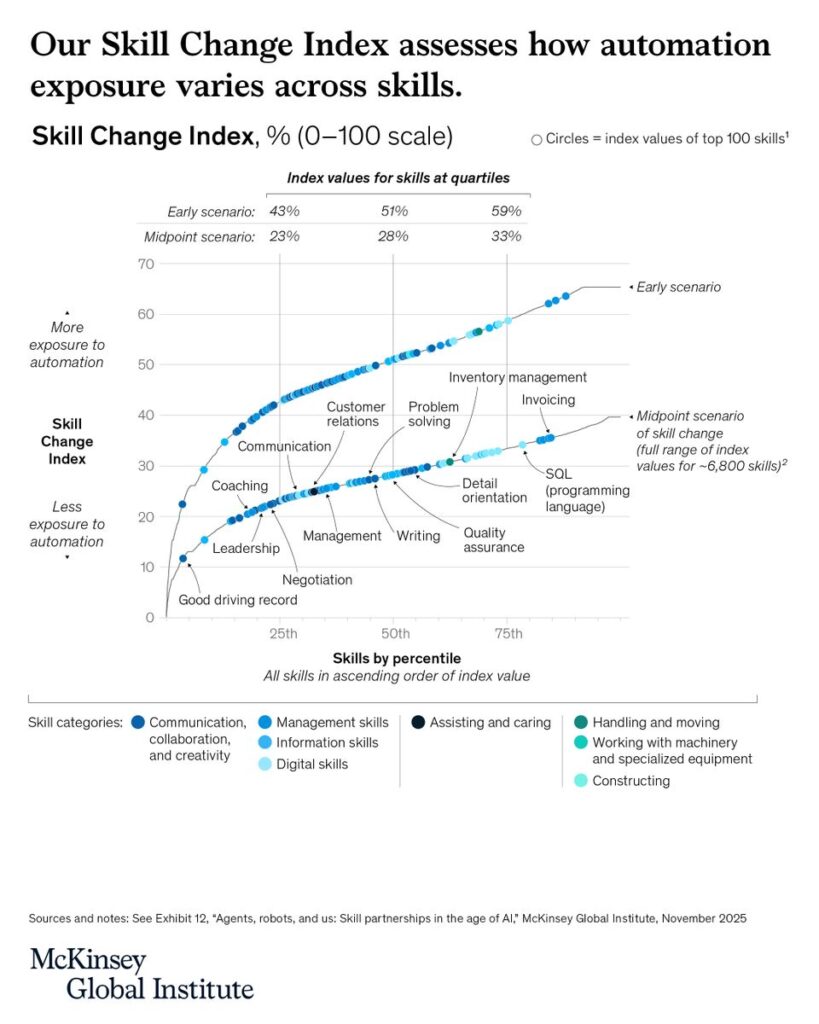
That’s an important clarification. McKinsey isn’t saying that a skill with an 80% exposure means that 80% of jobs related to it will automatically vanish. Instead, it indicates a risk of transformation: how much the way that skill is applied, combined with others, or integrated into the work process, could change. For the intermediate scenario, the quartiles of the index for the top 100 skills sit at 23%, 28%, and 33%; in an early scenario, those numbers rise to 43%, 51%, and 59%. The accompanying chart clearly shows that not all capabilities move at the same pace.
McKinsey also states that current technologies could theoretically automate more than half of the current working hours in the United States, but explicitly emphasizes that this does not predict job destruction. Adoption will take time; some roles will shrink, others will grow, and some will change in nature. Additionally, the firm highlights that more than 70% of today’s skills may still remain relevant, even if they aren’t used in exactly the same way or at the same point in the value chain.
For a tech-focused outlet, this nuance is crucial because it shifts the conversation from the easy headline about replacement to a more interesting question: how AI reconfigures work architectures, decision systems, and the relationship between human talent and software.
Which skills are most and least exposed
McKinsey’s chart places some distinctly human abilities among the skills least exposed to automation, such as leadership, coaching, and negotiation. In an intermediate zone, skills like communication, customer relations, management, writing, and problem solving are found. Higher up the exposure scale, with greater change potential, are skills like quality assurance, inventory management, invoicing, or SQL. A superficial reading would suggest that AI will replace digital tasks while leaving human-centric skills intact. But even this requires nuance.
A helpful way to summarize the chart is like this:
| Less exposed skills | Medium exposure skills | Most exposed skills |
|---|---|---|
| Leadership | Communication | Invoicing |
| Coaching | Management | Quality Control |
| Negotiation | Writing | Inventory Management |
| Good driving record | Problem solving | SQL |
The report’s own classification suggests many skills won’t disappear but will change function. Communication, information management, and problem-solving aren’t outside AI’s reach, but they don’t quite fit into a pure replacement logic either. Instead, they seem to move into a zone of augmentation: machines provide synthesis, speed, and exploration of options; humans set criteria, provide context, and validate.
The blind spot of many interpretations: AI also amplifies capabilities
This is where the automation thesis falls short. History shows that the greatest breakthroughs often aren’t just about machines doing the same faster, but about enabling tasks that were previously impractical. Boeing points out that the 777 was the first commercial airplane entirely designed with digital tools, allowing for complex geometry simulations and reducing the need for full physical mock-ups. It wasn’t just a productivity boost; it was a shift in what design could be.
The same pattern applies to precision medicine. The National Institutes of Health define it as an approach that tailors prevention and treatment to individual differences in genes, environment, and lifestyle. This medicine isn’t created just because an algorithm accelerates traditional lab work; it’s due to big biological data processing capabilities opening new models of care that weren’t feasible before.
With current AI, a similar pattern is observable. An agent not only shortens the time for administrative or analytical tasks; it also makes possible decision chains, tests, and simulations that previously weren’t viable due to time, cost, or processing limits. Evaluating AI impact solely by hours saved can be misleading. Often, the real competitive advantage comes from doing better, with more context, fewer errors, and higher success rates. This doesn’t contradict McKinsey; it broadens the interpretation of their own findings.
McKinsey’s core thesis: redesign over reduction
Indeed, the report emphasizes that economic potential won’t come solely from automation. McKinsey estimates that in an intermediate scenario, generative AI and agents could generate $2.9 trillion annually of economic value in the US, but links this figure to the ability of organizations to reimagine how work is done. The message is clear: gains won’t just come from automating tasks but from reorganizing entire processes.
This nuance is especially significant in technology. Many companies still layer AI onto poorly designed processes, hoping that the smart layer will fix structural inefficiencies by itself. The result often is increased speed but also greater chaos, operational debt, and noise, if systems aren’t redefined first. Here, the report rightly points out that the challenge isn’t just technical but organizational.
Another striking fact: McKinsey notes that demand for AI fluency—the ability to use and manage AI tools—has increased sevenfold in US job postings over just two years. This suggests that the workforce isn’t only preparing for automation but for a new level of hybrid skills, where understanding and orchestrating AI tools becomes as important as traditional expertise.
The question isn’t what AI automates, but what it makes possible
This is likely the most compelling insight for a tech publication. The Skill Change Index is useful as a thermometer of exposure and as a signal for talent strategy, team building, and training initiatives. But it doesn’t tell the whole story. If we only measure AI by the human roles it can replicate, we miss the other dimension: how it can enable new capabilities.
The real advantage isn’t just faster execution but fewer mistakes, more options, more hypotheses, and better decisions. Sometimes, this reduces manual workload; other times, it enhances the sophistication of work. Although harder to quantify in an index, this second aspect could ultimately determine who wins this transition.
Frequently Asked Questions
What exactly is McKinsey’s Skill Change Index?
It’s a metric attempting to gauge the exposure of various skills to automation over the next five years. It doesn’t measure layoffs or direct job loss but rather how much the application of each skill might change in the workplace.
Does McKinsey say AI will eliminate more than half of all jobs?
No. The report suggests that current technologies could theoretically automate over half of the hours worked in the US, but explicitly clarifies that this isn’t a forecast of job destruction.
Which skills are least exposed to automation?
Leadership, coaching, negotiation, as well as others related to human interaction and coordination, are among the least exposed according to the chart. McKinsey considers these areas to have relatively lower susceptibility to automation.
Why talk about augmentation rather than just automation?
Because many technologies don’t just replace tasks but enable new, previously impossible activities. Boeing’s digital design of the 777 is an example of capacity enhancement, and NIH highlights precision medicine as a data-driven approach that creates new models of care.
