
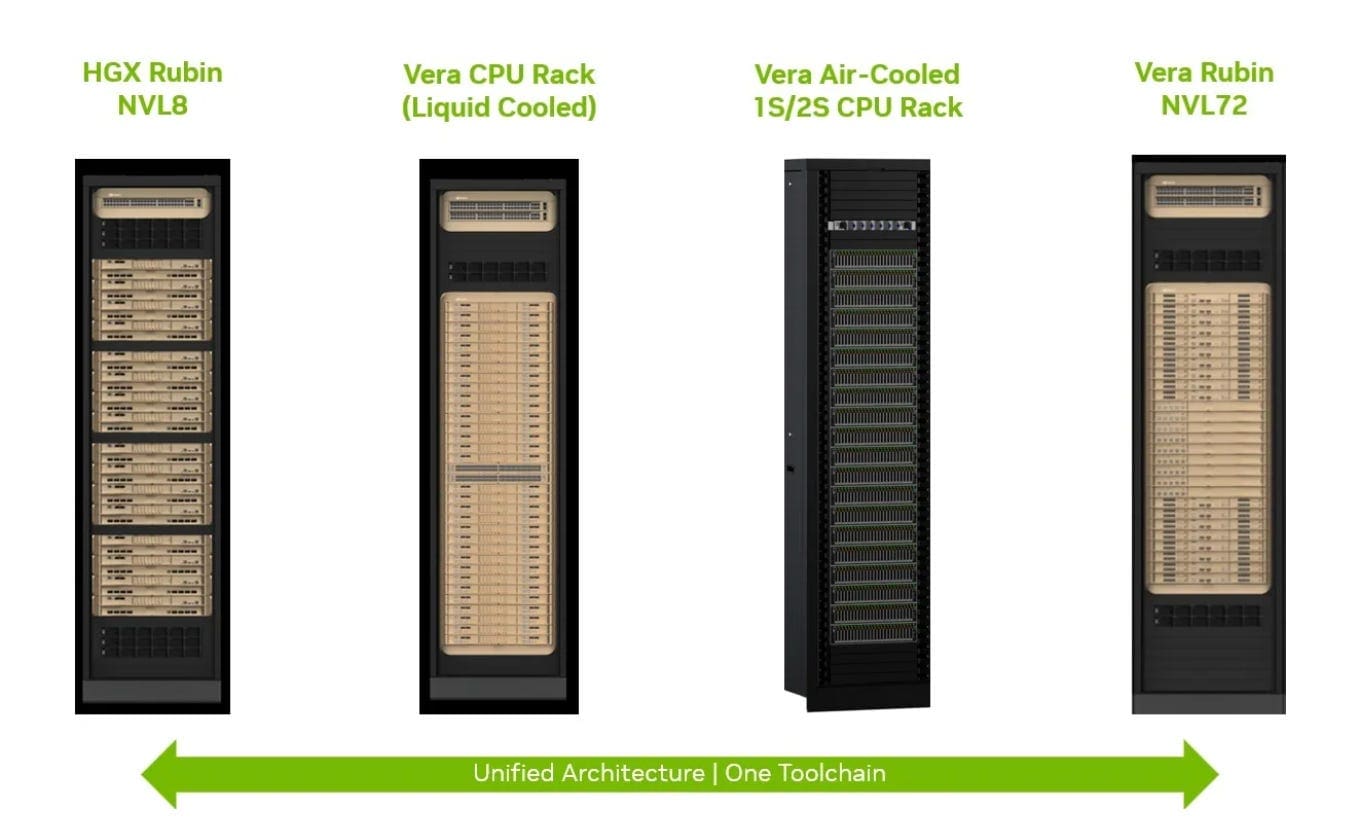
In recent years, the conversation about infrastructure for Artificial Intelligence seemed settled: GPUs ruled, and CPUs were relegated to a secondary role. But that distribution is beginning to change. TrendForce argues that the arrival of agentic AI—models capable of planning tasks, calling tools, coordinating sub-agents, and executing actions—is fundamentally altering data center design and restoring the prominence of CPUs.
The most visible signal came in March, when NVIDIA began selling its Vera CPU as a standalone product, and Arm introduced its first proprietary data center processor, the Arm AGI CPU. The fact that one company known for its GPUs and another famous for licensing architecture are entering the server CPU market at the same time doesn’t seem coincidental: it reflects a shift in the actual demand from AI data centers.
In traditional model deployments, TrendForce estimates the CPU:GPU ratio at around 1:4 to 1:8. In the era of agents, this ratio could move toward 1:1 or 1:2, as CPUs take on critical orchestration, control, evaluation, and data movement tasks. Arm, for example, estimates demand could increase from around 30 million CPU cores per gigawatt in traditional AI data centers to about 120 million in agent-dominated scenarios.
Why Agentic AI Needs More CPUs
The key lies in the type of work. GPUs remain unbeatable for massively parallel computation and matrix calculations powering model training and inference. But agentic AI not only generates tokens; it also breaks down tasks, coordinates steps, calls tools, queries databases, interprets code, tracks web pages, and decides whether the original request has already been fulfilled. That “traffic control” responsibility falls on the CPU.
TrendForce also notes that in these workloads, bottlenecks are no longer solely dependent on accelerators. In agentic AI, limits related to latency, throughput, and power consumption tied to general-purpose processors become apparent. According to the analysis referenced by the consultancy, processing tools on CPUs can account for up to 90.6% of total latency in certain workflows, and dynamic CPU power consumption can reach 44% of total dynamic energy expenditure during large batch workloads.
The following table summarizes, simply, how roles are currently divided between CPUs and GPUs in AI environments, based on the scheme published by TrendForce.
| Key Comparison | CPU | GPU |
|---|---|---|
| Calculation Principle | Complex logic and sequential processing | Simple parallel computation |
| Number of Cores | Low, tens to hundreds | High, thousands to tens of thousands |
| Typical Memory Type | DRAM | HBM |
| Role in AI | Data pre-processing, planning, orchestration | Model computation and massive generation |
| Major Manufacturers | Intel, AMD, Ampere | NVIDIA, AMD, Intel |
The Market Is Already Repositioning
This shift is already evident in current offerings. NVIDIA Vera features 88 Olympus cores and 176 threads, along with NVLink-C2C with 1.8 TB/s of coherent bandwidth between CPU and GPU, and up to 1.2 TB/s of memory bandwidth. NVIDIA describes Vera as a CPU designed for reinforcement learning, cache management, and agent workflows with high data movement.
Meanwhile, Arm AGI CPU arrives with up to 136 Arm Neoverse V3 cores, 300 W TDP, and a clear focus on agent infrastructure, accelerator control, and cloud services. Arm positions it as the foundation for agentic data centers and states it already has partners such as Meta, Cloudflare, OpenAI, SAP, and SK Telecom.
Major cloud providers are also shifting. AWS Graviton5 was announced with 192 cores per chip; Microsoft Cobalt 200 with 132 active cores; and Google Axion N4A is available in instances with up to 64 vCPUs, where each vCPU equals a physical core since SMT isn’t used. All this confirms that the CPU market for data centers is no longer only the domain of Intel and AMD.
TrendForce also projects an even broader offensive by 2026. Its comparison of cores and threads includes AMD EPYC Venice with 256 cores and 512 threads, Intel Xeon 6+ with 288/288, Intel Xeon 7 with 256/256, and AmpereOne MX with 256/256. It’s important to note that these are forecasts and roadmap plans from the consultancy for 2026, not a snapshot of current products on the market.
The following table combines official announced data with TrendForce’s 2026 forecast to illustrate how the AI and data center CPU market is expanding.
| Highlighted CPU in 2026 | Cores | Threads | Situation |
|---|---|---|---|
| NVIDIA Vera | 88 | 176 | Officially announced |
| Arm AGI CPU | 136 | 136 | Officially announced |
| AWS Graviton5 | 192 | 192 | Officially announced |
| Microsoft Cobalt 200 | 132 | 132 | Officially announced |
| Google Axion N4A | 64 | 64 | Available in N4A instances |
| AMD EPYC Venice | 256 | 512 | Forecast/TrendForce |
| Intel Xeon 6+ | 288 | 288 | Forecast/TrendForce |
| Intel Xeon 7 | 256 | 256 | Forecast/TrendForce |
| AmpereOne MX | 256 | 256 | Forecast/TrendForce |
It’s Not the End of the GPU, Just a Different Distribution
All this does not mean that GPUs lose their central role. In fact, TrendForce emphasizes that accelerators will still remain the main component for intensive model computation. What changes is the system balance: instead of an architecture where nearly all value was in the accelerator, agentic AI demands strengthening the control plane and orchestration layer.
This explains why NVIDIA wants to sell Vera separately, why Arm moved from licensing to creating its own chip, and why AWS, Microsoft, and Google continue to push their own CPUs. The next big data center battle will not just be about who has the fastest GPU, but who offers the best balance between parallel compute, orchestration, latency, bandwidth, and energy efficiency. In this game, the CPU again becomes a strategic piece.
Frequently Asked Questions
Why does agentic AI need more CPU than a traditional LLM?
Because it does not only generate text or responses; it also manages task coordination, calls tools, moves data between sub-agents, and evaluates results. That orchestration layer relies heavily on the CPU.
What is the current CPU:GPU ratio, and what is expected in agentic AI?
TrendForce estimates the current ratio at about 1:4 to 1:8 in traditional AI data centers, with a projected shift to 1:1 or 1:2 in the era of agents.
Will GPUs cease to be the main component in Artificial Intelligence?
No. GPUs will continue to be vital for massively parallel calculations and token generation. However, CPUs are gaining importance because agentic AI requires more control, planning, and data movement.
Which manufacturers are best positioned in this new phase?
Intel and AMD remain key players, but the market is opening up with offerings from NVIDIA, Arm, and major cloud providers like AWS, Microsoft, and Google.
via: insights.trendforce
