
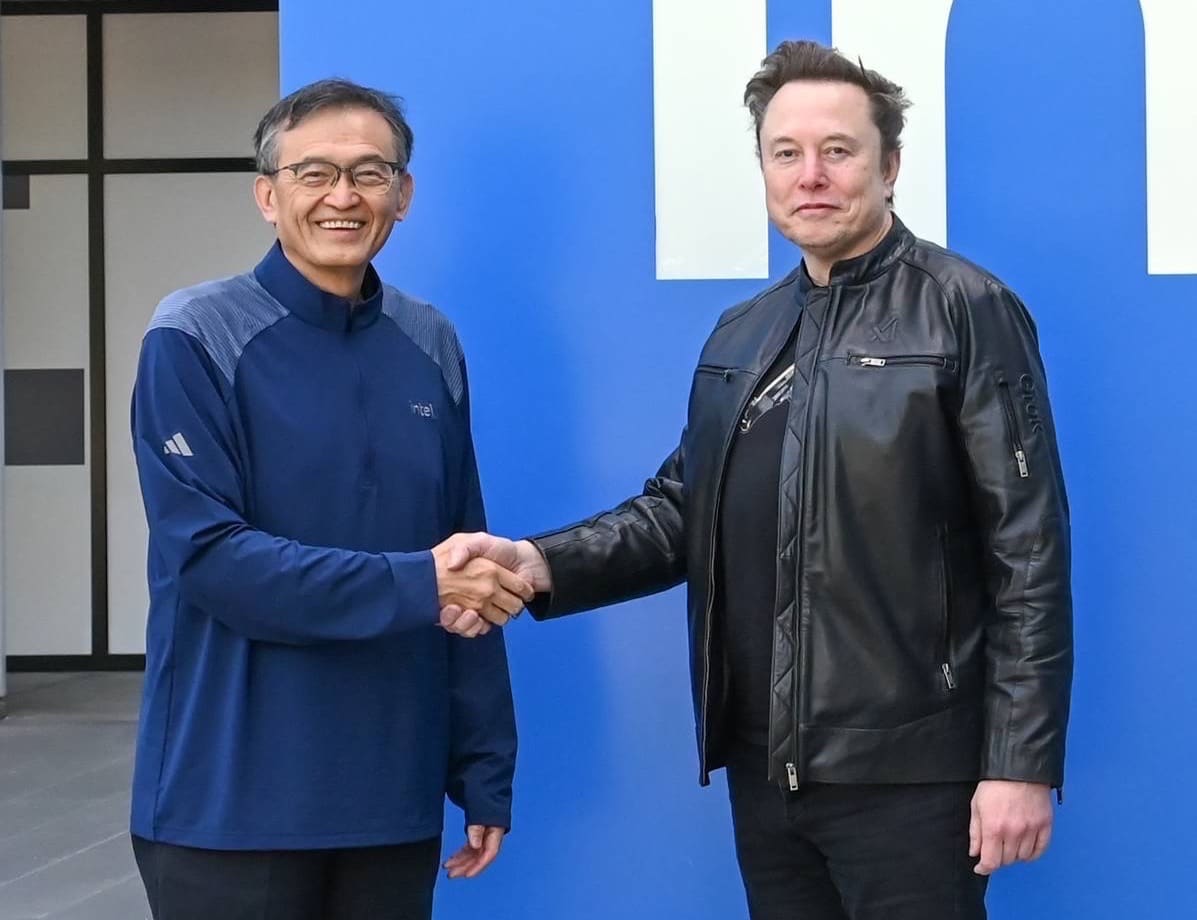
Intel has finally achieved the validation it has been pursuing for its advanced foundry business. Tesla plans to use Intel’s 14A process in the Terafab project, the massive AI chip complex Elon Musk proposed in Austin, according to the entrepreneur himself during Tesla’s earnings presentation, as reported by Reuters. If confirmed for production, it would be Intel’s first major external customer for this technology and a strategic endorsement for a company still trying to prove it can truly compete with TSMC in third-party manufacturing.
This news matters for two reasons. First, it is purely industrial: Intel needed a high-profile client to legitimize 14A, its upcoming 1.4-nanometer node of the next-generation process. Second, it is symbolic: the customer wouldn’t be Apple, NVIDIA, or Google—the usual suspects in speculation—but Tesla, backed by Musk, who also framed this move as a deliberate bet on a technology that, he said, will reach maturity when Terafab scales. Reuters notes that Intel had been in talks with major clients about 14A, but no significant contracts of this size had been publicly announced.
Musk was quite explicit. In Tesla’s conference call transcript available on Yahoo Finance, he stated that the company plans to use Intel 14A, describing it as a cutting-edge process still under development, and added that, by the time Terafab reaches scale, this node should be “ready for prime time.” He also confirmed that Tesla maintains a strong relationship with Intel and respects their new direction.
A lifeline for Intel Foundry
For Intel, the announcement comes at a very delicate moment. Reuters points out that the company had warned it might abandon third-party manufacturing if it couldn’t secure significant external customers. Thus, this potential deal with Tesla is not just a commercial footnote; it’s a market signal that could alter perceptions about Intel Foundry’s viability and the true competitiveness of 14A as a platform. Following Musk’s statements, Intel’s shares rose by 3.6% outside regular trading hours.
The technical context also helps understand the scope of this move. Over recent months, Intel has claimed that 14A will be ready for production by 2027, incorporating technologies like a new generation of RibbonFET transistors, PowerDirect backside power, and other performance and efficiency improvements, as summarized by Tom’s Hardware analyzing Lip-Bu Tan’s statements earlier this year. This aligns with Musk’s idea that, when Terafab needs real volume, the node will have reached sufficient industrial maturity.
Moreover, for Intel, this isn’t just about gaining a famous logo. Reuters cites analysts who believe Tesla could provide substantial volumes, valuable experience with a demanding customer, and a decisive boost to “clear the pipeline” for a leading-edge node. It wouldn’t be the same as onboarding Apple or NVIDIA overnight, but it would be enough to demonstrate that 14A isn’t just an attractive roadmap on paper.
Terafab: An enormous ambition with many uncertainties
However, the project tied to this agreement remains shrouded in fog. Reuters recalls that Terafab is a joint initiative among Tesla, SpaceX, and Intel to manufacture processors for automotive applications, humanoid robots, and space data centers. Musk has spoken of two advanced factories within the complex and a final goal of one terawatt of annual computing capacity, compared to about half a terawatt that, according to him, currently powers all of the United States.
The problem is that most key details are still unclear: who will finance the equipment, who will operate the facilities, when production would start, and what the actual share of costs and risks will be. Reuters adds that, according to Bernstein estimates, scaling enough capacity to reach that terawatt annually would require between 5 and 13 trillion dollars in capital expenditures—an indication of how much Terafab remains an enormous vision rather than a fully concrete project.
This lack of clarity does not invalidate the news’s significance but warrants nuance. What currently exists is a public endorsement from Musk for 14A and a plan to use that node in Terafab. What’s still missing—at least publicly—is a detailed schedule, a finalized financial architecture, and a clear picture of which chips will be produced there and under what operational model. Reuters emphasizes that the value of this announcement for Intel lies more in having a visible customer than in having resolved all project doubts.
The comparison with TSMC no longer seems so distant
An interesting aspect is the competitive timeline. TrendForce, summarizing TSMC’s 2026 roadmaps shared at their Technology Symposium, notes that the Taiwanese foundry targets A16 and N2X in 2027, while A14 pushes to 2028. If Intel manages to bring 14A into useful production by 2027—and with a visible external customer—it could promote the idea of a temporary advantage or, at least, a credible alternative to TSMC’s upcoming next-generation node deployment.
This doesn’t mean Intel has already overtaken TSMC in industrial execution. TSMC remains the industry leader in foundry, with a massive installed capacity, extensive customer base, and ecosystem. However, combining an advanced node, the use of High-NA EUV per Intel’s roadmaps, and Tesla as a potential client provides Intel with an argument it lacked before: not just promising, but starting to demonstrate real external demand.
More than a contract: a credibility test
Ultimately, that is what’s at stake. Intel doesn’t just need 14A to work; it needs the market to believe it can become an attractive commercial node for third parties. Tesla, with its size, technical demands, and industrial influence, is a customer capable of shaping that perception. If the project progresses and Terafab moves from vision to execution, Intel will gain much more than just a contract: it will gain credibility exactly where it most needed.
via: trendforce
