
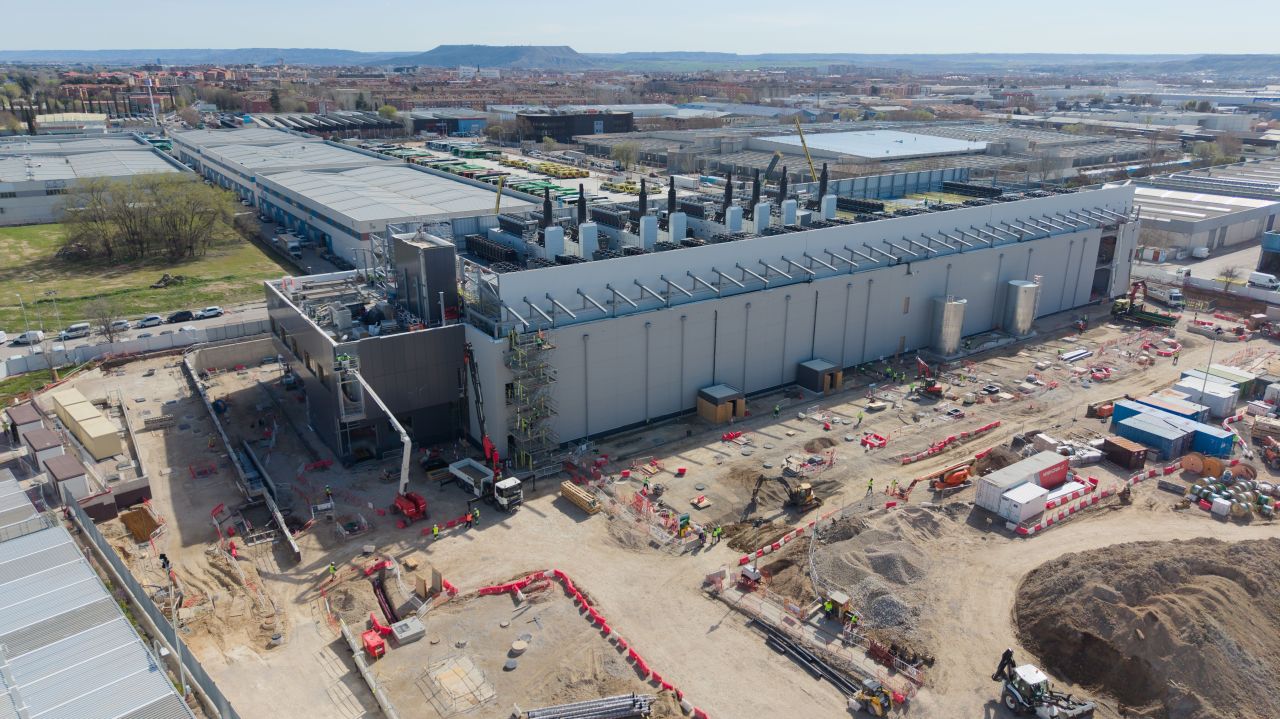
Iron Mountain Data Centers has announced new progress in its Madrid data center campus, one of the company’s most visible investments in Europe, the Middle East, and Africa. According to the company, MAD-2 remains on track to deliver an additional 10 MW in the fourth quarter of 2026, while MAD-3 will add another 10 MW in the first quarter of 2027. With this, the group continues deploying a roadmap that elevates the planned capacity of the Madrid campus to 79 MW.
The update reinforces an idea that has been consolidating for months: Madrid is no longer just competing as an emerging data center market but is now one of the major growth hubs in Southern Europe. Iron Mountain claims that its facility in San Fernando de Henares is on its way to becoming Spain’s largest multi-tenant campus, a statement that matches the scale of the project: 60,000 square meters, eight planned data centers, and a mix of colocation, enterprise deployments, and infrastructure for hyperscalers.
A campus that moves from promise to real weight
The first phase of the complex, MAD-1, is already operating with 3 MW of IT capacity within a 4,000 square meter facility, but the truly significant leap comes with the subsequent buildings. Iron Mountain’s official documentation indicates that there are 20 MW currently under construction, precisely the capacity associated with MAD-2 and MAD-3, which are part of the plan to develop one of the largest data center parks in the country.
The project’s appeal isn’t solely in its power capacity. The company emphasizes several factors that are increasingly influential in infrastructure decisions today: the campus holds High ENS certification, is powered by 100% renewable energy on an equivalent basis, and is situated along the Barcelona-Madrid fiber corridor, one of the most important connectivity routes in the Peninsula. Additionally, its proximity to Barajas Airport and location within a market still experiencing demand for cloud, AI, and large-scale digital services contribute to its attractiveness.
All these elements help explain why Madrid has become so coveted. In a corporate article published by Iron Mountain, the company cites projections from Structure Research suggesting that the Madrid market could grow from 126 MW to 763 MW between 2025 and 2029, representing a growth of over 600%. While this figure is used by the company to support its thesis, it provides context for the ongoing expansion.
AI, hyperscalers, and enterprise: the growth-driving combination
Iron Mountain clearly frames the development of MAD-2 and MAD-3 within the new demand for AI loads, cloud services, and enterprise digital transformation. This isn’t incidental. The company has been showcasing its new expansions as part of a strategy focused on infrastructure capable of higher power densities, rapid scalability, and connectivity requirements typical of hyperscalers and large corporations.
This positioning also aligns with broader sector shifts. Data centers are no longer envisioned solely as rack-hosting spaces but as critical platforms to support inference, training, cloud services, and continuous digital operations. In this new landscape, construction speed, access to energy, network connectivity, and phased growth capacity are as important as location. Madrid, with its land availability, connectivity, demand, and proximity to Africa and the Mediterranean, has become a market closely monitored by major operators.
Iron Mountain aims to establish itself in this landscape with a clear message: security, sustainability, scale, and rapid deployment. In a recent document, the company describes itself as one of the fastest-growing data center operators in colocation, cloud, and AI, placing accelerated capacity demand as a key driver of the market’s new phase. This messaging, naturally, involves a commercial aspect but also reflects the pressures faced by all major European hubs today.
Madrid’s growing importance—now it’s time for execution
The key moving forward will be execution. The market has heard many big future capacity announcements for Madrid, but the real difference between projects that transform a market and those that remain on paper lies in meeting deadlines, ensuring supply, and converting promised capacity into available space for clients. Iron Mountain has established concrete timelines for its next two buildings: 10 MW in MAD-2 by the end of 2026 and another 10 MW in MAD-3 by early 2027. If it adheres to this schedule, it will strengthen its position just as competition intensifies in the Madrid market.
Another important aspect concerns the types of clients targeted by the campus. Public documentation from Iron Mountain mentions requirements for hyperscale, cloud, enterprise, and build-to-suit environments. This indicates their strategy does not rely solely on one demand category but aims to capture multiple profiles simultaneously—from enterprise colocation deployments to larger-scale projects linked to cloud and AI. In today’s market, diversification can work in their favor.
Ultimately, Madrid continues to send strong signals that its role as a digital hub for Southern Europe is serious. The Iron Mountain campus, with 79 MW planned, eight buildings underway, and a new 20 MW phase already scheduled, aims to be one of the most prominent players in this transformation. While the city has yet to compete in volume with Europe’s traditional data center hubs, it’s becoming increasingly difficult to consider it a secondary market.
Frequently Asked Questions
When will MAD-2 and MAD-3 from Iron Mountain in Madrid come online?
According to the company’s latest update, MAD-2 aims to deliver 10 MW in the fourth quarter of 2026, and MAD-3 another 10 MW in the first quarter of 2027.
What will be the total capacity of Iron Mountain’s campus in Madrid?
The total planned capacity is 79 MW, within a 60,000 square meter site, with eight data centers planned.
Where is Iron Mountain’s campus located in Madrid?
The campus is in San Fernando de Henares, with MAD-1 at Calle del Mar Egeo, 4, situated along the Barcelona-Madrid fiber corridor, and about ten minutes from Barajas Airport.
What certifications and attributes does Iron Mountain highlight for its Madrid campus?
The company emphasizes the High ENS certification, multiple ISO certifications, its status as a neutral campus for operators, and 100% renewable energy on an equivalent basis.
