
Artificial intelligence is no longer being presented at the industry level as a distant promise or merely a software layer to automate reports. At Hannover Messe 2026, NVIDIA and its ecosystem of partners aimed to showcase something more ambitious: a factory where design, simulation, computer vision, AI agents, and robotics share the same technological foundation, from the edge to the data center. The company has turned the German fair into a showcase for this message: manufacturing is entering a new phase where the question is no longer if to adopt AI, but at what pace and with what infrastructure to do so.
This tone shift is purposeful. NVIDIA highlights an idea that is already gaining momentum in Europe: the AI factory as a new industrial infrastructure. It’s not just about running models, but about having the computing power, simulation capabilities, and data to redesign processes, test changes before touching a real line, coordinate robots, detect failures, and optimize operations almost in real time. Within this framework, Germany is positioned as a key player thanks to the Industrial AI Cloud, driven by Deutsche Telekom, which NVIDIA and Telekom describe as a sovereign base to accelerate AI and robotics in European industry.
Europe Wants Its Own Industrial AI
One of the clearest messages from Hannover is that the next wave of industrial automation doesn’t want to rely solely on external infrastructure. Deutsche Telekom explicitly emphasizes this by presenting its Industrial AI Cloud as a sovereign platform for data, simulation, robotics, and AI applied to manufacturing. Hannover Messe’s own catalog describes it as an infrastructure with tens of thousands of NVIDIA GPUs deployed in Munich to develop and run models, simulations, and industrial applications without companies having to build their own supercomputer.
NVIDIA supports this vision with partners like SAP, Siemens, PhysicsX, Wandelbots, Agile Robots, and EDAG. For example, EDAG has already announced that it will run its industrial platform metys on this cloud to connect virtual development and physical production within a single ecosystem. This clearly indicates where the sector is heading: it’s not just about adding AI to an existing factory but creating a continuous layer covering design, digital twins, simulation, operation, and maintenance.
The following table summarizes the most visible components of NVIDIA’s showcase at Hannover Messe 2026:
| Area | What is being showcased | Companies cited |
|---|---|---|
| AI Infrastructure | Sovereign industrial cloud for AI and robotics in Europe | Deutsche Telekom, NVIDIA, EDAG |
| Design & Engineering | Real-time simulation, physics-based AI, agent-based workflows | Cadence, Dassault Systèmes, Siemens, Synopsys |
| Digital Twins | Factories, energy assets, and production lines simulated in real time | ABB, Dassault Systèmes, Kongsberg Digital, Microsoft, Siemens, Wandelbots |
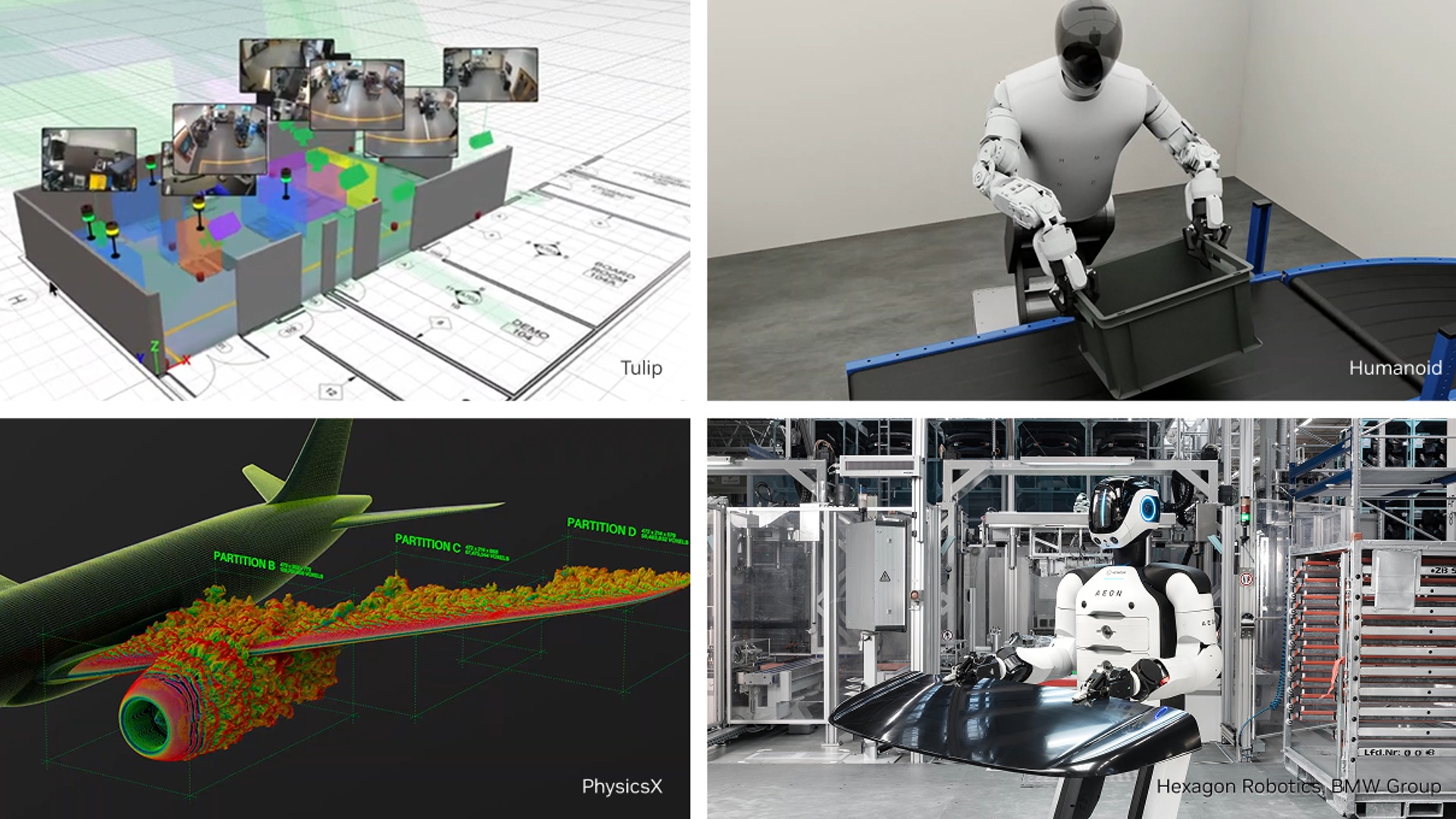
| Computer Vision with Agents | Plant inspection, traceability, and contextual analysis | Invisible AI, Tulip, Fogsphere |
| Physical Robotics | Autonomous and humanoid robots in production environments | Humanoid, SCHUNK, Wandelbots, Hexagon Robotics, QNX |
Data for this table comes from NVIDIA’s official announcement and public pages of Siemens, Tulip, and Telekom related to Hannover Messe 2026.
From Digital Twin to Autonomous Robot
One of the most interesting points of the announcement is that NVIDIA isn’t just selling chips or servers but an entire architecture for what they call physical AI. This includes Omniverse, OpenUSD, Isaac Sim, Metropolis, Cosmos, Nemotron, and all the software layers that connect simulation, computer vision, and robotic action. The clear idea is that if a company can replicate its plant, assets, and workflows in a physically consistent virtual environment, it can train systems, validate changes, and detect errors before touching the real installation.
Siemens is a major name in this story. At the fair, they showed how to integrate Omniverse libraries into their Digital Twin Composer to turn engineering and operational data into ready-to-simulate digital twins. Microsoft, meanwhile, presents the combination of Omniverse with Fabric Real-Time Intelligence and IQ, plus its Azure Physical AI Toolchain, aiming to accelerate the path from simulation to industrial deployment. ABB also joins this movement by integrating Omniverse and Azure within ABB Genix to help understand asset performance and support root cause analysis with AI agents.
The other key scene is in robotics. Humanoid showcased its HMND 01 robot with wheels in a Siemens plant in Erlangen, supported by Jetson Thor, Isaac Sim, and Isaac Lab, claiming to have compressed a development cycle that typically takes up to two years into just seven months. Hexagon Robotics advances with AEON for assembly tasks at a BMW plant in Leipzig, while QNX expands its collaboration with NVIDIA for critical edge systems on IGX Thor and the Halos security stack.
Factory Now Not Only Executes but Also Interprets
Another important element is the jump from traditional computer vision to agents that understand context. NVIDIA discusses systems capable of combining video, telemetry, operational flows, and quality events to detect problems before they escalate. For example, Invisible AI introduces a Vision Execution System designed to capture and analyze each production cycle in real time, while Tulip presents Factory Playback to synchronize video, machinery, and operations on a searchable timeline. The promise is no longer just “seeing what happens” but understanding what occurred, why, and what actions are needed afterward.
This explains NVIDIA’s focus on concepts like vision AI agents, physical AI, or agentic engineering. The goal isn’t solely to automate repetitive tasks but to develop systems that interpret complex industrial scenes, coordinate decisions, and serve as a bridge between the physical and digital worlds. In a real factory, this could translate into fewer downtime, less reprocessing, increased productivity, and much faster validation of changes.
The takeaway from Hannover Messe 2026 is quite clear: industrial AI is no longer a supplement but the new backbone of design, simulation, and operation. NVIDIA aims to lead this transition with a proposal that combines sovereign infrastructure, physical simulation, agents, and robotics. The truly significant aspect is that this vision is no longer a futuristic mockup but a current reality, with deployments, partnerships, and proof-of-concept projects featuring very concrete names. Meanwhile, Europe is striving to ensure this new industrial layer isn’t built entirely outside its borders.
Frequently Asked Questions
What is NVIDIA showcasing at Hannover Messe 2026?
NVIDIA and its partners are demonstrating industrial AI infrastructure, digital twins, vision agents, physical simulation, and autonomous robots for manufacturing, energy, and automotive sectors.
What is the Deutsche Telekom and NVIDIA Industrial AI Cloud?
It is a sovereign industry AI platform in Germany designed for European companies to develop and operate AI, simulation, and robotics applications on NVIDIA infrastructure without needing to build their own supercomputers.
What roles do Siemens and Microsoft play in this strategy?
Siemens is integrating Omniverse libraries into its Digital Twin Composer to create ready-to-simulate digital twins. Microsoft combines Omniverse with Fabric Real-Time Intelligence and Azure Physical AI Toolchain to design and optimize physical systems.
Are humanoid robots already appearing in real industrial environments?
Yes. NVIDIA highlights proof-of-concept deployments like HMND 01 at a Siemens plant in Erlangen and the planned rollout of AEON at a BMW plant in Leipzig, both as early examples of AI-supported physical robotics.
via: blogs.nvidia
