

IPv6 has just reached a milestone that has been announced for years and seemed never to arrive: on March 28, 2026, Google recorded 50.1% of traffic accessing its services over IPv6, surpassing IPv4 for the first time in its history. A year earlier, on the same date, the percentage was 46.33%. Although this figure does not yet make IPv6 the dominant standard across the entire Internet, it marks a significant turning point in the most public and comprehensive indicator of large-scale real adoption.
The importance of this data is both technical and symbolic. Google is not a minor sample: with its search engine and YouTube, it concentrates a huge portion of worldwide consumption traffic. If IPv6 already manages to surpass IPv4 in that environment—even if just for a day—it means that the transition has ceased to be an ever-delayed project and has become an operational reality in major networks, large providers, and millions of devices. At the same time, Google’s own dashboard showed 45.54% IPv6 access on April 13, 2026, confirming that crossing 50% is not yet a stable plateau but a threshold that’s being approached and occasionally exceeded.
Google’s data doesn’t mean the Internet is now mostly IPv6
This is the first important nuance for a tech media outlet. Google has crossed that 50%, but other measurements still depict a global Internet where IPv4 remains dominant. Networks-Sociales.com cites two useful references for understanding this: Cloudflare Radar reports that IPv6 accounts for 40.1% of HTTP requests seen on its network, while APNIC Labs estimates that 43.13% of observed networks are capable of using IPv6. These percentages are high and unthinkable a few years ago, but they still do not constitute clear and uniform dominance of the new protocol across the entire Web.
This explains why this milestone should be seen as a turning point rather than a final goal. IPv6 is progressing, yes, but its adoption remains uneven by geography, operator, and infrastructure type. Networks-Sociales.com also points out that the slow migration is driven by two specific historical reasons: for years, IPv6 didn’t offer enough visible incentives to push change, and address translation via NAT allowed many operators and organizations to stretch their IPv4 reserves without redesigning end-to-end networks. That patch worked too well for too long.
The case of Spain: good fiber infrastructure, poor IPv6 adoption
Zooming into the Spanish market, the picture is less optimistic. Cloudflare Radar reports that in the last seven days, Spain has 11.1% IPv6 traffic versus 88.9% IPv4. In other words, the country remains noticeably behind the global level reflected by Google. Given Spain’s well-known FTTH coverage, this gap is striking. The physical infrastructure has improved much faster than the modernization of the IP layer.
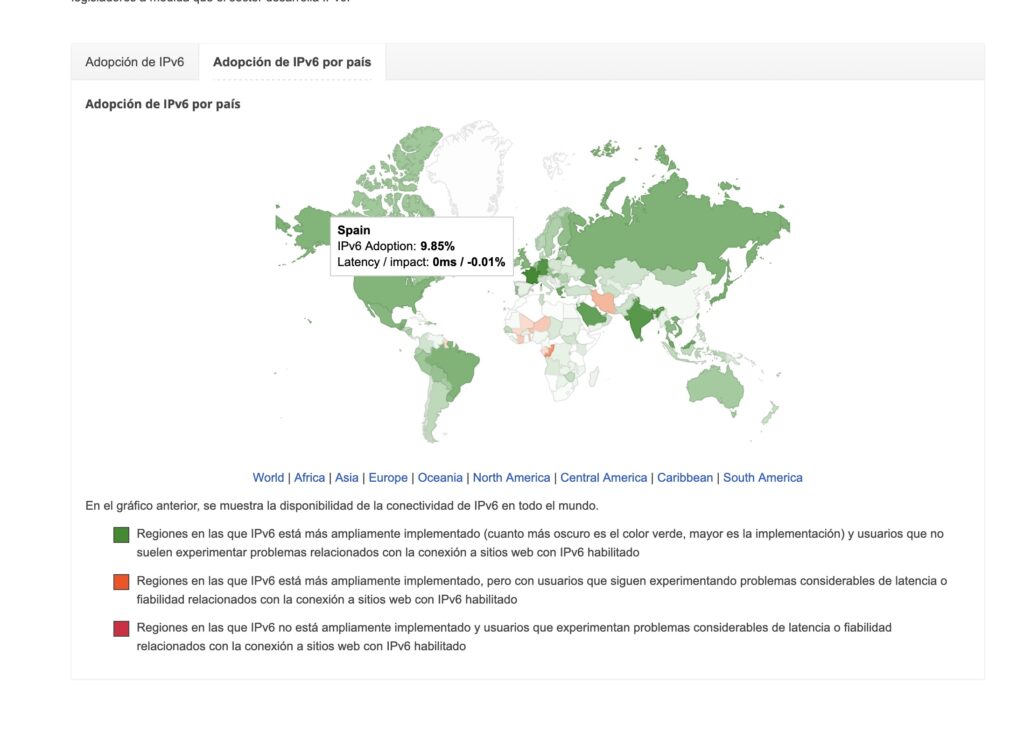
The issue isn’t institutional ignorance. Spain has had a dedicated public portal for IPv6 deployment for years, led by the Ministry for Digital Transformation, emphasizing the need for a gradual transition and coexistence with IPv4. But one thing is having the topic on the agenda, and another is having enough pressure to truly accelerate progress. The result is stagnation: the country isn’t at zero, but it’s not on an aggressive adoption path comparable to other advanced markets.
Why it should matter more to technical readers than it seems
For years, IPv4 scarcity has been managed through containment engineering: NAT, CGNAT, intensive address reuse, and secondary markets where IPv4 addresses are bought and sold as a scarce asset. This has allowed continued growth but at the cost of increased operational complexity and a less clean Internet from a design perspective. Some sources remind that IPv6 was born precisely because the 4.3 billion theoretical IPv4 addresses fell short for the growth of connected devices.
From an operational perspective, IPv6 is not just “more address space.” It’s also an opportunity to simplify architecture, reduce dependency on intermediate layers, and restore end-to-end visibility in many scenarios. That’s why Spain’s delay isn’t just a statistical detail: it means continued reliance on legacy infrastructure, which is more complex operationally and less prepared for the growth of new loads like IoT, distributed services, and edge computing. This part isn’t always visible to end users, but network and systems teams feel it profoundly.
The market has already changed, even if some industry players behave as if it hasn’t
Google’s data sends a clear signal: large-scale consumer traffic is entering a zone where IPv6 is no longer residual and begins to compete directly with IPv4. This should shift the conversation among providers, integrators, network equipment vendors, and platform managers. The question is no longer if IPv6 will someday become majority, but how much longer the transition can be postponed—a process that, outside Spain, is already becoming normalized at many layers of the Internet.
For tech media, the conclusion is straightforward: IPv6 has not fully won, but IPv4 is no longer inviolable. Meanwhile, Spain continues to observe this change from a position that is too comfortable, given the considerable effort it will take to react once the market refuses to accept delay as a reasonable option.
Frequently Asked Questions
Is Google already seeing stable traffic over IPv6 higher than IPv4?
Not yet continuously. Google hit 50.1% on March 28, 2026, but its public dashboard still showed 45.54% on April 13, so the 50% crossing has occurred, but not yet maintained daily.
Why does Google report more IPv6 traffic than Cloudflare or APNIC?
Because each source measures different things. Google tracks access to its own services, Cloudflare measures HTTP requests on its network, and APNIC estimates IPv6 capacity in networks. That’s why Google reached 50.1%, while Cloudflare was at 40.1% and APNIC at 43.13%.
What is the real IPv6 situation in Spain?
Cloudflare Radar reports Spain has 11.1% IPv6 traffic versus 88.9% IPv4, remaining well behind the global pace reflected by Google and other observers.
What’s still delaying IPv6 deployment?
According to Redes-Sociales.com, two main factors have weighed for years: perceived lack of functional incentives and widespread use of NAT to extend IPv4 usage without redesigning entire networks.
