
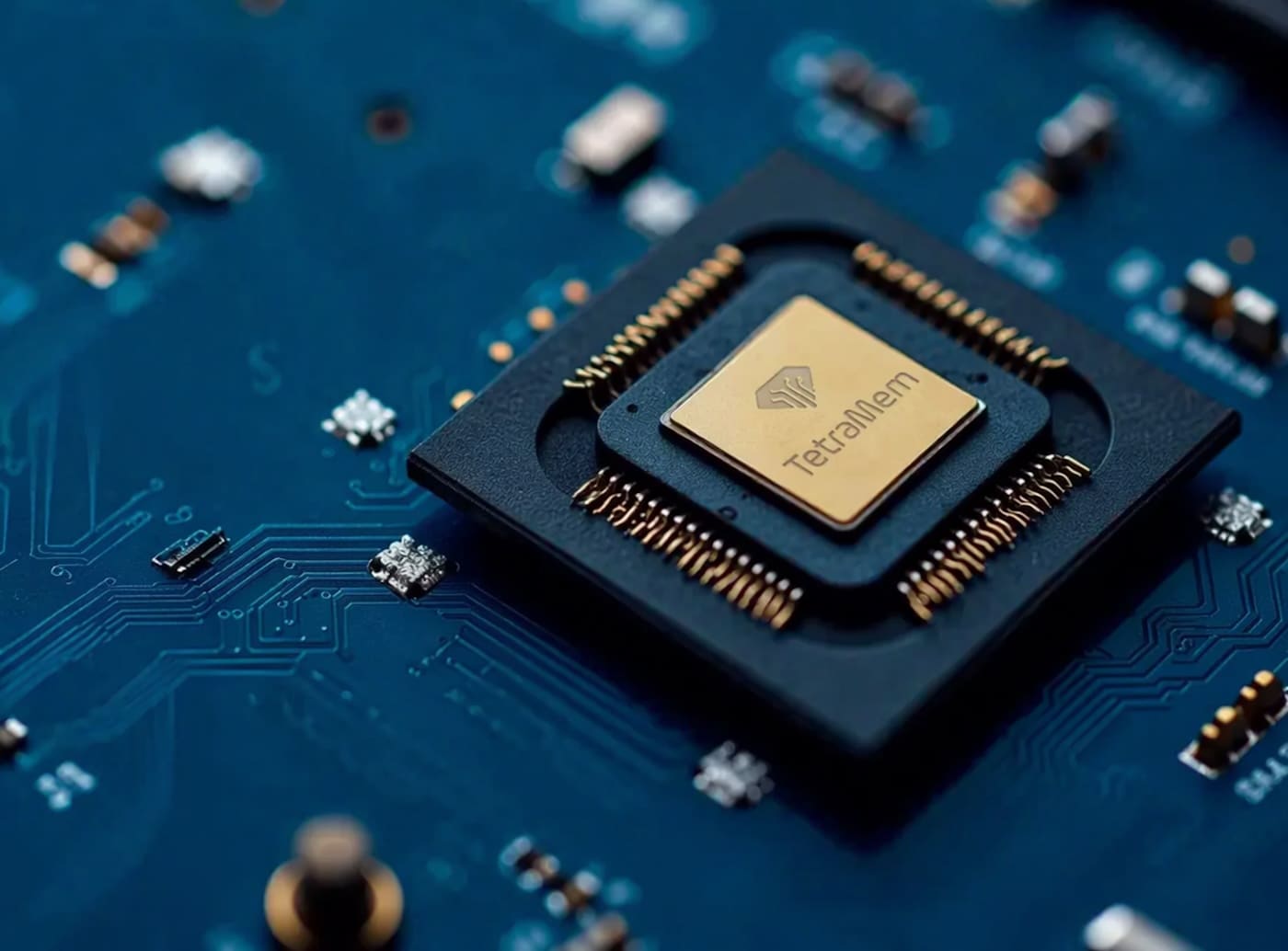
Modern electronics have a silent enemy that rarely appears in new chip advertisements: heat. Phones, cars, satellites, industrial sensors, and servers rely on memory and circuits that operate well within certain margins, but start to fail when temperatures rise too high. That’s why the work presented by a team led by the University of Southern California has garnered so much attention: their researchers have demonstrated a memristor capable of functioning at 700 °C, a figure well above the range where silicon-based conventional electronics become unreliable.
The key is that it’s not just a heat-resistant component; it’s a non-volatile memory with computing capability, especially valuable in extreme environments. The study, published in Science on March 26, 2026, titled High-temperature memristors enabled by interfacial engineering, describes a device that maintained data for over 50 hours at 700 °C, exceeded 1 billion switching cycles at that temperature, and operated with about 1.5 volts and response times of tens of nanoseconds. In other words, this isn’t just a laboratory curiosity; it’s a functional demonstration of memory functioning where many current technologies fail.
A “sandwich” of graphene, tungsten, and hafnium oxide
The device has a surprisingly simple structure. The top electrode is tungsten, the switching layer is hafnium oxide, and the bottom electrode is graphene. Tungsten is particularly interesting because it has the highest melting point of all elements, while graphene—a one-atom-thick carbon sheet—provides thermal stability and very unusual interfacial behavior. This combination has enabled breaking a barrier that has limited the development of memories for extreme environments for years.
This architecture addresses a very specific problem. In more conventional resistive memories, heat causes metallic atoms from the top electrode to gradually penetrate the insulating layer, eventually causing a permanent short circuit. When that happens, the device gets stuck in a single state and ceases to function as memory. According to USC’s team, graphene acts nearly as a “hostile” surface for tungsten: these atoms struggle to find stable anchoring, greatly inhibiting short circuit formation. Electron microscopy, spectroscopy, and quantum simulations support this difference, marking a significant leap compared to more traditional configurations.
What’s especially relevant is not just that it worked once. The authors believe this understanding of the mechanism opens the door to exploring other materials with similar behavior, which is important if we want to move from hand-crafted prototypes in the lab to scalable manufacturing in the future. They also note that two of the three materials used—tungsten and hafnium oxide—are already known in the semiconductor industry, while graphene remains less common, though major players like TSMC and Samsung are including it in their development roadmaps.
Why this breakthrough matters for Venus and industry
The reference to Venus isn’t exaggerated, but it deserves context. The planet’s average surface temperature is about 464 °C, according to NASA, so a device capable of operating at 700 °C far exceeds that thermal threshold. That doesn’t mean a computer ready to land and operate there for weeks or months tomorrow. What it signifies is that one missing component—memory capable of surviving such heat—is starting to be within reach, with solid results.
This is particularly important because many missions to Venus and other extreme environments have been limited by electronic constraints. A probe arriving isn’t enough; it must continue measuring, processing, and storing data without becoming nonfunctional within minutes. This need isn’t exclusive to space exploration. Deep geothermal drilling, certain nuclear systems, fusion research, and high-end industrial sensing also demand components that withstand temperatures far above usual electronic limits. USC frames it precisely in these terms: as a technology with potential to operate where current chips fail due to thermal stress.
Furthermore, the memristor has a secondary appeal for the tech community: it’s not just a memory device, but also capable of in-memory computation. Joshua Yang, one of the project leaders, states that much of the computational burden in AI systems involves matrix multiplications, which these devices could perform more efficiently by directly leveraging current flow. While this doesn’t instantly make it the next data center processor, it connects the research to a major current industry focus: reducing the energy cost of computation.
A real advance, but still far from a final product
For this reason, it’s important to avoid overly sensational headlines. The team emphasizes that this is only a first step. Heat-resistant memory doesn’t mean a complete computer capable of operating on Venus, in an advanced power plant, or in extreme geothermal drilling. High-temperature logic circuits, subsystem integration, reproducible manufacturing processes, and extensive durability testing are still needed. The current prototypes have been manually fabricated at sub-micrometer scales, and the researchers acknowledge that industrialization will take time.
Nevertheless, the significance of this work is undeniable. In technology, a breakthrough often isn’t about having a finished product but demonstrating that a nearly insurmountable barrier can be broken. Until now, extreme heat remained one of those frustrating limits of advanced electronics. This memristor doesn’t solve the entire problem alone, but it changes the conversation. No longer is the focus solely on whether a heat-hardy non-volatile memory is desirable; now there’s compelling proof that it can be built. And that distinction—between an attractive idea and a technology with future—is often what separates mere research from impactful innovation.
Frequently Asked Questions
What exactly is a memristor, and why is it important?
It’s a nanoelectronic component capable of storing information while performing certain calculations. In this case, the interest lies in its ability to combine non-volatile memory with potential for in-memory computing, which is relevant for AI systems and electronics in extreme environments.
Could this chip actually enable sending computers to Venus?
Not on its own. This work demonstrates that a memory device already survives at temperatures well above Venus’s average surface temperature of around 464 °C. However, a complete system would still require high-temperature logic, integration, and validation of other components.
What materials does this high-temperature memristor use?
The device employs tungsten as the top electrode, hafnium oxide as the switching layer, and graphene as the bottom electrode. This combination is designed to slow atom diffusion, which heat usually exacerbates and can ruin such memories.
What applications could it have outside space exploration?
Researchers mention areas such as deep geothermal drilling, nuclear systems, fusion technology, industrial sensors, and any environment where current electronics can’t withstand the high temperatures. They also see potential in energy-efficient AI computing, though that application is still in early stages.
References: science.org and the brighter side
