
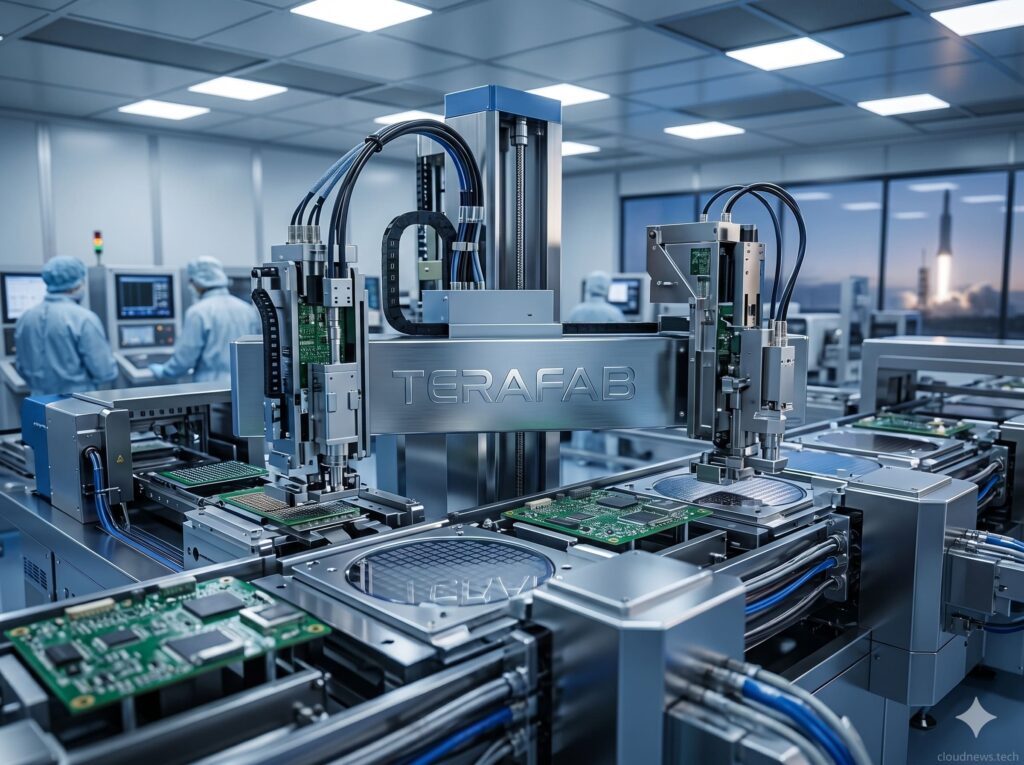
Elon Musk wants to move his Terafab project at an unusually rapid pace, even by tech industry standards. According to reports published by Bloomberg and picked up by Reuters, the team connected to the project has already reached out to major semiconductor equipment suppliers, including Applied Materials, Tokyo Electron, and Lam Research, to request pricing and delivery timelines for key tools intended for a future AI chip manufacturing factory.
The information points to an early but significant phase: this isn’t just a generic inquiry but specific requests for manufacturing equipment such as mask aligners, etching, testing, and other essential steps in a production line. Reuters warns, however, that it hasn’t been able to independently verify all details from Bloomberg’s report, so this should be seen as an early planning sign rather than confirmation that a factory is ready to operate.
Terafab, a factory to reduce dependence on TSMC and Samsung
Terafab is envisioned as an initiative linked to the needs of Tesla, SpaceX, and xAI, aiming to produce chips for robotics, data centers, autonomous driving systems, and future AI workloads. Intel announced on April 7, 2026 that it would join the project, though the exact scope of its role has not yet been publicly detailed. Reuters reported that Intel will participate in the complex to manufacture processors for Musk’s ambitions in robotics and data centers.
Intel has framed its involvement as a way to help “refactor” silicon manufacturing technology and to advance toward an ambitious goal of 1 TW of AI compute capacity annually. This is an extraordinarily ambitious target, even in a sector accustomed to massive investments. TechCrunch, which also covered the announcement, highlighted that Intel has not provided many additional details about its specific contributions to the project.
The strategic goal is clear: Musk wants to reduce reliance on external suppliers in a time when advanced AI capacity is highly concentrated among players like TSMC, Samsung, SK Hynix, Micron, and the NVIDIA ecosystem. Tesla, SpaceX, and xAI have growing and very diverse computing needs—chips for vehicles, humanoid robots, edge inference, model training, data center infrastructure, and space systems. Building his own factory, if it materializes, would give Musk greater control over design, timelines, vertical integration, and supply chain management.
Pressure on suppliers shows urgency but also risk
The most striking element of these reports is the tone of urgency. According to Bloomberg, Musk’s team reportedly asked for quick estimates on pricing and delivery, while providing few details about the final products to be manufactured. This pressure aligns with Musk’s corporate culture, which often imposes aggressive schedules and challenging goals to push rapid progress. However, semiconductor manufacturing is not a conventional assembly line.
Advanced chip fabrication requires highly specialized machinery, critical raw materials, clean rooms, lithography, etching, deposition, inspection, advanced packaging, testing, performance control, and a lengthy learning curve to reach high manufacturing yields. Even with significant capital, strong partners, and top-tier suppliers, transforming an idea into a stable manufacturing line can take years.
Reuters indicates that the goal would be to start silicon production around 2029, with a rapid ramp-up afterward. This timeline suggests that despite the push to move “at the speed of light,” Terafab is not an immediate project. It’s more of a long-term industrial investment than a quick fix for Tesla or xAI’s current AI needs.
Applied, Lam, and Tokyo Electron, key players for any advanced fab
The names Applied Materials, Lam Research, and Tokyo Electron are no coincidence. These companies are core suppliers without whom cutting-edge semiconductor manufacturing capacity is nearly impossible. Applied Materials specializes in deposition, materials, and process engineering; Lam Research is heavily involved in etching and wafer processing; and Tokyo Electron is a major Japanese supplier of chip fabrication tools.
The fact that Musk’s team is engaging these firms indicates that Terafab aims for more than just a symbolic pilot line. The project would require a full industrial architecture and capable suppliers able to provide critical tools in a market where timelines, delivery capacity, and technical integration are as important as cost. There have also been reports of contacts with Samsung Electronics, one of Tesla’s current equipment suppliers, which is said to have offered increased manufacturing capacity, according to Investor’s Business Daily.
A massive ambition in a industry that punishes improvisation
The fundamental question remains whether Musk can replicate in the semiconductor world the vertical integration approach he applied at Tesla and SpaceX. While tempting, the comparison has limits. Tesla transformed electric cars, and SpaceX changed the economics of space launch, but fabricating advanced chips faces an industrial chain of extreme complexity—companies that have spent decades optimizing processes with minimal margins.
Moreover, the project arrives amid a demand surge for AI semiconductors, straining the industry. Capacity shortages, pressure on advanced memory, the rise of High Bandwidth Memory (HBM), fierce competition for manufacturing tools, and geopolitical controls make this a highly demanding market for any new entrant. Musk would need to acquire machinery, coordinate a full supply chain capable of producing competitive, high-performance chips at scale and reasonable costs.
Nevertheless, Terafab cannot be dismissed as mere noise. Intel has acknowledged its participation, and reports of equipment supplier contacts have appeared in financial media. The project aligns with Musk’s need for computing power across vehicles, robots, satellites, data centers, and AI models. If successful, it won’t just be another factory—it would be an attempt to create a proprietary silicon platform for a tech conglomerate increasingly dependent on AI.
The key lies in distinguishing ambition from execution. While Terafab might be one of Musk’s boldest industrial bets, it’s also among the most challenging. In semiconductors, speed helps but doesn’t replace physics, process engineering, manufacturing performance, or accumulated experience. That will determine whether Terafab emerges as an industrial revolution or an overly ambitious promise—even for Elon Musk.
Frequently Asked Questions
What is Terafab?
Terafab is a project driven by Elon Musk’s business ecosystem to establish significant AI chip manufacturing capacity linked to Tesla, SpaceX, and xAI, with Intel announced as a partner in April 2026.
Which equipment companies has Musk’s team contacted?
According to Bloomberg and Reuters, Musk’s team has reached out to suppliers like Applied Materials, Tokyo Electron, and Lam Research to request pricing and delivery times for semiconductor manufacturing tools.
When could Terafab start producing chips?
The available information suggests a target of starting silicon fabrication around 2029, with a subsequent ramp-up. However, this schedule has not been officially detailed by all involved parties.
Why does Musk want to manufacture his own chips?
Because Tesla, SpaceX, and xAI need increasing computing capacity for autonomous vehicles, robots, data centers, AI, and space systems. Manufacturing his own chips would reduce dependency on external suppliers and give him greater control over supply and design.
