
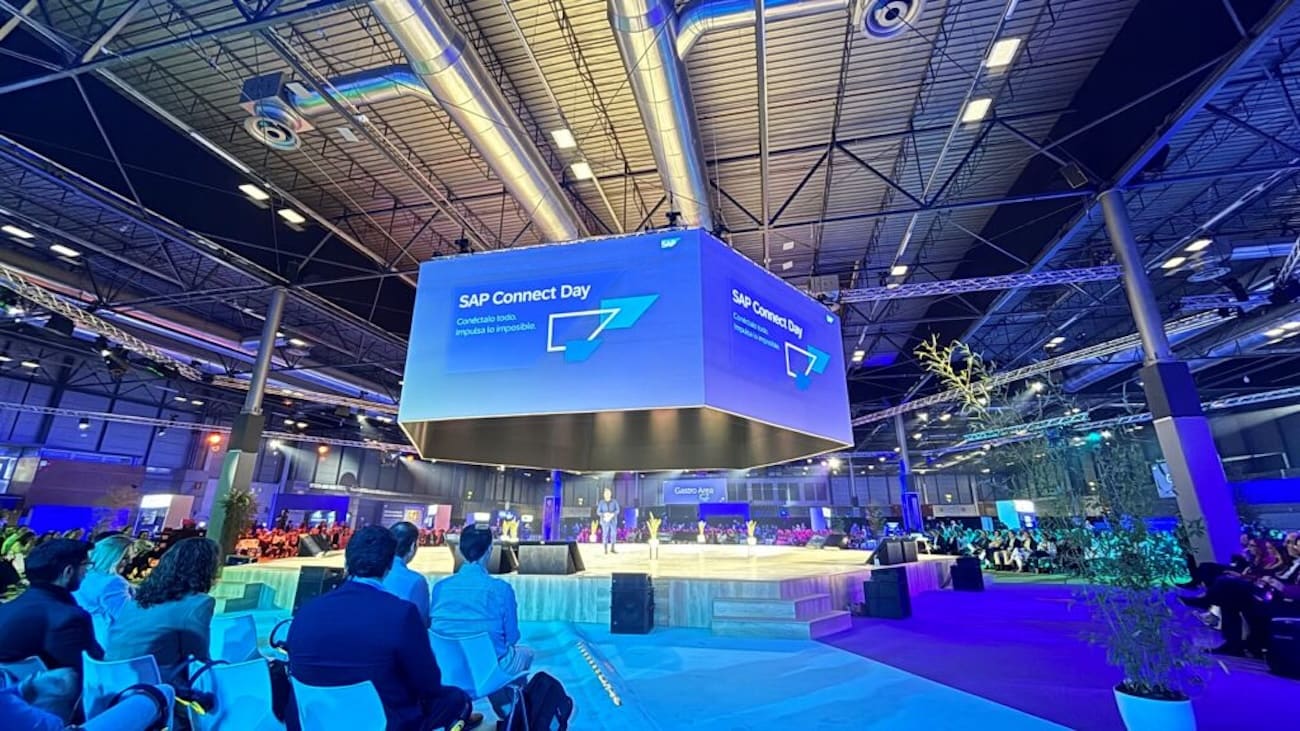
SAP has turned Madrid into a major showcase for its strategy for the coming years. The company’s Spanish subsidiary held SAP Connect Day with over 1,600 attendees and support from 41 partners, in an event designed to show how artificial intelligence, data, and enterprise applications are beginning to redefine daily operations for companies.
The core thesis of the event was clear: AI will only generate real value within a company when it stops functioning as an isolated layer and starts operating with reliable data, connected processes, and business context. This is a concept SAP has been emphasizing for months, and in Madrid, it was brought back to the center of the debate—a time when many organizations are still testing AI use cases but haven’t yet seen a clear return or a stable formula for deployment into production.
Carlos Lacerda, Senior Vice President and General Manager for Southern Europe at SAP, opened the event with a message closely aligned with this vision. He argued that many companies are still not obtaining the expected return on their AI investments due to data fragmentation, disconnection between processes, and lack of governance. In response, SAP proposes progressing toward what it calls an “autonomous enterprise”—a model where decision automation relies on integrated systems rather than isolated initiatives.
The Autonomous Enterprise, the Main Underlying Message
Beyond the slogan, what’s interesting is what SAP aims to position beneath that idea. The company insists that the true value of Artificial Intelligence doesn’t reside solely in the models themselves but in their ability to operate with structured business information connected to real processes under controlled rules. Essentially, SAP is advocating that the future of corporate AI depends not just on large models but on who can better integrate them into the core of the business.
This argument directly links to one of SAP’s strategic pillars for 2026: SAP Business Data Cloud, a managed SaaS solution that, according to SAP, aims to unify and govern SAP and third-party data to support intelligent applications and more reliable AI use cases. In other words, SAP seeks to position itself not only as an enterprise application provider but as the layer that provides context, consistency, and governance to data fueling automation.
This is a logical stance in today’s market. While many vendors compete to lead the conversation around generative AI, SAP tries to steer the discussion toward a domain where it feels stronger: business processes, ERP, supply chain, finance, or customer relationships. Instead of marketing AI as a separate entity, it is presented as a capability that should be integrated on a foundation already familiar to its clients.
Seven Events in One and an Unusual Format
SAP Connect Day was not conceived as a traditional event with linear sessions. The company organized it as a kind of multiple gathering, divided into seven parallel tracks dedicated to different business areas: Data & IT Business AI / Business Data Cloud, Business Technology Platform, Finance, Spend Management, Customer Experience, and Supply Chain, among others.
To manage this format, SAP opted for a “silent conference,” with a central heptagonal stage and headphones so each attendee could follow the sessions of interest without interference from others. This approach visually reinforces another message: business transformation is no longer approached from a single department but from multiple layers moving simultaneously and needing to communicate with each other.
In the data and AI-related segment, Jorge Pérez, SAP’s Head of BTP, Business Data Cloud, and AI for Southern Europe, emphasized a point common to almost all enterprise software vendors, but one that SAP highlights with particular nuance: AI doesn’t work well with data alone; it also needs business context. According to SAP, this context still resides primarily in enterprise applications managing procurement, sales, logistics, finance, or HR.
From Formula 1 to Investment: Real-World Examples to Ground the Discourse
As is typical of such events, SAP didn’t limit itself to showcasing its technological strategy but supported it with external profiles and near-business examples. One of the most notable was Laura Goodrick, Director of Finance Operations for Mercedes-AMG PETRONAS F1 Team, who explained how she connects finance, operations, and technology in an environment where decision speed and data accuracy have a direct impact on on-track performance.
Her presentation highlighted an idea frequently echoed by SAP: before talking about advanced AI, you need a solid database foundation, consistent processes, and tools capable of operating with real-time information. In this context, Goodrick mentioned SAP S/4HANA as a key component to improve efficiency, analytics, and decision-making capacity.
Alongside them, the event featured profiles like Saúl Craviotto and Luis García Abad, CEO of the Madrid 2026 Formula 1 Grand Prix, discussing performance in high-demand environments and the economic impact of major events.
Why This SAP Movement Matters
The significance of the event isn’t just in the number of attendees or its format. It confirms the direction SAP intends to pursue at this stage of the market. The company is not competing solely to sell more enterprise software but aims for a more ambitious role: as the logical infrastructure that allows AI to operate within companies with less friction, greater traceability, and more control.
This is critical because many companies are already in a second phase of AI discussion. The first phase was about testing tools, copilots, and assistants. The much more challenging next step is integrating them into actual operations without losing governance, security, or economic sense. That’s where SAP sees its opportunity: offering a combination of applications, platforms, and data that makes AI a practical tool for execution, not just experimentation.
The key will be whether this promise translates into measurable results for clients. Because beyond the rhetoric, the main challenge remains for almost all organizations: turning AI into something less flashy but more valuable. Less demo, more process. Less pilot, more operation.
Frequently Asked Questions
What is SAP Connect Day Madrid?
An event organized by SAP Spain to bring together clients, partners, and experts around data-driven business transformation, applications, and AI.
What does SAP mean by “autonomous enterprise”?
It’s the concept SAP uses to describe an organization capable of automating decisions and processes with the help of AI, supported by integrated data, business context, and solid governance.
What is SAP Business Data Cloud?
A managed SaaS solution from SAP aimed at unifying and governing SAP and third-party data to fuel advanced analytics, intelligent applications, and enterprise AI use cases.
Why does SAP emphasize data context?
Because SAP argues that AI can only deliver reliable results within a company if it works with connected data tied to real processes, rather than isolated or disorganized information.
via: news.sap
