
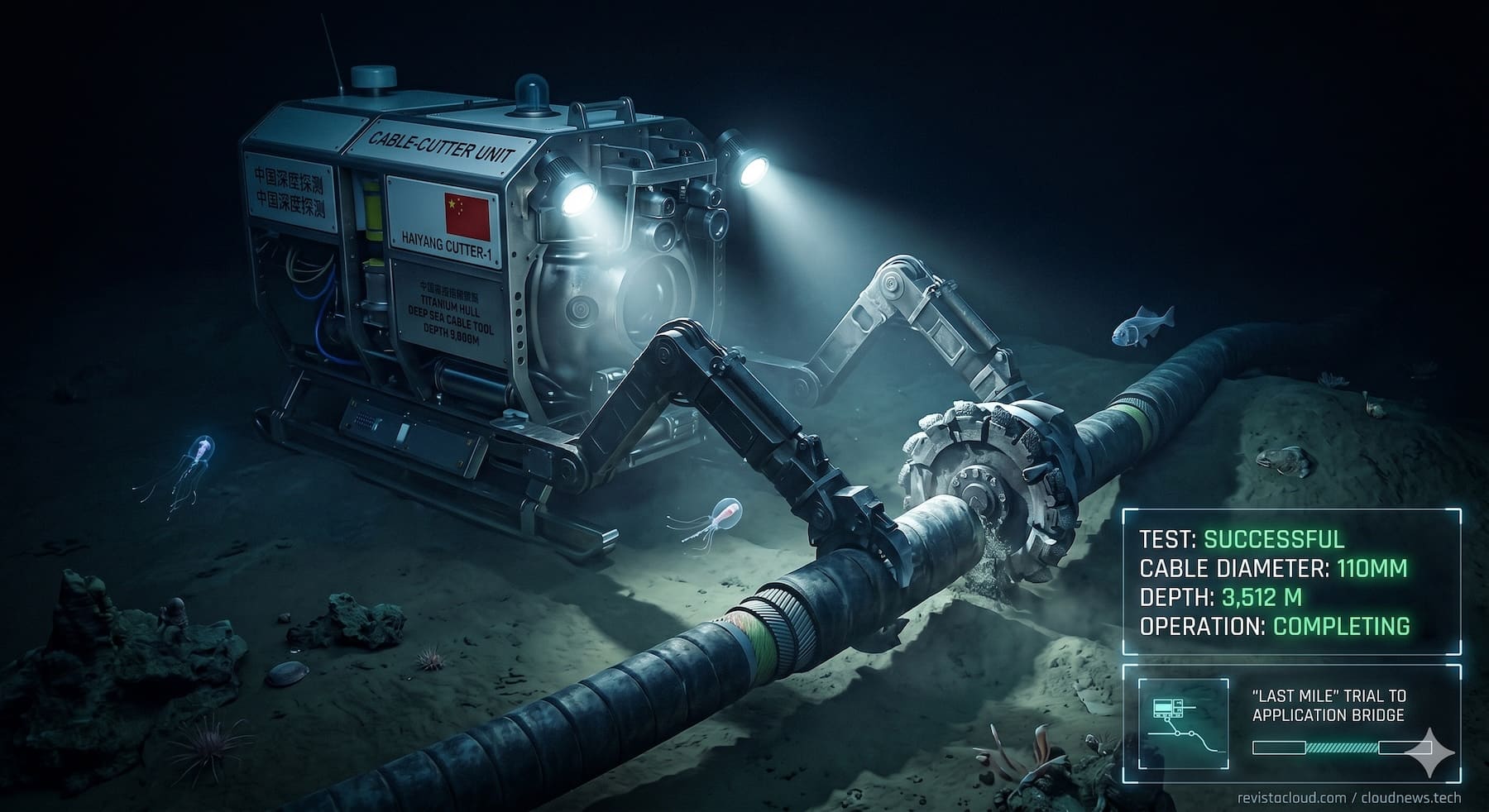
China has once again spotlighted one of the most sensitive infrastructures of the global digital economy: submarine cables. The reason is the successful testing of a deep-water electrohydrostatic actuator capable of performing mechanical tasks at 3,500 meters depth, including the cutting of underwater structures such as cables or conduits. The test was carried out during the first scientific mission of 2026 aboard the vessel Haiyang Dizhi 2, according to information published this week based on data from China’s Ministry of Natural Resources and state media outlets.
This news matters because it’s not just a marine engineering breakthrough. Submarine cables carry more than 95% of international data traffic, supporting financial services, cloud platforms, intercontinental communications, and much of the everyday functioning of the Internet. Simultaneously, the international cable protection ecosystem has been warning that between 100 and 200 incidents of damage to these infrastructures are recorded every year. Most are accidental, but there’s increasing concern over risks of sabotage or deliberate interference.
A technical test with immediate geopolitical implications
According to released information, the experiment involved testing an electro-hydrostatic actuator (EHA), a system that integrates hydraulics, an electric motor, and control mechanisms into a compact unit, eliminating external wiring and oil pipes typical of conventional systems. Reinforced to withstand extreme pressure and corrosion, this design would allow precise mechanical work on the seafloor at great depths. China Science Daily described the test as the “last mile” between developing the equipment and its engineering application, a characterization interpreted as a sign of operational maturity.
Officially, the system’s use is framed within civil projects such as construction and repair of submarine oil and gas pipelines and other deep-water engineering tasks. However, the international debate has quickly shifted toward its potential dual-use. The obvious reason is that a tool capable of operating at 3,500 meters beneath the surface directly relates to the protection—or potential threat—of telecom cables and other critical underwater infrastructure.
Why is 3,500 meters such a significant figure?
The 3,500-meter depth is not a minor technical detail. At these depths, a significant portion of the oceanic routes for international cables is located—particularly in offshore routes where repairs become much more complex and costly compared to shallow waters. An incident near the coast is different from damage on a route at great depth, where intervention logistics require specialized ships, favorable weather windows, and longer response times. This is one reason why any advancement in tools capable of operating at such depths generates concern outside China.
Furthermore, this isn’t the first time the issue has appeared on the radar. In March 2025, the South China Morning Post reported on a Chinese device capable of cutting reinforced submarine cables at depths of up to 4,000 meters. That episode raised alarms about potential security implications for international communications. The current development is notable because it’s no longer just a technological revelation but involves an ocean test during an official mission, with a public narrative suggesting a higher level of practical readiness.
Critical infrastructure and real vulnerabilities
International concern over submarine cables isn’t new, but it has intensified over the past two years. The International Cable Protection Committee (ICPC) emphasizes that these networks are vital global infrastructure requiring coordinated technical, legal, and operational protection. The European Union, strategic analysis centers, and international agencies have been stressing that the threat isn’t hypothetical: cables can suffer damage from fishing, anchors, natural events, and sometimes malicious actions. The fact that a major power develops and tests systems for deep intervention on these structures adds a new element to the debate.
That said, it’s important to maintain a cautious perspective. There’s no public evidence that this system has been deployed for offensive operations, nor has China announced a military-only use. What exists is a demonstrated technical capability in testing, against a backdrop of increasing geopolitical rivalry over underwater infrastructures, and a Chinese media narrative that speaks of progression from development to application. This suffices for a strategic impact in the public eye but does not alone justify framing the device as an already-deployed or operational weapon.
An uncomfortable reminder for Europe and the West
For Europe, the United States, and global operators, this test sends an unwelcome message: digital resilience isn’t solely dependent on data centers, satellites, or terrestrial networks. A significant part also relies on thousands of kilometers of fiber optic cables laid on the ocean floor, where surveillance remains limited, and repairs are slow and costly. TeleGeography estimates that by early 2026, there are more than 1.5 million kilometers of submarine cables in service worldwide, illustrating how the digital economy is anchored in extensive, vulnerable physical infrastructure that is very difficult to fully safeguard.
Thus, China’s test doesn’t alone shift the global strategic balance but signals a broader trend: the seabed is becoming an increasingly contested space for technological, energy, and geopolitical competition. When a country demonstrates precise intervention capabilities at 3,500 meters, the discussion quickly shifts from scientific curiosity to security and strategic considerations.
What exactly did China test at 3,500 meters?
China tested a deep-water electrohydrostatic actuator during a mission with the Haiyang Dizhi 2. According to published reports, this system can perform mechanical tasks on underwater structures at great depths, including cutting cables or other subsea elements.
What is an electro-hydrostatic actuator used for in the ocean floor?
This type of system combines an electric motor, hydraulics, and control in one compact unit, enabling precise operations in high-pressure, corrosive environments. Officially associated with the repair and construction of underwater infrastructures, its cutting capacity also points to potential dual use applications.
Why is the security of submarine cables a major concern?
Because they carry more than 95% of international data traffic and are crucial for the functioning of the Internet, finance, cloud services, and global communications. Moreover, over 100 incidents of damage or faults are reported annually worldwide involving this infrastructure.
Is there any confirmation that China will militarily deploy this technology?
There is no public confirmation of military deployment or offensive operational use. What exists is a real test in the sea and an official Chinese statement framing the experiment as a significant step toward practical application of the system.
Featured image: AI-generated simulation.
