
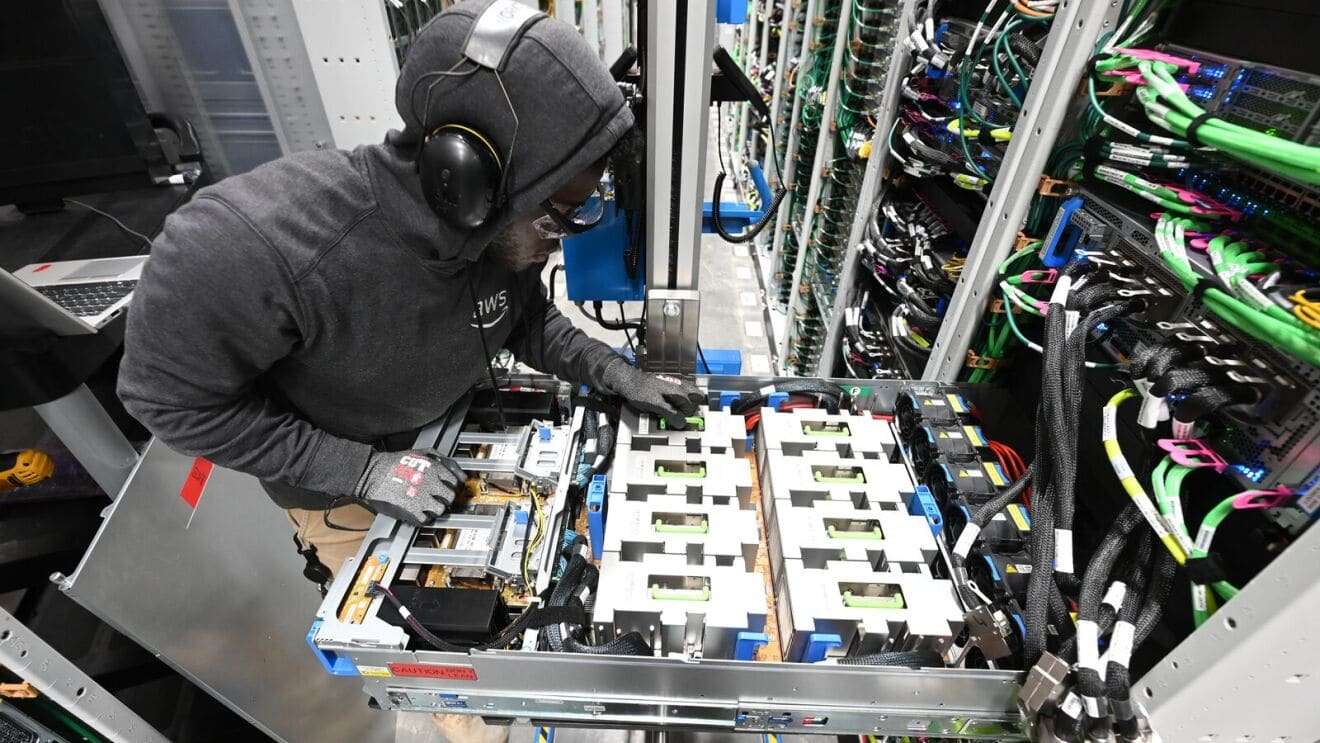
Amazon is testing a new way to build data centers aimed at saving weeks, reducing thousands of hours of on-site work, and getting more capacity into production much earlier. The project, internally known as Project Houdini, has not been officially announced to the market but has come to light through internal documents reviewed by Business Insider and later reported by Data Center Dynamics. The core idea is to shift much of the construction of the data center’s core—the room housing the servers—from traditional on-site building to a factory environment, where modules are pre-assembled before arriving at the final site.
This news aligns closely with the current situation at Amazon Web Services. In their shareholder letter, Andy Jassy recently acknowledged that AWS still faces capacity constraints and unmet demand. Amazon added 3.9 GW of new electrical capacity in 2025, expects to double its total capacity by the end of 2027, yet admits it still lacks infrastructure to meet all market demands. Meanwhile, Jassy announced an investment of around $200 billion in 2026, heavily focused on Artificial Intelligence and AWS infrastructure.
Project Houdini: less fieldwork, more factory assembly
According to documents cited by Business Insider, AWS aims to replace part of the traditional “stick-built” construction model—assembling piece by piece on-site—with prefabricated modules or skids produced in controlled factory environments. These modules would arrive with racks, electrical distribution systems, cabling, lighting, and fire safety and protection elements already integrated. They would then be transported to the data center and connected to each other on-site.
The potential savings for Amazon are significant. Currently, setting up a data room can take about 15 weeks and require between 60,000 and 80,000 work hours. With Houdini’s approach, server installation could start in as little as 2 or 3 weeks from the beginning of construction, and could eliminate up to 50,000 hours of electrical work on-site, according to internal estimates. The modules, approximately 45 feet long and weighing around 20,000 pounds, would be transported on specialized double-axle trailers. Amazon hopes to have the system operational by August and to design it to support over 100 data centers per year.
Though AWS hasn’t publicly detailed the project in an official announcement, they have confirmed to Business Insider that they are innovating in data center construction to deliver AI infrastructure faster and at lower costs. This lends credibility to the core idea, although specific deployment details still depend on internal documents rather than a finalized commercial roadmap.
The biggest challenge remains energy
Amazon’s proposal makes industrial sense but does not solve the sector’s most critical bottleneck alone. The Business Insider report, citing university experts, reminds us that securing electricity supply, substations, and grid connection can take years—much longer than physically building a data center. Dimitrios Nikolopoulos, a professor at Virginia Tech quoted in the report, summarized the situation clearly: speeding up construction to weeks helps, but makes little difference if energy takes years to arrive.
This nuance is important because it prevents an overly optimistic interpretation. Project Houdini does not eliminate the infrastructure challenge for AI, but it targets a very specific part: the time from when the land and energy are ready to when compute capacity can start generating revenue. In that window, each week counts. If AWS can reduce data room activation from 15 weeks to 2 or 3 weeks, the difference could be huge—especially as hyperscalers compete to deploy more GPUs, racks, and capacity online as quickly as possible.
Modular isn’t new, but Amazon aims to scale it up
Prefabricated data centers aren’t a new concept. Companies like Schneider Electric and Vertiv have been offering modular or pre-assembled solutions for years, enabling faster capacity deployment by integrating power, cooling, and IT equipment into modules tested in factories. Schneider describes their solutions as modular infrastructure capable of accelerating data center projects and adapting to high-density AI environments. Vertiv also promotes prefabricated solutions as a way to reduce deployment time and fieldwork through pre-integration of power, cooling, and IT systems.
What seems different in Amazon’s case is the scale and level of integration within a hyperscale environment. Business Insider explains that AWS is not planning small modules for edge or limited deployments, but rather applying this modular logic directly to their primary server environments in large data centers. According to the report, Amazon is working with Cupertino Electric to prototype and scale the system, with initial production planned for Topeka, Houston, and Salt Lake City, along with discussions with other external assembly providers. Professor Shaolei Ren from the University of California Riverside highlights that the most interesting aspect is not just the existence of the module but its level of integration—particularly the inclusion of servers designed for AI—and the scale at which they aim to implement this across hyperscale infrastructure.
A further indication of where cloud infrastructure is headed
The overall takeaway is quite clear. Amazon isn’t experimenting with a curious idea but is attempting to further industrialize data center construction amidst the race for AI capacity. The more a data center resembles a factory-assembled product rather than a handcrafted structure at each location, the easier it will be to standardize, test beforehand, reduce errors, and minimize reliance on local labor markets. This approach aligns with current sector pressures: if demand outpaces infrastructure growth, deployment speed becomes not just an advantage but a necessity.
In this context, Project Houdini matters less for its name than what it represents. It demonstrates how the AI race is no longer just about chips, models, or software; it’s also about concrete, cabling, prefabricated modules, substations, and industrial logistics. And Amazon seems committed to shaving every possible minute off this process.
Frequently Asked Questions
What exactly is AWS’s Project Houdini?
It’s an internal Amazon initiative to accelerate data center construction through factory-prefabricated modules that replace some traditional on-site assembly. The information has been revealed through internal documents reviewed by Business Insider.
How much time could Amazon potentially save with this modular system?
Based on internal estimates cited by Business Insider, a data room that currently takes about 15 weeks to build could be ready to install servers in just 2 or 3 weeks.
Does this solve the main capacity problem for AI data centers?
Not entirely. The biggest bottleneck remains energy access, grid connection, and substation construction, which can take years. Houdini accelerates the construction phase but does not eliminate this structural issue.
Did modular data centers exist before Amazon?
Yes. Companies like Schneider Electric and Vertiv have been offering prefabricated or modular solutions for years. What’s new with AWS is the intent to scale this approach to hyperscale environments and integrate it directly into their main server facilities.
via: enterprise AI
