
Oracle has announced new capabilities for Aconex aimed at strengthening two of the most critical areas in large construction and engineering projects: document review and the management of inspection and testing plans, known as ITPs by their acronym in English. The presentation was made at the Oracle Edge Customer Summit in Austin, held from April 12 to 14, and fits into the company’s strategy to turn Aconex into a more centralized system for coordinating documentation, reviews, approvals, inspections, and evidence within a single contractual environment.
This development is noteworthy because it addresses a common friction point in the industry. In many complex projects, the review of plans, models, technical documents, or deliverables still partially depends on spreadsheets, loose emails, and comment chains scattered across multiple organizations. This creates additional administrative work, makes it difficult to determine which version is valid, and complicates reconstructing who decided what, when, and with which information. Oracle presents these improvements precisely as a way to reduce operational noise and leave a clearer, more auditable trail of the entire process.
From Dispersed Comments to a Connected Document Process
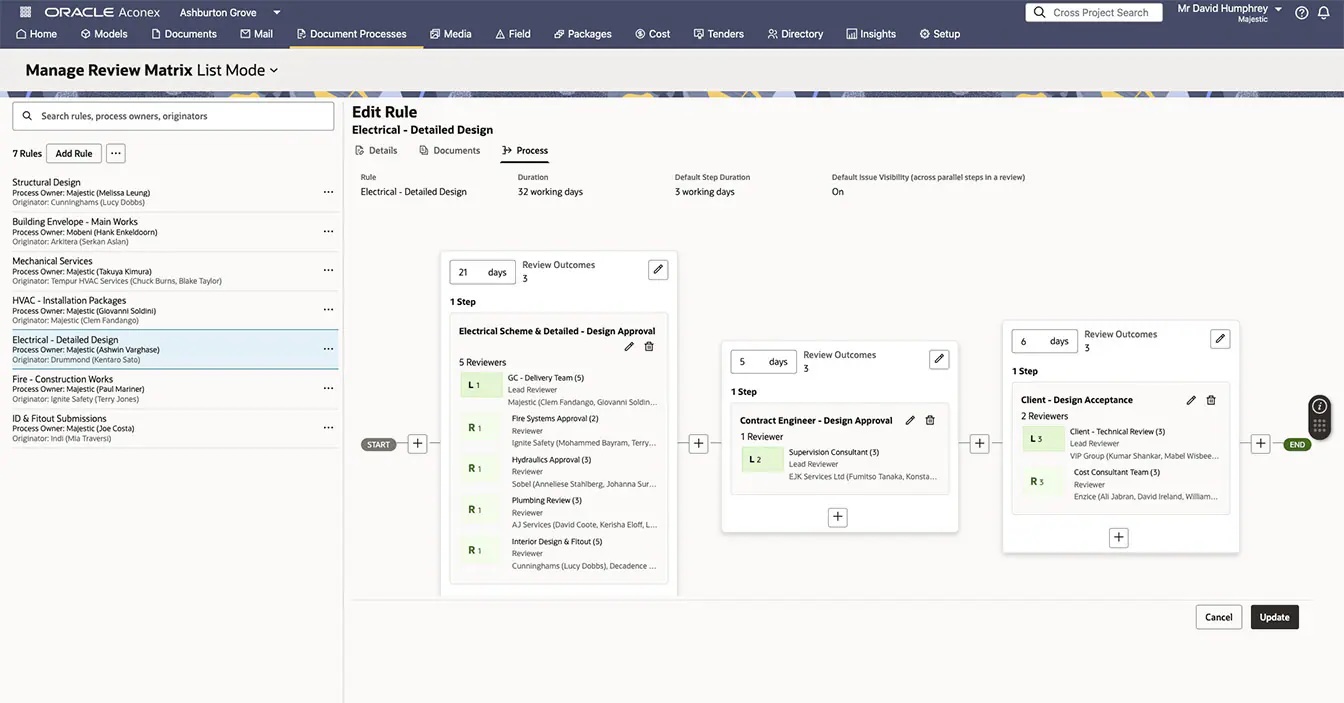
One of the most significant changes affects Document Process, Aconex’s feature aimed at managing document revisions among teams and companies. According to Oracle, this capability allows comments, resolutions, and review statuses to be linked with the centralized project record, ensuring that information doesn’t remain scattered across parallel systems. The company also emphasizes that its traceability is supported by an integrated and unalterable audit trail, which is especially relevant in projects with strict contractual, regulatory, or quality requirements.
Added to this is an automated Review Matrix that initiates the appropriate approval flow based on each document’s metadata. In practice, this means deliverables can be distributed following a predetermined sequence with project-specific rules, avoiding some of the improvisation often seen when multiple contractors, engineers, and owners work on the same documentation. Aconex’s documentation explains that this review matrix defines which documents need review, by whom, and under what process, precisely leveraging the metadata.
Oracle doesn’t frame this as a mere interface enhancement. Its approach is more ambitious: to ensure that document reviews are no longer isolated from the project’s contractual record system. This distinction matters because in construction and engineering, collaboration alone isn’t enough; it must also be possible to demonstrate how approvals were achieved, what comments were made, and which version supported the work executed. Operational efficiency is important, but document governance is even more critical when deadlines, risks, certifications, and claims are involved.
More Structured and Trackable ITPs
The other major update is Test Plans, a feature aimed at better structuring the workflows related to ITPs, the plans that specify how, when, and where each part of the work should be inspected, tested, and validated. In Aconex’s documentation, Oracle describes this as a traceable workflow linked to project information, designed so that each activity, approval, and evidence is associated with verifiable and version-controlled documentation.
On paper, this addresses a well-known onsite problem: paper-based ITPs, loose sheets, or manual processes often cause duplicate management, unclear approvals, difficulty tracking the real status of inspections, and inconsistent traceability across teams. Oracle has previously explained in client materials that disconnected inspection processes lead to poor traceability, task duplication, and manual follow-up. The new functionality aims to correct this by enabling the creation of plans, role assignments, progress tracking, field data capture, and the generation of final, exportable packages with all work documented.
The key here isn’t just digitizing forms; it’s connecting inspections, decisions, and tests with the rest of the project. Oracle states that the ITP manager can develop the plan, assign responsible parties, push progress through notifications, and record all communications, actions, and decisions in an audit-ready history. This is an attractive promise for capital-intensive projects, where quality and compliance are not only about execution but also about being able to demonstrate that work was performed as planned.
More Document Control, But Also Greater Adoption Pressure
The announcement also references Observation, a recently launched Aconex capability to standardize the collection of observations and safety workflows in the field, additionally connected to Advisor for Safety, Oracle’s predictive safety analytics tool. In March, Oracle introduced this solution as a system capable of cross-referencing observations, incidents, payrolls, schedules, and other data to anticipate risks and suggest corrective actions.
All of these developments point toward a clear direction: Oracle wants Aconex to be more than just a document repository; it aims to evolve into a platform increasingly integrated with project execution, quality, safety, and contractual traceability. However, like many such announcements, the real utility will depend less on the headline features and more on implementation. In construction, many tools promise visibility and control, but true change occurs only when owners, contractors, subcontractors, and engineering teams adopt common processes and genuinely move away from spreadsheets, parallel emails, and informal workflows. Technology alone cannot resolve this; operational discipline remains decisive.
Nevertheless, the strategic logic makes sense. The push to better document decisions, reduce errors, and accelerate approvals is growing in infrastructure, energy, industrial, and complex construction projects. If Oracle succeeds in integrating these new review processes and Test Plans with less friction into daily site operations, Aconex can reinforce its position as a reference system for projects where data not only needs to flow but also be firmly tied to contractual requirements.
Frequently Asked Questions
What is Oracle Aconex and what is it used for?
Oracle Aconex is a construction and engineering project management platform focused on document coordination, change control, collaboration among organizations, and fieldwork. Oracle positions it within its offerings for construction and critical assets.
What do the new Document Process functions in Aconex contribute?
They enable managing document revisions, comments, and resolutions within the project system, with automatic review rules based on metadata and a built-in audit trail. The goal is to reduce spreadsheet use and improve traceability.
What are ITPs and why are they important in construction?
Inspection and Test Plans (ITPs) define how each part of the work is inspected, tested, and approved. They are key for ensuring quality, compliance, and traceability, especially in complex or regulated projects.
Does Aconex now integrate quality and safety in the same platform?
Oracle is advancing in this direction. Along with new document review and Test Plans features, the Observation capability has been introduced, linked to safety workflows and Oracle’s Advisor for Safety, a predictive risk analysis tool launched in March 2026.
