
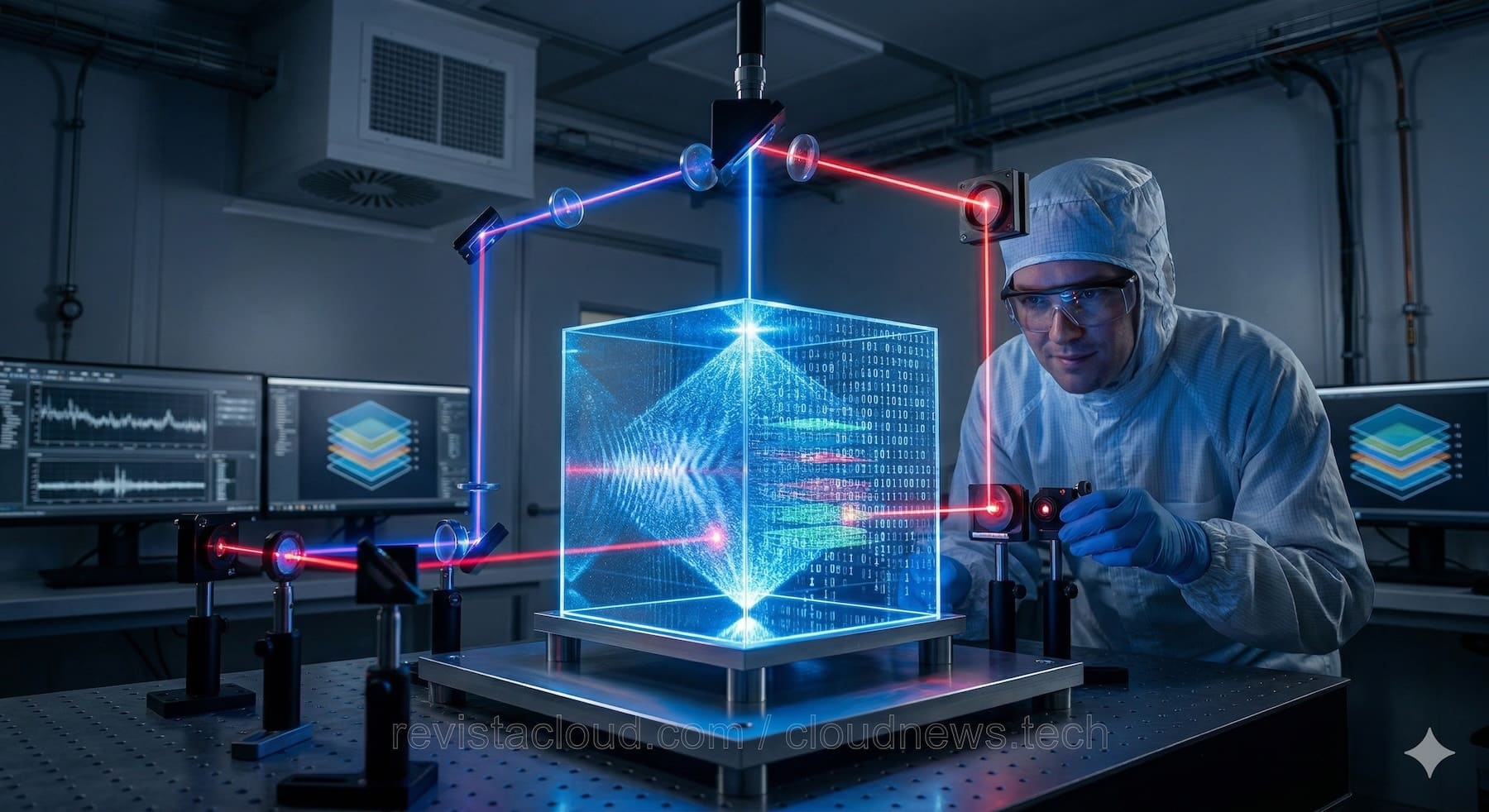
Data storage is looking towards the light again. A team led by Xiaodi Tan from Fujian Normal University in China has presented a new holographic storage method in the journal Optica. This method combines three properties of light simultaneously—amplitude, phase, and polarization—to store more information within the same physical space. The proposal isn’t intended to be used in everyday computers tomorrow or to suddenly replace SSDs or hard drives, but it does pursue an industry goal: increasing storage density without making data reading even more complicated.
The novelty lies not just in the amount of information that can be concentrated, but also in how it is retrieved afterward. Compared to more cumbersome approaches, this system uses a neural network to reconstruct the information from two light intensity images, reducing the need for more complex instrumentation. Simply put: it’s not only about packing more data in, but also about finding a more realistic way to read it later without making the system impractical.
How this new holographic storage works
Unlike a traditional hard drive or optical disc, where information is primarily recorded on a surface, holographic storage works within the volume of the material. Instead of writing data point-by-point on a layer, it records entire pages of information through light patterns inside the medium itself. That’s why it’s been considered a promising avenue for achieving higher density and faster transfers for years.
The Chinese team has now increased the amount of information that can travel within a single holographic “page.” Conventional systems typically encode data using one light property—like amplitude or phase—or at most two. In this case, the researchers add a third: polarization. Combining amplitude, phase, and polarization allows each data unit to be significantly enriched.
To achieve this, they designed a system that controls the intensity and phase of two orthogonal polarization states, using a double-phase technique so that everything can be managed with a single phase-only spatial light modulator. This matters because it avoids building a much larger and more delicate optical architecture. Then, to recover the information, the system captures two diffraction images: one without a polarizer and one with a vertical polarizer. These images become inputs to a neural network called TriDecode-Net, which reconstructs the amplitude, phase, and polarization simultaneously.
What the experiment has actually demonstrated
This work isn’t just theoretical; the researchers built a compact experimental setup and tested it on a polarization-sensitive photopolymer material. In their current configuration, each of the three dimensions was coded with three levels, allowing for 27 possible states per pixel. This is a notable figure because it shows how much information can be packed into a single holographic page without resorting to more complex volumetric techniques.
Additionally, the team trained the neural network with 120 sets of experimental data: 100 for training and 20 for validation. According to their results, the average reconstruction errors were below 3% for amplitude, phase, and polarization, although phase was the most challenging to recover accurately. This makes sense: amplitude leaves a more direct imprint on detected intensity, while phase is more hidden within overlapping patterns and more affected by other variables.
This detail helps distinguish genuine enthusiasm from overhype. The study demonstrates that the approach works and can robustly recover multidimensional information even with a limited training set. But it doesn’t yet prove that a commercial platform ready to compete with current storage systems exists. The authors acknowledge that the work is at the proof-of-concept stage and that further improvements are needed in recording medium stability, coding levels, and combining this technique with volumetric multiplexing methods to store many more pages in the same volume.
Why this could matter for data centers
The reason this research sparks interest is clear: the amount of data to store, move, and process continues to grow. If a technology can store more information in less space while maintaining high read/write speeds, the potential impact on massive archives and data center environments could be significant. The researchers suggest that, with further development, this approach could contribute to more compact and efficient high-capacity storage systems.
However, caution is advised. The leap from laboratory proof of concept to industrial solution is often vast, especially in the demanding field of storage. It’s not enough for the system to work once or perform well academically; it must operate reliably, repeatedly, over long periods, and at reasonable costs. That’s where many promising technologies fall short.
Nevertheless, the value of this advancement seems notable. On one hand, it demonstrates a practical way to exploit three fundamental properties of light within a single holographic storage system. On the other, it leverages artificial intelligence to simplify decoding. Plus, it opens doors to other applications beyond pure storage, such as optical encryption, high-capacity optical communications, and advanced imaging techniques.
In summary, this isn’t an immediate replacement for SSDs, but it’s an interesting piece in a technological race that’s gaining speed again. Holographic storage has repeatedly appeared as a promising technology with great potential, yet has yet to establish a foothold in the market. This new work doesn’t solve all those hurdles, but it adds something highly valuable in applied science: a convincing demonstration that there’s still room to leverage light as an information carrier in ways that seemed too complex until recently.
Frequently Asked Questions
What is holographic storage, and how does it differ from a hard drive?
It’s a technology that stores information within the volume of a material using light patterns, rather than recording it only on a surface like a traditional hard drive or optical disc. This potentially allows for higher density and faster transfer speeds.
What is the advantage of using amplitude, phase, and polarization simultaneously?
The main benefit is that each data page can carry more information. By exploiting three properties of light instead of one or two, the system can increase capacity without physically enlarging the support medium.
Will it soon replace SSDs or hard drives?
No. Currently, it’s an experimental demonstration. The researchers have shown that the concept works, but significant steps remain before reliable, scalable, and cost-effective commercial products are possible.
What other applications could this technology have beyond data storage?
The authors point to possible uses in optical encryption, high-capacity optical communications, and advanced imaging techniques. These are potential directions, not yet large-scale implementations.
Sources: opg.optica.org and thebrighterside.news
