
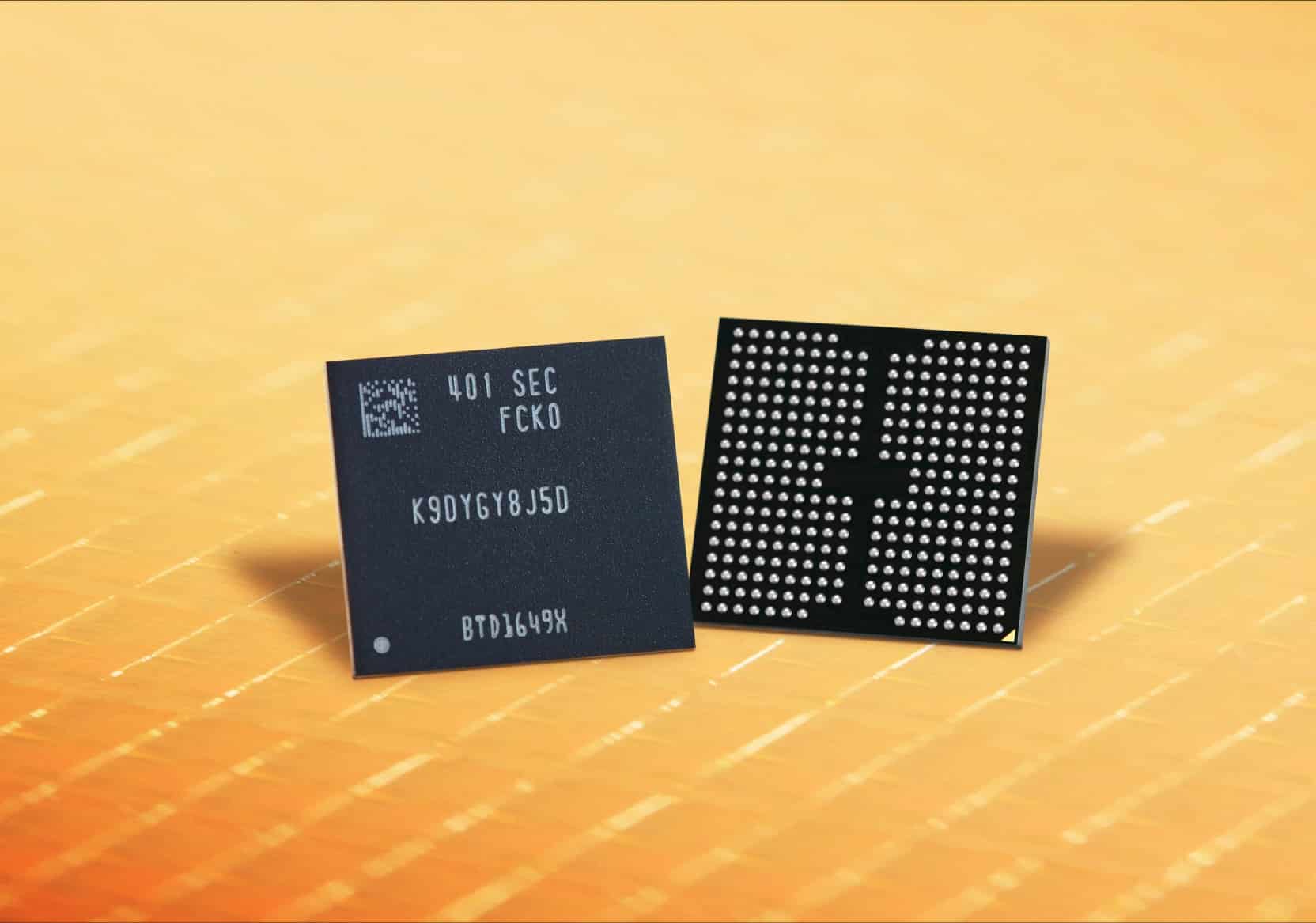
NAND flash memory has returned to the forefront of the major Korean manufacturers’ business. After several quarters where the market focus seemed almost exclusively on HBM and DRAM for AI accelerators, Samsung Electronics and SK hynix are seeing flash storage regain prominence thanks to the boost from enterprise SSDs, rising memory market prices, and the growing demand for high-capacity, high-performance data center storage for AI.
The most visible sign of this shift is in market tone and product decisions. Samsung has just forecasted a consolidated operating profit of 57.2 trillion won for the first quarter of 2026, significantly higher than the previous year, driven by strong demand for AI data center chips and rising memory prices. Although the company does not officially specify how much of that figure exactly comes from NAND, industry context points to a very clear improvement in that business as well. At the same time, expectations for SK hynix have risen sharply ahead of its quarterly results, supported by the same tailwinds: rising prices and increasingly tight memory supply.
This change is no coincidence. TrendForce warned at the end of March that NAND Flash contract prices could rise between 70% and 75% in Q2 2026, with capacity increasingly redirected toward enterprise SSDs as consumer applications retreat due to cost pressures. Reuters also reported in March that the same AI enthusiasm stressing the HBM market could eventually lead to storage unit shortages, as data centers demand more SSDs to support new workloads.
In this scenario, Samsung and SK hynix are accelerating a movement they have already been preparing: shifting their NAND catalog toward higher value-added products, especially enterprise SSDs and next-generation QLC memories. Samsung had already announced in September 2024 mass production of its ninth-generation QLC V-NAND, based on 286 layers, positioned as the industry’s first QLC 9th-gen. SK hynix, meanwhile, made a particularly visible move this week by beginning supply of its new cSSD PQC21, the first with 321-layer QLC NAND, with initial deliveries to Dell Technologies starting in April 2026.
QLC Is Gaining Momentum Because AI Needs Capacity, but Also Efficiency
The push for QLC makes a lot of sense in the current market phase. This technology stores 4 bits per cell, allowing higher density and lower cost per bit compared to TLC. This makes it especially attractive in environments where capacity and efficiency per unit matter greatly, such as high-volume enterprise SSDs or certain AI storage scenarios. In announcing the PQC21, SK hynix emphasizes this combination as an advantage for the AI PC era, citing IDC forecasts that QLC NAND’s share in the global cSSD market will rise from 22% in 2025 to 61% in 2027.
For data centers, the pressure comes from multiple fronts. TrendForce had already anticipated in 2025 that the rapid expansion of AI infrastructure could lead the NAND market into a shortage situation by 2026, especially if high-capacity SSDs continue to gain ground over nearline HDDs. The firm even spoke of a structural market transformation, with CSPs and AI operators turning to high-capacity enterprise QLC SSDs as a partial replacement for HDDs in certain workloads.
This helps explain why NAND is regaining importance for Samsung and SK hynix. It’s no longer just about selling more chips but about selling them in formats and segments with better margins. In early February, TrendForce cited industry estimates placing NAND margins for Samsung and SK hynix in the 40% to 50% range during the first half of 2026—something that was unthinkable not long ago in a business that has historically been more cyclical and less profitable than DRAM.
PLC Is Still in the Horizon, But Not an Immediate Next Step
The next major sector debate centers on the future transition from QLC to PLC—memories with 5 bits per cell. SK hynix appears to be moving with more visible public disclosures. At IEDM 2025, it presented a paper on Mass Producible Multi-Site NAND Flash for Fast, Reliable and Power-Efficient 5-Bits/Cell Operation, a research effort aimed specifically at making NAND PLC viable. The technical approach suggests the company wants to leave an open path to commercialization, but that doesn’t mean that the shift is ready for the market in the short term.
Current industry logic seems to run counter to an immediate PLC adoption. In a market where inference and AI systems are beginning to prize sustained performance and effective speed over maximum density, QLC and TLC remain more realistic options for many commercial products. PLC requires deeper redesigns in devices, processes, and circuitry, and although IEDM work shows progress, the gap between solid research papers and large-scale products remains substantial.
Therefore, the picture for 2026 appears quite clear. Samsung and SK hynix are leveraging the current memory scarcity to better monetize their NAND businesses—but not with any product. The priority is shifting the mix toward high-performance enterprise SSDs and QLC, where AI is creating a demand that is more sustainable and profitable. The big takeaway isn’t just that NAND is growing again, but that it’s doing so driven by an AI infrastructure market that no longer only needs computing, but also fast, dense, and energy-efficient storage.
FAQs
Why are Samsung and SK hynix now strengthening their NAND business?
Because demand for enterprise SSDs for AI data centers is tightening supply and raising NAND prices, which clearly improves segment profitability.
What role does QLC memory play in this new market phase?
QLC allows more capacity per cell and better cost per bit, making it very valuable in high-capacity SSDs and certain AI storage deployments.
What new products have Samsung and SK hynix announced in NAND?
Samsung has been producing its ninth-generation 286-layer QLC V-NAND since 2024, while SK hynix began supplying its new cSSD PQC21 with 321-layer QLC NAND in April 2026.
Is commercial adoption of PLC memory imminent?
Not yet. SK hynix has shown research advances at IEDM 2025, but transitioning from research to large-volume commercial products remains complex.
via: dealsite.co.kr
