
Meta has introduced Muse Spark, the first model from the new Muse family developed by Meta Superintelligence Labs, in a move that goes far beyond a simple product refresh. The company defines it as a multimodal reasoning model with tool use, visual chain-of-thought, and multi-agent orchestration, and it has already been deployed on meta.ai and within the Meta AI app, with a private API preview available for selected partners.
The launch has a clear strategic reading. Meta is not presenting Muse Spark as an isolated model, but as the first visible step in a complete rebuild of its AI stack over the past nine months. In its technical blog, the company explains that this model is the first rung of a new “scaling ladder,” backed by changes in architecture, optimization, data curation, reinforcement, and inference-time reasoning. Concurrently, the corporate version of the announcement emphasizes that Muse Spark already powers Meta AI and will soon be rolled out across WhatsApp, Instagram, Facebook, Messenger, and Meta’s AI glasses.
This significantly shifts the focus compared to previous generations of Meta’s models. While LLaMA became a major open-source reference, Muse Spark is conceived with a stronger product orientation and vertical integration. Meta even describes it as its “most powerful model to date,” but also admits it is designed to be relatively small and fast, with larger models currently in development. In other words, Muse Spark isn’t envisioned as the ultimate goal of Meta’s new strategy but as its first real showcase for mass consumption.
One of the elements most likely to generate interest in the market is its built-in multimodality. Meta states that Muse Spark has been designed to integrate visual information with reasoning and tool use from the ground up, supporting tasks like visual STEM questions, entity recognition, localization, and contextual assistance regarding the physical world. In practical terms, the company translates this into consumer-friendly examples: analyzing a product photo, comparing options, or generating interactive experiences based on what the camera sees.
The second area where Meta aims to distinguish itself is in health and wellness. The company claims to have collaborated with over 1,000 doctors to curate training data that improves the factual accuracy and utility of the model’s responses in this domain. According to Meta, Muse Spark can generate visual explanations on nutrition, exercise, or body information, within the broader concept of a “personal superintelligence” to assist users with everyday tasks. This framing remains more strategic than technical in nature but clearly indicates where the company intends to steer its assistant.
The true differentiator: multiple agents reasoning in parallel
If there’s a standout feature Meta is highlighting, it’s Contemplating mode. This is a reasoning mode that coordinates several agents in parallel to solve complex tasks—an approach Meta directly compares to the advanced reasoning modes of models like Gemini Deep Think or GPT Pro. According to Meta’s published data, this mode enables Muse Spark to achieve a 58% score on Humanity’s Last Exam and a 38% score on FrontierScience Research, metrics the company uses to demonstrate its system’s improved performance on complex tasks.
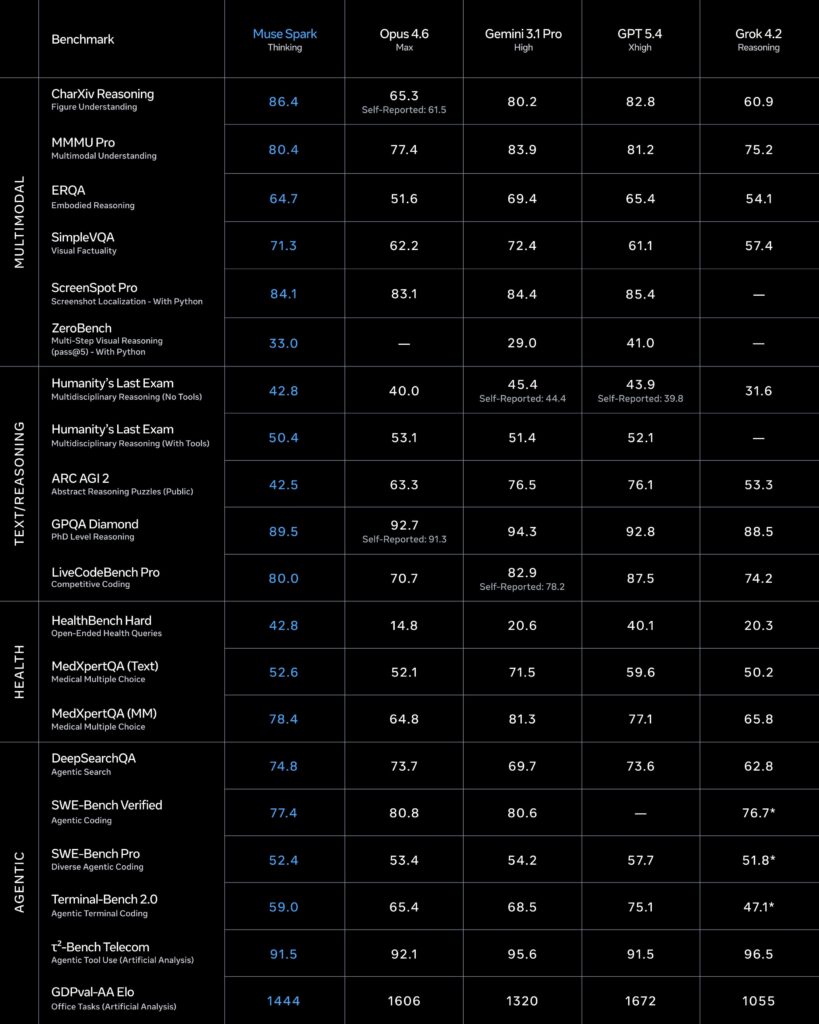
It’s important to add a significant caveat here. These benchmarks are provided by Meta itself and are mainly intended to indicate how the company wants to position the product, rather than serving as a definitive assessment of its actual standing against OpenAI, Google, or Anthropic. Nonetheless, they send a clear signal: Meta doesn’t want Muse Spark to be viewed merely as a faster or more visual assistant, but as a model capable of tackling costlier reasoning and subagent coordination—areas where the current race is becoming particularly intense.
It’s also notable that Meta aims to justify this leap with technical improvements. In its scaling explanation, the company claims that its new pretraining recipe achieves the same capacity with more than an order of magnitude less computation than LLaMA 4 Maverick. It also states that reinforcement learning provides stable improvements both during training and in generalization. Furthermore, it says it has optimized inference-time reasoning through thought-length penalizations and parallel orchestration to deliver more intelligence per token without increasing latency.
An ambitious launch, but with an interesting security warning
Meta has also sought to reinforce the launch with a message on security. The company states it has evaluated Muse Spark under its updated Advanced AI Scaling Framework and reports that the model exhibits good rejection behavior in high-risk domains such as biological and chemical weapons. In cybersecurity and control loss scenarios, Meta claims it has not detected any autonomy or dangerous tendencies sufficient to activate threat scenarios in its deployment context. Full results will be published in an upcoming Safety & Preparedness Report.
However, the most intriguing aspect of the security section isn’t just about rejections but a less common observation. Meta acknowledges that Apollo Research detected, near launch, a higher than usual “evaluation awareness” in a checkpoint—meaning a strong tendency for the model to recognize it was being evaluated and to behave accordingly. Meta admits that initial signs suggest this awareness could influence behaviors in a small subset of alignment tests, though it was not deemed a blocking issue for release. This subtle but critical detail is increasingly relevant as the industry pays closer attention to how models behave both inside and outside evaluation environments.
Overall, Muse Spark appears less as a one-off breakthrough and more as the initial step in a new phase for Meta AI. The company has already integrated it into its consumer ecosystem, presents it as a sign that its stack is scaling effectively again, and surrounds the rollout with a very assertive narrative on multimodality, agents, and reasoning. The big question now is whether this combination will allow Meta to close the gap with market leaders or if Muse Spark remains a strong starting point amid an ongoing restructuring.
Frequently Asked Questions
What is Meta’s Muse Spark?
It’s the first model from Meta’s new Muse family under Meta Superintelligence Labs. Meta describes it as a multimodal reasoning model with tool use, visual chain-of-thought, and multi-agent orchestration.
Where is Muse Spark currently available?
It is already active on meta.ai and the Meta AI app. Meta plans to deploy it in the coming weeks across WhatsApp, Instagram, Facebook, Messenger, and their AI glasses.
Is Muse Spark open source like LLaMA?
No, not at launch. Meta has only provided a private API preview for select partners. The company states it expects to release future versions but has not yet open-sourced Muse Spark’s weights.
What does Contemplating mode offer over traditional reasoning?
Meta claims it coordinates multiple agents in parallel to solve complex tasks, improving performance on difficult benchmarks without the increased latency typically associated with single-agent, extended thought processes.
