
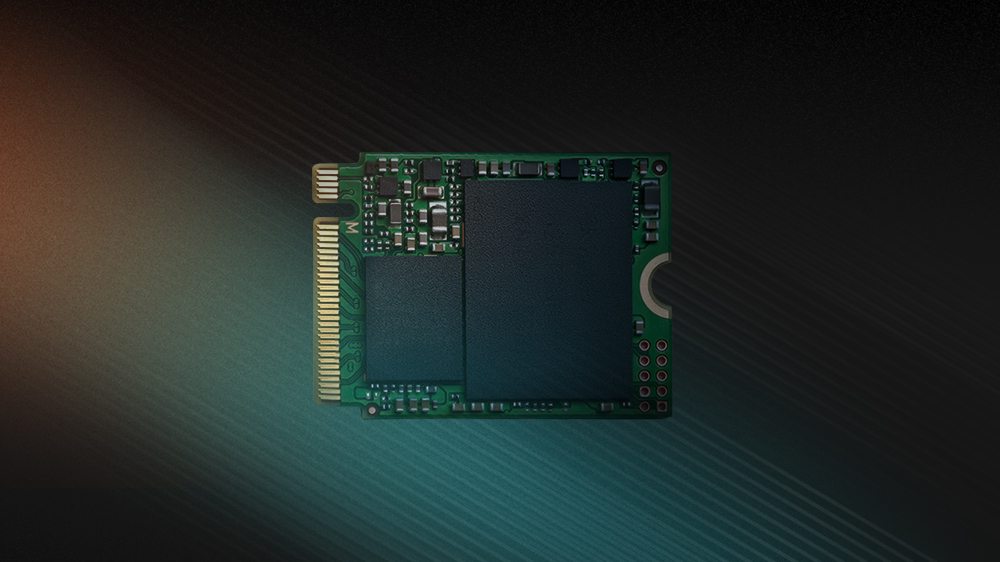
SK hynix has taken a significant step in the personal computer storage market by beginning the supply of its new cSSD PQC21, the first industry device based on 321-layer NAND QLC memory, according to the company itself. The South Korean manufacturer announced on April 8 that this new client SSD will initially be available in 1 TB and 2 TB capacities, aiming to strengthen its position in a segment that is gaining considerable importance: local AI-powered PC loads.
The move is notable for several reasons. First, SK hynix had already announced in August 2025 that it had completed development and mass production of its 321-layer, 2 TB QLC NAND, which it presented as the world’s first implementation of over 300 layers with QLC technology. Second, the current announcement turns this memory breakthrough into a concrete commercial product for PCs and laptops, with a known launch customer: Dell Technologies, which will start receiving these units from April 2026.
From Laboratory to AI PC Market
The new unit, named PQC21, combines two approaches that until recently did not always go hand in hand in client storage: high density and a clear message of useful performance. SK hynix highlights that its new cSSD combines its first 321-layer QLC NAND with SLC caching technology to accelerate frequent read/write operations, and it is presented as a solution designed to meet the growing demand for efficient storage in AI PC environments. The company also emphasizes three key attributes: capacity, performance, and low power consumption.
The technical aspect matters because QLC inherently prioritizes density and cost per bit by storing 4 bits per cell, compared to 3 bits per cell in TLC. This allows for more capacity in the same space, although it has traditionally required more work in controllers, firmware, and caching to compensate for weaknesses in sustained write performance and endurance. In this context, SK hynix’s step is not just “more layers,” but an attempt to bring QLC into a domain where the market is increasingly demanding higher local capacity without boosting power consumption or costs.
The company has not provided specific figures for sequential speeds or IOPS for the PQC21 in this public statement, so it’s best not to go beyond what has been confirmed: the product is already in supply, available in 1 TB and 2 TB versions, with SLC cache to improve performance with frequently accessed data. This positions the announcement more as a strategic commercial entry than as an exhaustive technical specification sheet.
Why AI PCs Are Driving QLC Adoption
The term AI PC has become a broad market label, but in storage it is beginning to have a tangible consequence: an increasing need for efficient local capacity. Lightweight device models, context files, personal data for AI functions, and new multimodal workloads are boosting interest in client SSDs with higher capacity that don’t significantly impact battery life or device cost. SK hynix is aiming to position itself right at that balance point, and the involvement of Dell as a launch customer reinforces the idea that this isn’t just an experimental move.
TrendForce frames the announcement within a broader shift in the NAND market, noting that major manufacturers are accelerating the phase-out of legacy memories and strengthening next-generation solutions to ride the AI wave. Its coverage emphasizes that the PQC21 is the first 321-layer QLC cSSD and that Dell will be the first to receive these units in April.
Another interesting point in the timeline is that SK hynix announced in August 2025 that 321-layer QLC NAND had entered mass production and that commercial products were expected to launch in the first half of 2026 after completing global validation with customers. The fact that supply to Dell is now starting suggests that this roadmap has been met without significant deviations—an important detail in a market where turning memory innovations into ready OEM products within the promised timeframe is not always straightforward.
A Market Share Battle for the Next Two Years
SK hynix frames this launch as a strategic move aimed at leadership. Its statement claims that the company intends to secure a strong position in AI PC storage and expand its share of QLC-based cSSD. As with any corporate announcement, it’s wise to interpret the tone with some skepticism. However, a key market insight that helps explain why the company is acting now is attributed by SK hynix to IDC: that the share of QLC NAND in the global cSSD market is expected to rise from 22% in 2025 to 61% in 2027. I have not independently verified the original IDC report, so this projection should be taken as a cited figure from the company rather than an independently confirmed forecast.
If this trend materializes, the PQC21’s launch is very well-timed. The storage client market has been seeking higher capacity in compact formats at reasonable margins, while the growth of local content and AI functions is increasing pressure on SSD capacity. In this scenario, whoever manages to introduce high-density QLC with sufficiently convincing power and performance for OEMs like Dell will gain a significant advantage.
The core point is that SK hynix is not just selling a new SSD. It is positioning itself as a reference in a broader transition within client storage—from units where capacity was a primary concern to units where capacity is once again decisive, as PCs start executing more tasks locally. If the AI PC market grows as manufacturers anticipate, these high-density QLC SSDs could become some of the most understated but essential components of that new generation of devices.
Frequently Asked Questions
What makes SK hynix’s PQC21 SSD special?
According to SK hynix, it is the industry’s first cSSD using 321-layer QLC NAND. It is available in 1 TB and 2 TB configurations and employs SLC caching to boost performance for frequent data access.
What does QLC mean, and how is it different from TLC?
QLC stores 4 bits per cell, whereas TLC stores 3 bits per cell. This enables higher capacity per surface area but requires tighter optimization to balance cost, performance, and endurance.
Who will be the first to receive SK hynix’s new SSD?
SK hynix has confirmed that Dell Technologies will start receiving the PQC21 in April 2026. The company also plans to expand supply to other major global customers later.
Why is this launch related to AI PCs?
Because SK hynix presents the product as a solution designed to meet the growing demand for efficient local storage in AI PC environments, where higher capacity, performance, and low power consumption are increasingly important.
via: news.skhynix
