
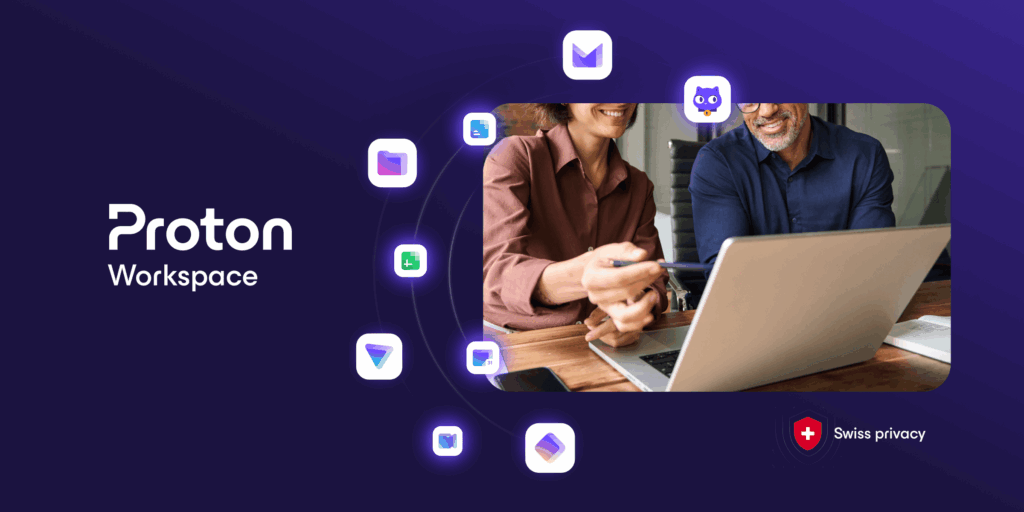
Proton has decided to go beyond its role as a provider of encrypted email and privacy services by launching a more ambitious enterprise suite. The Swiss company has introduced Proton Workspace, a unified offering that combines email, calendar, storage, document editing, spreadsheets, video calls, password manager, VPN, and artificial intelligence assistant, with the explicit goal of competing with Google Workspace and Microsoft 365. Proton asserts that this new proposal responds to growing demand from businesses and the increasing adoption of its entire ecosystem by organizations that no longer seek isolated services but instead want a comprehensive alternative to the dominant platforms of major tech companies.
The new suite is structured around two plans. Workspace Standard includes Proton Mail, Calendar, Drive, Docs, Sheets, Meet, Pass, and VPN, priced at €14.99 per month or €12.99 per user per month with annual billing. Workspace Premium adds more storage, email retention policies, a higher number of participants in Proton Meet, and access to Lumo AI, the company’s AI assistant, for €24.99 per month or €19.99 per user per month with an annual subscription. Proton has also confirmed that current Proton Business Suite customers will be transitioned to Workspace Standard at no additional cost, and Proton Meet will be included in that update.
Proton’s marketing message primarily emphasizes privacy. The company emphasizes that Workspace has been designed with end-to-end encryption and zero-access encryption, meaning, according to their own claims, that neither the company nor anyone else can access the content of encrypted customer data. Proton also highlights that this architecture prevents the use of these data for training AI models and presents Lumo as a “privacy-first” AI assistant whose stored chats are also protected under the same approach. This argument is especially relevant amid a context where many European companies are reviewing how much they want their corporate information to depend on platforms that, directly or indirectly, may exploit data and metadata to improve other services.
Complementing this privacy promise is a discourse on technological sovereignty. Proton stresses that it operates from Switzerland, is not an American company, and therefore is not subject to the same legal exposure as major U.S.-based enterprise software providers. The company also highlights that its applications are open source, undergo external audits, and hold certifications such as ISO 27001 and SOC 2 Type II. Additionally, Proton claims that Workspace can help simplify compliance with regulatory frameworks such as GDPR, HIPAA, and CCPA, though this should be understood as support for compliance rather than an automatic guarantee of conformity by itself.
For a tech outlet, however, the interesting point is not just the encryption. What matters is that Proton attempts to occupy a space that has been relatively underserved: a fairly complete enterprise suite with an integrated experience and a strong narrative around privacy, but without relying on Google’s business model or Microsoft’s traditional approach. The inclusion of Proton Meet as a new videoconference service reinforces this ambition. Proton presents it as a secure collaboration tool, while Workspace aims to transform this catalog of scattered services into a coherent working environment for companies seeking to reduce their exposure to U.S. hyperscalers.
The challenge, however, is significant. Competing with Google Workspace and Microsoft 365 is not just about offering encryption and better headlines on privacy. It also requires functional maturity, integrations, compatibility with existing workflows, enterprise support, genuine team adoption, and an everyday experience capable of replacing long-standing habits. Proton starts with clear advantages in image, security, and European positioning, but still needs to demonstrate it can compete at the same level in productivity, mass collaboration, and ecosystem around its platform. Having over 100 million users and more than 100,000 companies already using its services provides a strong starting point, but turning that user base into a dominant corporate alternative is another story.
In this debate, David Carrero, co-founder of Stackscale (Aire Group), views it positively that European alternatives to Google Workspace and Microsoft 365 are emerging, especially as privacy, digital sovereignty, and geopolitics weigh increasingly on technological decisions. But he also introduces an important nuance: in his opinion, Europe should not merely replace one dependency with another—even if the new provider is within the continent. Carrero advocates for a stronger push toward self-hosted open source solutions, so companies can deploy their own email and workspace with real capacity to move workloads and data when necessary, without being tied to a single corporation that might change pricing, strategy, or service conditions in the future.
This point is especially relevant because Proton Workspace could be very attractive for organizations wanting to step outside the Google and Microsoft environments without sacrificing an integrated experience. But true sovereignty depends not only on the country where the provider is domiciled, but also on how much technical control the client company has over its infrastructure, data, and migration capabilities. Proton has launched a serious, coherent proposal aligned with its identity. The fundamental question is whether the European market will settle for a more private alternative—or if it will ultimately demand even greater freedom of movement than any closed suite can offer, even when marketed as privacy advocates.
Frequently Asked Questions
What exactly does Proton Workspace include?
It includes Mail, Calendar, Drive, Docs, Sheets, Meet, Proton Pass, and Proton VPN in its Standard plan, while Premium adds more storage, email retention options, more participants in Meet, and access to Lumo AI.
How much does Proton Workspace cost for businesses?
Workspace Standard is €14.99 per month or €12.99 per user per month with annual billing. Workspace Premium is €24.99 per month or €19.99 per user per month on an annual subscription.
Can Proton use business data to train AI?
According to the company, no. Proton asserts that its encryption and zero-access encryption model prevent access to encrypted content and its use for model training.
Does Proton Workspace automatically ensure GDPR or HIPAA compliance?
Not automatically. Proton states that its platform is designed to help with frameworks like GDPR, HIPAA, and CCPA, and holds ISO 27001 and SOC 2 Type II certifications, but final compliance depends also on configuration, processes, and how each organization uses it.
via: Proton Workspace
