
Memory is becoming one of the most critical bottlenecks in the new AI investment boom, and major tech companies no longer seem willing to leave their supply chains at the mercy of quarterly market fluctuations. Several media outlets and industry sources in South Korea report that Microsoft and Google are negotiating long-term supply agreements with SK hynix to secure volume of DRAM in the coming years. This move is unusual given that DRAM has traditionally been characterized by cyclical price volatility. For now, neither company has officially confirmed this information, so it should be read as a market development reported by South Korean press, not as an already signed contract.
Nevertheless, the rumor fits perfectly with the current industry context. SK hynix closed 2025 with record revenues of 97.1467 trillion won and record operating profit of 47.2063 trillion, driven by strong demand for AI memory and high-value products like HBM. The company explained in its financial results that, besides the boom in HBM, demand for conventional memory for servers also increased significantly, and that the role of all memory— not just HBM, but also server DRAM and NAND— will become increasingly critical as AI shifts from training to inference and more distributed architectures.
This context helps explain why Microsoft and Google might have an interest in changing the game. For years, major memory buyers preferred shorter contracts or opportunistic purchases, mainly because DRAM is one of the most cyclical markets in the semiconductor sector. But the explosion of AI infrastructure is disrupting that balance. TrendForce already warned in January that Samsung and SK hynix had entered a market clearly dominated by sellers, with sharp increases in server DRAM prices and tighter supply, as priority is given to HBM and AI memory.
This shift makes sense: for a hyperscaler, running out of memory today could be more critical than paying a high price. Building AI clusters, the growth of DDR5 servers, expansion of proprietary ASICs, and competition for HBM are pushing cloud giants to secure capacity ahead of time. SK hynix itself acknowledges that, looking ahead to 2026, HBM3E will continue leading growth, but mainstream server DRAM for DDR5 will become a major pillar of the business alongside HBM.
Interestingly, the reported agreement would not necessarily be limited to HBM. Market sources indicate that discussions with Microsoft focus on DDR5 for servers, while talks with Google extend to both HBM and conventional DRAM for data centers. If confirmed, this would suggest that the memory market is beginning to resemble less a spot or quarterly market and more a strategic capacity industry, where guaranteed volume is almost as valuable as the technology itself.
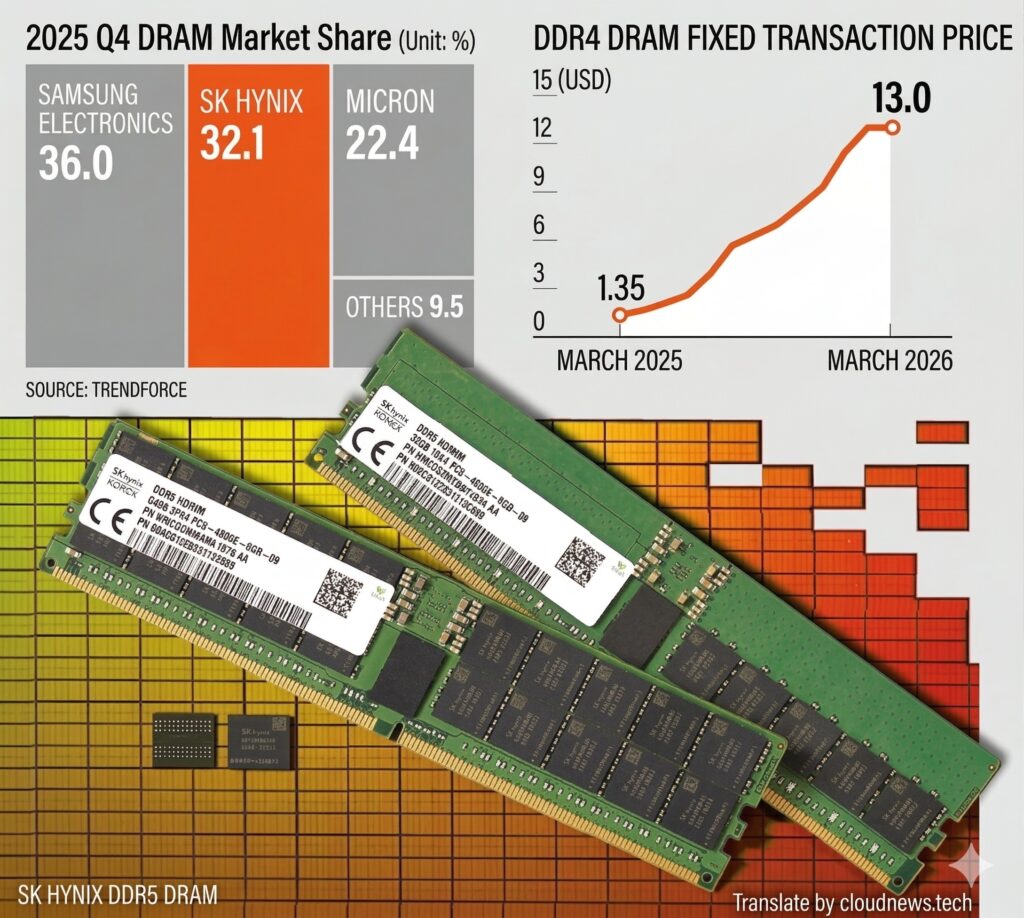
Additionally, SK hynix is positioning itself precisely for this scenario. In its annual results, the company stated it plans to prioritize customer demand in a period of supply-demand imbalance, strengthen alliances, and accelerate capacity expansion at its M15X plant in Cheongju. It also aims to advance its medium- and long-term capacity plans with the construction of the company’s first factory in the Yongin cluster. The company emphasized that it will continue to accelerate the transition to its 1c node in DRAM and expand its AI memory portfolio with products like SOCAMM2 and GDDR7.
It’s no coincidence that Google and Microsoft appear so close to this story. In February, South Korean media revealed meetings between SK Group Chairman Chey Tae-won and Satya Nadella and Sundar Pichai, where discussions covered memory collaboration, AI infrastructure, and potential investments. Although these meetings did not translate into signed contracts, they indicate that the relationship between hyperscalers and the South Korean manufacturer goes well beyond routine component procurement.
All of this leads to a fairly clear conclusion: the memory market is shifting away from a traditional supply-demand cycle and starting to resemble a strategic capacity reserve in the era of AI. If Microsoft and Google do end up signing multi-year LTAs with SK hynix, it will be more than just a commercial victory for the Korean manufacturer. It will also signal that hyperscalers have adopted the view that, by 2026, ensuring volume is more important than chasing prices. This fundamentally changes how the global DRAM business is interpreted.
What would it mean for the market if this is confirmed
If these agreements materialize, the impact could go well beyond SK hynix. First, because they would reinforce the idea that server DRAM is no longer solely purchased opportunistically, but also through multi-year supply contracts. Second, because they would give even more visibility to Samsung and Micron to pursue similar strategies. And third, because they would solidify a trend already observable in industry comments: part of the memory market is moving closer to capacity reservation rather than the classic boom-and-bust cycle.
In other words, AI has not only driven up the demand for GPUs but is also forcing a rethink of how big tech companies buy memory— a component once treated almost like a commodity, now starting to behave like critical infrastructure.
Frequently Asked Questions
Have Microsoft and Google already signed these agreements with SK hynix?
No official confirmation has been publicly announced by the companies. What exists for now are market rumors and South Korean economic media reports indicating that advanced negotiations are underway for long-term supply contracts.
Why would a DRAM LTA be important now?
Because the memory supply is under intense pressure from AI data center demand, HBM, and DDR5 server memory. In this context, securing volume for several years could be more crucial for a hyperscaler than trying to buy at the lowest price each quarter.
What has SK hynix officially said about the market?
The company has confirmed a strong increase in demand for server memory, record results in 2025, and plans to prioritize customer demand and expand manufacturing capacity amid supply-demand imbalance.
Does the AI boom only benefit HBM?
No. SK hynix states that, besides HBM, the importance of server DRAM and NAND for data centers will also grow, especially as AI shifts from training to inference and more distributed architectures.
