
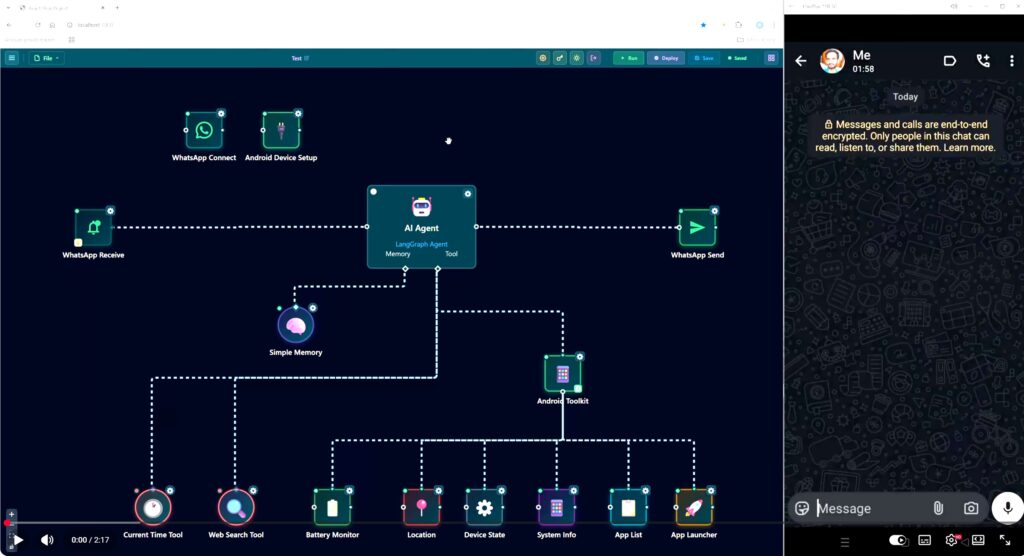
The idea of an AI personal assistant is no longer limited to a cloud chat window. MachinaOS, an open-source project published on GitHub, proposes something more ambitious: a self-hosted platform to create assistants and “co-employees” powered by AI capable of executing workflows, using tools, recalling context, coordinating with each other, and connecting to services like email, calendar, WhatsApp, or Android devices. The repository itself describes it as a blend between n8n and OpenClaw, offering greater visibility into what the assistant does and more control over its capabilities.
The project arrives at a time when increasingly technical users want to reduce reliance on closed assistants and move some of that intelligence onto their own infrastructure. According to the official documentation, MachinaOS can run locally, support models from multiple providers, and leverage conversational memory, tool calls, and reasoning modes. This positions it closer to an AI-powered automation platform with persistent capabilities rather than a simple desktop chatbot.
A visual panel to build truly functional assistants
One of MachinaOS’s main attractions is that it doesn’t present itself solely as a developer tool. The official documentation describes it as a visual, node-based automation platform built with React Flow on the frontend and FastAPI on the backend, with real-time execution via WebSocket. Practically, this means users can design workflows, chain services, and observe execution without relying solely on scripts or manual coding.
The documentation mentions 60 nodes and an architecture aimed at real automation: AI, skills, WhatsApp, Android, documents, webhooks, and task scheduling. It also states that the recommended deployment uses Docker Compose with four containers and an Nginx reverse proxy, plus Redis in production or SQLite in development as a persistence layer. This makes clear that MachinaOS aims to be more than a flashy demo—it’s a solid foundation for operating persistent assistants on your own infrastructure.
More than just a chatbot: memory, tools, and agent teams
The project aspires to stand out through its broad capabilities. On GitHub, MachinaOS claims to support creating assistants that remember conversations, use tools, and work collaboratively. Its documentation specifies compatibility with multiple AI providers, agent with tool calling, simple conversational memory, long-term vector storage, and a workflow and automation system that resembles platforms like n8n.
Within that scope, a particularly notable feature is the construction of agent teams. The README describes a model with an “AI Employee” or orchestrator that delegates tasks to specialized agents—for example, code, web, or task agents—and automatically exposes delegate_to_* tools. The official docs emphasize the idea of agents with skills and collaboration, although the multi-agent system remains in active development. Nonetheless, the vision is clear: not just chatting with an AI, but organizing multiple capabilities within a unified system.
Google Workspace, WhatsApp, Android, and documents
Where MachinaOS seeks to differentiate itself is in connecting to the real world. The repository promises automation with Google Workspace—email, calendar, Drive, spreadsheets, tasks, contacts—sending messages via WhatsApp, Telegram, and X (Twitter), and even controlling Android devices for aspects like WiFi, Bluetooth, camera, apps, and device status. Public documentation confirms many of these functionalities, especially WhatsApp, Android, webhooks, HTTP, and executing Python code within workflows.
It also mentions document and web processing: scraping, using actors from Apify, PDF analysis, and file search with AI. It’s important to note that just because a project offers these capabilities doesn’t mean they are all equally mature or ready for intensive production use. With young repositories, the README often presents an optimistic overview, while actual documentation is more reflective of the current operational state. In MachinaOS’s case, the available documentation confirms a solid functional base but makes clear that it remains a work in progress.
Quick installation, but not entirely trivial
MachinaOS attempts to lower the entry barrier with a fairly straightforward setup. The repository specifies Node.js 22+ and Python 3.12+ as prerequisites, and offers three main installation methods: global install with npm install -g machinaos, a one-line installer for Linux/macOS or PowerShell, and deployment for developers by cloning the repo and running npm run build and npm run start. Initial access is via http://localhost:3000.
However, for sysadmins or skilled users, it’s worth being clear: while initial setup seems simple, this isn’t a “frictionless” SaaS-style app. It requires modern dependencies, some familiarity with Node/Python environments, and, if deploying in production, a more structured deployment with Docker Compose, proxies, and persistence layers. In other words, technically inclined users will find it accessible, but it’s still far from a plug-and-play tool for general users.
The most exciting part of MachinaOS is where it’s headed
The project doesn’t yet feel like a fully mature, closed product, but it clearly reflects a trend: a self-hosted, persistent, extendable personal assistant connected to real tools. Unlike commercial assistants, MachinaOS emphasizes control over infrastructure, visual orchestration, and the possibility to set up a personal environment where data, memory, and logic are kept within the user’s own infrastructure. The documentation highlights that it’s designed for self-hosting, keeping data on the user’s hardware.
This doesn’t automatically mean MachinaOS is the “army of artificial employees” some promotional messages suggest. But it is among the most interesting projects in this new wave of open assistants aiming to go beyond chat and into operational automation. If it stabilizes its technical foundation and matures its multi-agent model, it could become a significant component within the ecosystem of self-hosted AI for personal and enterprise use.
Frequently Asked Questions
What exactly is MachinaOS?
An open-source platform to create personal assistants and AI agents using visual workflows, memory, tools, and external service connections, designed to run on your own infrastructure.
Does MachinaOS only work with cloud models?
No. The repository mentions multiple providers, and the documentation indicates support for various models and AI modes, though specific configurations depend on user setup and integrations.
Can it be used with WhatsApp and Android?
Yes. The official docs include dedicated sections for automation with WhatsApp and Android device control, among other external services.
Is it ready for any company to use?
Still with some caveats. The project offers a very promising base, but remains a growing platform that requires a certain technical level to install, maintain, and deploy in production.
