

Cloudflare has introduced EmDash, an open-source CMS that it describes as the “spiritual successor” to WordPress. The proposal is significant: rethinking much of the logic behind a traditional content management system from scratch to adapt to an Internet dominated by serverless deployments, TypeScript development, native HTTP payments, and AI agent automation. The company already offers it as a preview v0.1.0 and publishes it under the MIT license, with a promise that it does not reuse WordPress code.
This move carries a clear message. Cloudflare doesn’t question the historical importance of WordPress, but argues that its architecture carries limitations that are hard to overcome—especially in plugin security, modern deployment, and developer experience, which now align more with Astro, Node.js, or TypeScript than PHP. EmDash aims to fill that gap: maintaining the ambition of an open, easily adoptable CMS but with a completely different technical foundation.
It’s a noteworthy idea in market terms. WordPress remains, by far, the most used CMS worldwide: according to W3Techs, it powers 42.5% of all websites and accounts for 59.8% of sites with an identifiable CMS. Any serious attempt to build a modern alternative thus starts from an ecosystem that continues to dominate online publishing worldwide.
Plugin Security at the Core of the Initiative
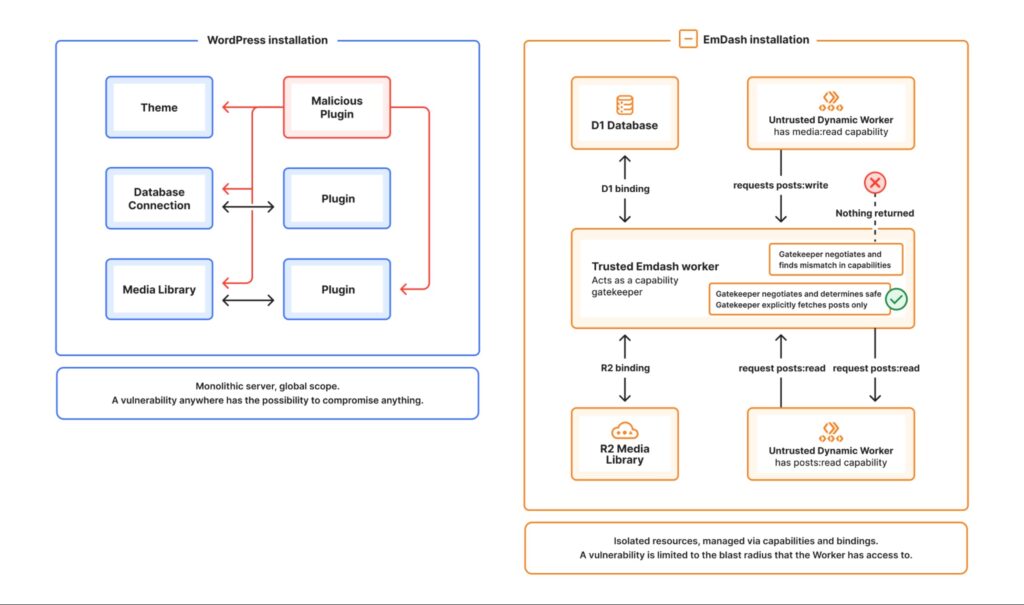
The core emphasis of the announcement is security. Cloudflare argues that the traditional WordPress plugin model is structurally weak because plugins run with broad system access—covering the database, system files, and more. This criticism isn’t unfounded: the “State of WordPress Security 2024” report by Patchstack identified 7,966 new vulnerabilities in the WordPress ecosystem during 2024, with 96% of those in plugins, while only a small fraction affected the core.
Building on that, EmDash proposes a different approach. Instead of running extensions within the same context as the CMS, each plugin runs in an isolated environment via Dynamic Workers, with permissions explicitly declared in its manifest. The idea is that the plugin can only access the capabilities it requests and that the administrator approves—similar to a permissioned model rather than full trust. Cloudflare presents this as a way to reduce the risk of plugins compromising the entire site. It’s an interesting proposal, though we’ll need to see how it performs once the project leaves beta and is tested with large ecosystems, complex plugins, and less technical administrators.
There’s also a political and economic dimension here. Cloudflare argues that improving plugin security could lessen reliance on centralized marketplaces and give developers more freedom in choosing licenses and distribution channels. For EmDash, the platform is released under the MIT license, allowing plugin authors to select their own licensing. This is not a minor detail, considering that WordPress is often at the center of debates around GPL, compatibility, and dependence on the official ecosystem.
A Modern CMS and Strategic Showcase for Cloudflare
EmDash is built in TypeScript, uses Astro for themes and frontend, and is designed as serverless. However, Cloudflare emphasizes that it can also run on any Node.js server or even on dedicated hardware. In practice, its architecture aligns closely with Cloudflare’s vision: Workers, isolates, Workerd, Cloudflare for Platforms, and a “scale to zero” approach that the company has promoted as a competitive advantage over traditional hosting.
This makes EmDash more than just a new CMS. It’s also a technological demonstration of where Cloudflare wants to steer modern web development: distributed apps, isolated execution, global deployment, low inactive infrastructure costs, and an extensibility layer designed to integrate with AI and automation. While EmDash can run outside of Cloudflare, its entire approach is closely aligned with the company’s operational model.
Additionally, it features a particularly notable component: native integration with x402, the open payment standard over HTTP driven by the x402 Foundation—created by Cloudflare and Coinbase in 2025. EmDash includes support for monetizing content access without traditional subscriptions, using HTTP 402 Payment Required as the basis for on-demand payments. Theoretically, it aims to facilitate scenarios where automated agents and machine-to-machine clients pay for specific resources. Journalistically, this is one of the most innovative aspects of the launch—though its real-world adoption remains speculative in the short term.
Native AI, Passkeys, and Migration from WordPress
Cloudflare’s announcement isn’t limited to security. EmDash is also presented as a “native AI CMS,” with its own CLI, integrated MCP server, and tools enabling agents to automate administrative tasks, migration, and customization. The company even suggests that the CMS includes “skills” to help port legacy WordPress themes or create new extensions. This aligns with current trends of exposing context and actions to AI assistants and agents, though whether this translates into real productivity or operational complexity remains to be seen.
Regarding access security, EmDash defaults to passkeys, foregoing traditional passwords, while also supporting SSO providers. For migration, it offers import from WordPress via WXR files or a dedicated export plugin. Cloudflare claims that the migration process can transfer multimedia content and custom content types into EmDash’s native collections. These features are critical because, without a straightforward migration path, any alternative to WordPress faces a significant barrier.
That said, it’s important to keep in mind the project’s current stage. EmDash is still early preview—no mature platform capable of seamlessly replacing WordPress in general-purpose production environments. Its vision is more ambitious than immediate: to showcase what an open CMS could look like today, with priorities differing from those of 2003. The ambition might appeal to modern developers, hosting platforms, and projects eager to move away from PHP and traditional WordPress architecture. However, much work remains to determine if it can evolve beyond an appealing promise within Cloudflare’s ecosystem.
Frequently Asked Questions
What is EmDash and who launched it?
EmDash is an open-source CMS introduced by Cloudflare as a “spiritual successor” to WordPress. It’s built in TypeScript, uses Astro for themes, and is currently in preview v0.1.0.
How does EmDash differ from WordPress?
The main difference lies in its architecture: isolated plugins in sandboxes, a serverless approach, Astro-based themes, passkey authentication, and tools designed for AI agents, CLI, and MCP.
Why is Cloudflare emphasizing plugin security?
Because the launch addresses a real weakness in the WordPress ecosystem: Patchstack reported 7,966 new vulnerabilities in 2024, with 96% in plugins. EmDash responds with permission-based isolation and separate execution.
Can EmDash replace WordPress in production now?
It’s too early to say. Cloudflare offers it as an early beta and a modern foundation for experimentation, migration, and building, but it needs to prove its maturity, ecosystem, and stability before competing with WordPress in large deployments.
