
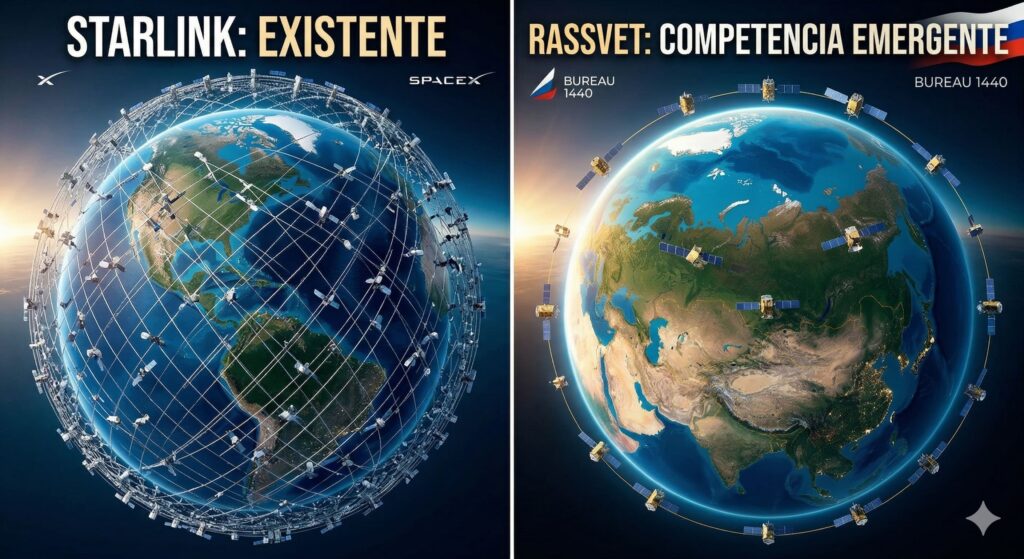
Russia has taken its first serious operational step into the next-generation satellite internet business. Bureau 1440, the company developing the Rassvet constellation, launched its first batch of 16 operational satellites into low Earth orbit on March 23, in a mission that the company described as a leap from the experimental phase to building a communications service. Until now, only six test satellites had been placed in two previous campaigns.
This move does not yet make Bureau 1440 a real rival to Starlink, but it confirms Moscow’s intent to develop its own alternative in an increasingly sensitive area: connectivity for remote regions, transportation, aviation, critical networks, and industrial sectors. The comparison with SpaceX highlights the scale of the challenge: Reuters notes that Starlink already exceeds 10,000 satellites in orbit, while Rassvet is only now entering its operational phase.
What Bureau 1440 has launched and its technical promises
The significance of the project is not just the number of satellites, but their architecture. Bureau 1440 claims its satellites operate as 5G base stations in orbit, incorporate laser links between satellites, and are designed to deliver up to 1 Gbps with latency under 70 milliseconds. The company also asserts that its network will support not only fixed terminals but also cars, ships, trains, and aircraft. In May 2024, it announced it had conducted its first communication session with a proprietary 5G NTN terminal and laser link tests between satellites at 10 Gbps.
The timeline remains demanding. The Moscow Times and other media following the project indicate that the launch should have occurred by late 2025. Russia aims to surpass 250 satellites by 2027 and 900 by 2035. They also point to a mixed financial backing—public funds and private capital—within the Russian national data economy program. This positions Rassvet closer to a strategic state project than to a simple space startup.
Comparison: how does Rassvet stack up against Starlink, Kuiper, and other networks
At this point, referring to “the Russian Starlink” is a journalistic shortcut, but it simplifies the market greatly. Today, several different models coexist: LEO broadband constellations for enterprise and consumers, hybrid GEO+LEO networks, ongoing deployment projects, and direct-to-device systems that don’t compete exactly for the same use cases. The following table summarizes the status as of March 2026.
| Project / Company | Network Type | Status as of March 2026 | Scale / Roadmap | Main Focus |
|---|---|---|---|---|
| Bureau 1440 / Rassvet | LEO | First batch of 16 operational satellites launched; previously 6 test satellites | 250+ satellites planned for 2027; 900+ for 2035 | Russian satellite broadband for industry, transportation, utilities, and remote connectivity |
| Starlink / SpaceX | LEO | Fully operational commercial network | Over 10,000 satellites in orbit | Consumer, mobility, maritime, aviation, enterprise, and defense |
| Amazon Leo (formerly Project Kuiper) | LEO | Constellation under deployment | Over 3,000 satellites; deployment started April 2025 | Global low-latency broadband |
| Eutelsat OneWeb | LEO + GEO integration | Network deployed and operational | LEO constellation of 600+ satellites; Eutelsat has ordered an additional 440 for continuity | Government, enterprise, telecom, maritime, aviation, critical environments |
| Telesat Lightspeed | LEO | Not yet commercial | First production satellites expected December 2026 | Enterprise, government, defense, and digital sovereignty |
| AST SpaceMobile | LEO (direct-to-device) | First BlueBird commercial satellites launched; new generation deploying during 2025-2026 | Network designed to connect regular mobile phones via satellite | Mobile voice and data directly to smartphones, more than fixed broadband |
| Lynk Global | LEO (direct-to-device) | Commercial service authorized in parts of the U.S. and with operator agreements | Partnerships with dozens of mobile operators in around 60 countries | Messaging, voice, and data from satellites to standard mobile devices |
The comparison draws on corporate information and recent publications from Bureau 1440, Reuters, Starlink, Amazon, Eutelsat, Telesat, AST SpaceMobile, and Lynk.
Not everyone is playing the same game
This nuance is key to understanding Russia’s progress. Starlink, Amazon Leo, OneWeb, and Telesat Lightspeed compete more directly in satellite broadband connectivity, albeit with different approaches. Starlink currently leads in scale and deployment speed; OneWeb targets enterprise, government, mobility, and telecoms; Amazon continues building its constellation; and Telesat aims for a network focused on sovereignty, defense, and corporate clients.
Meanwhile, AST SpaceMobile and Lynk represent another technological family. Their bet is less about replacing fixed connections or dedicated terminals, and more about delivering voice, messaging, and data to normal mobile phones without specialized satellite hardware. These are also strategic networks, but they don’t exactly serve as domestic broadband alternatives like Rassvet or Starlink. That’s why Rassvet makes more sense when compared to comprehensive LEO connectivity constellations rather than just direct-to-device segments.
What this launch means for Russia
From a technical perspective, launching 16 satellites doesn’t yet shift the global market balance. Strategically, however, it’s significant. Orbital connectivity has become critical infrastructure for defense, energy, transportation, aviation, mining, and operational continuity. Owning its own constellation is no longer solely a technological aspiration; it’s now a matter of sovereignty. In this arena, Rassvet matters less for what it is today and more for what it aims to prevent tomorrow: dependence on foreign networks for key services.
The question isn’t whether Bureau 1440 can currently compete with Starlink—that’s not the case. The real question is whether Russia can sustain its industrial schedule, launch pace, and investments to turn Rassvet into a useful network before the market becomes even more dominated by SpaceX, Amazon, OneWeb, and other emerging constellations. For now, the March 23 operation makes one thing clear: the global race for orbital internet is no longer a contest between two or three companies, but a much broader landscape where every country is eager to secure at least its own position.
Frequently Asked Questions
How many satellites did Bureau 1440 launch in March 2026?
The company launched 16 operational satellites on March 23, 2026, after previously testing its technology with six experimental satellites.
What speed and latency does Rassvet promise?
Bureau 1440 claims its network is designed to offer up to 1 Gbps and a latency under 70 ms.
When does Rassvet plan to begin commercial operation?
Industry sources suggest commercial start-up by 2027, when the constellation is expected to surpass 250 satellites.
Which companies are most similar to Bureau 1440?
The most comparable in business model are Starlink, Amazon Leo, Eutelsat OneWeb, and, in a earlier phase, Telesat Lightspeed. AST SpaceMobile and Lynk are also in the satellite market but focus more on direct-to-phone connectivity.
