
Neuralink has publicly demonstrated one of its most ambitious advances for the first time: assisted speech restoration in a person with ALS. The company released a video starring Kenneth, a participant in the VOICE clinical trial, showing how a brain-computer interface system converts his intention to speak into synthesized voice. The most striking scene of the video summarizes the moment well: “I’m talking to you with my mind.” But beyond the emotional impact, what truly confirms this case is that Neuralink has now entered the race to restore oral communication for people with severe speech impairments.
The demonstration is valuable, though it’s important to understand it in its proper context. It is not a commercial approval nor a technology ready for mass use, but a preliminary feasibility study. Neuralink defines VOICE as an early-stage study to evaluate the initial clinical safety and preliminary efficacy of its N1 implant and its R1 surgical robot in restoring communication. In other words, progress is being made, but the project remains in the experimental phase.
What Neuralink has actually shown
What Neuralink has demonstrated is not simply a patient moving a cursor to type letter by letter. The company and its trial materials point to something more ambitious: reading neural signals linked to speech production to reconstruct language more naturally. In its January 2026 update, Neuralink explained that the goal of this research line is to restore “real-time speech” by decoding signals from brain regions involved in speech production. The Kenneth video reinforces this idea: transitioning from assisted digital communication to a synthesized voice that more closely resembles normal conversation.
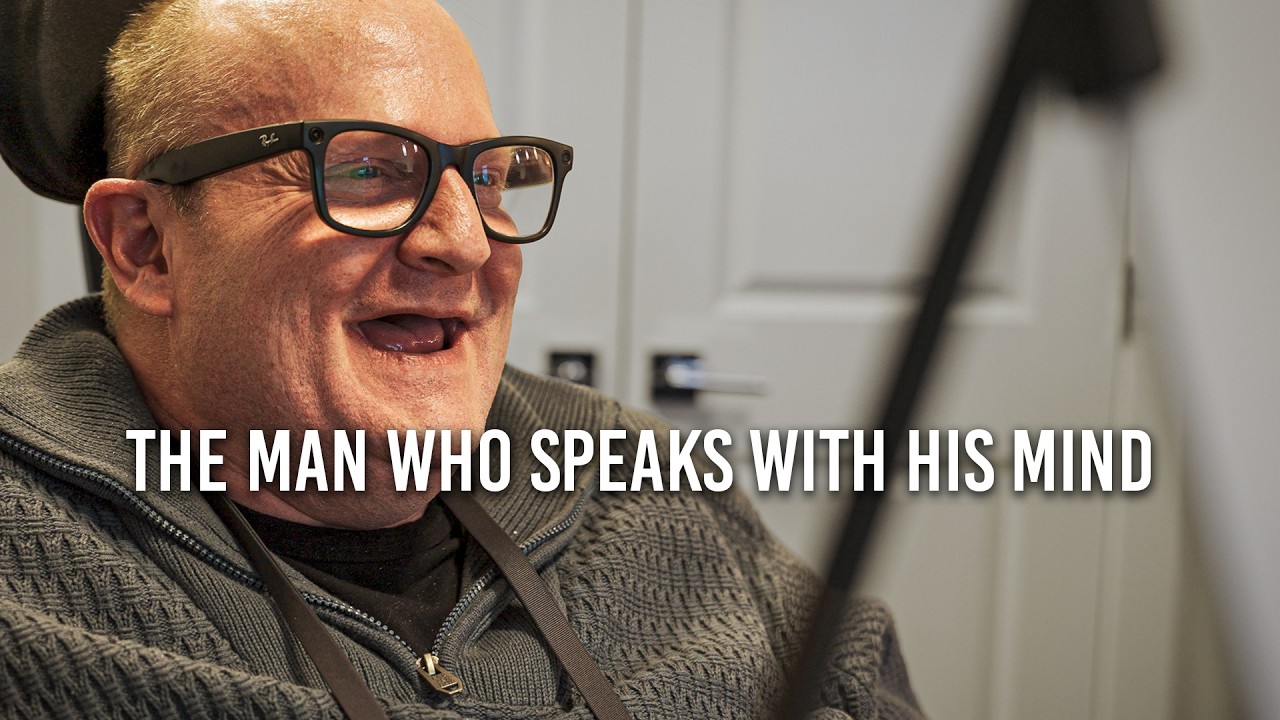
Another important nuance often lost in overly grandiose headlines is that talking about “reading thoughts” is a shortcut. Technically, the goal appears more specific: decoding the intention to silently articulate or move the mouth without producing physical speech. In the video itself, Neuralink’s team explains that Kenneth improves the system when he “utters” mentally and puts more intent into the neural signals. This suggests that the system does not freely read abstract thoughts, but rather decodes patterns linked to speech production.
Another relevant detail is that Neuralink positions Kenneth as the second participant implanted for voice in January 2026. The company does not present this as an isolated or purely anecdotal case but as part of a clinical program gaining experience in this area. Meanwhile, their trial webpage and official study registry make clear that VOICE is aimed at individuals with severe and irreversible speech deterioration caused by neurological conditions, including ALS, stroke, spinal injury, and similar disorders.
What VOICE is and what it still doesn’t mean
VOICE is listed on ClinicalTrials.gov as an early feasibility study to evaluate the initial safety and efficacy of the N1 + R1 concept in restoring communication. The registry notes that the implant is intended for adults with severe and irreversible speech impairments from neurological disruptions of the central speech pathways and with functional deterioration of upper limbs. This is a crucial definition because it situates the trial within the real clinical and regulatory landscape, far from the idea of a fully developed product.
The “Breakthrough Device” designation granted by the FDA to Neuralink in May 2025 for speech restoration should also be interpreted carefully. It’s a positive sign because it accelerates development and review, but it does not equate to commercial approval. The FDA explains that the program aims to faster access for promising technologies while maintaining the required safety and efficacy standards for potential approval. Moreover, the agency emphasizes that participation in this program does not alter the legal requirements for medical device approval.
In other words: Neuralink has achieved a very visible clinical and communicative milestone, but has not yet definitively proven that its system will work reliably, stably, and broadly in a large number of patients over the long term. In neurotechnology, the step from promising demonstration to validated tool is usually lengthy. Therefore, this announcement should be seen as an important advance, not as an already accomplished goal.
Neuralink is not starting from zero in a pre-existing race
Another critical point for understanding the news is that Neuralink did not inaugurate this field from scratch. In August 2024, a study published in The New England Journal of Medicine showed a fast and accurate brain-computer interface capable of restoring communication in a person with ALS. That same summer, UC Davis publicly explained its system could interpret brain signals associated with speech attempts and convert them into text that the computer then “said” aloud. Later, in 2025, teams from UC Berkeley and UC San Francisco presented a neuroprosthesis capable of restoring more natural voice in real time.
This context does not diminish Neuralink’s achievement but helps place it where it belongs. Elon Musk’s company’s value is less about inventing speech restoration entirely on its own and more about trying to industrialize it with its own implant, surgical robot, and clinical program seeking to scale. If Neuralink manages to combine rapid deployment, hardware miniaturization, and consistent clinical results, it could become a key player in the field. But for now, what it has shown is a solid promise in the trial phase, not a definitive solution.
Nevertheless, the human impact of Kenneth’s case is significant. In conditions like ALS, losing the voice means much more than simply stopping speech: it entails losing autonomy, spontaneity, and a central part of relationships with others. If Neuralink and similar projects succeed in enabling a person to communicate more fluidly, comfortably, and personally, the improvement will not only be technological but profoundly vital. That’s why this announcement matters—not because it closes the debate, but because it shows that a once science-fiction idea is now beginning to take a visible clinical shape.
Frequently Asked Questions
What is Neuralink’s VOICE trial?
A preliminary feasibility study to evaluate the initial clinical safety and preliminary efficacy of Neuralink’s N1 implant and R1 robot in restoring communication for individuals with severe and irreversible speech impairments.
Has Neuralink already enabled someone to speak naturally again?
It has shown an experimental case where a participant with ALS can generate synthesized voice from brain signals related to the intention to speak. It’s a meaningful advance, but it remains within a clinical trial and does not yet represent a commercial or fully validated solution.
Does the FDA’s “Breakthrough Device” designation mean the device is approved?
No. While it accelerates development and review, the FDA still requires safety and efficacy standards to be met before potential commercial approval.
Is Neuralink the only company or group working on speech restoration via brain interfaces?
No. In 2024 and 2025, several academic and clinical teams announced significant progress in restoring speech and synthesizing voice from brain signals in patients with ALS and severe paralysis.
