
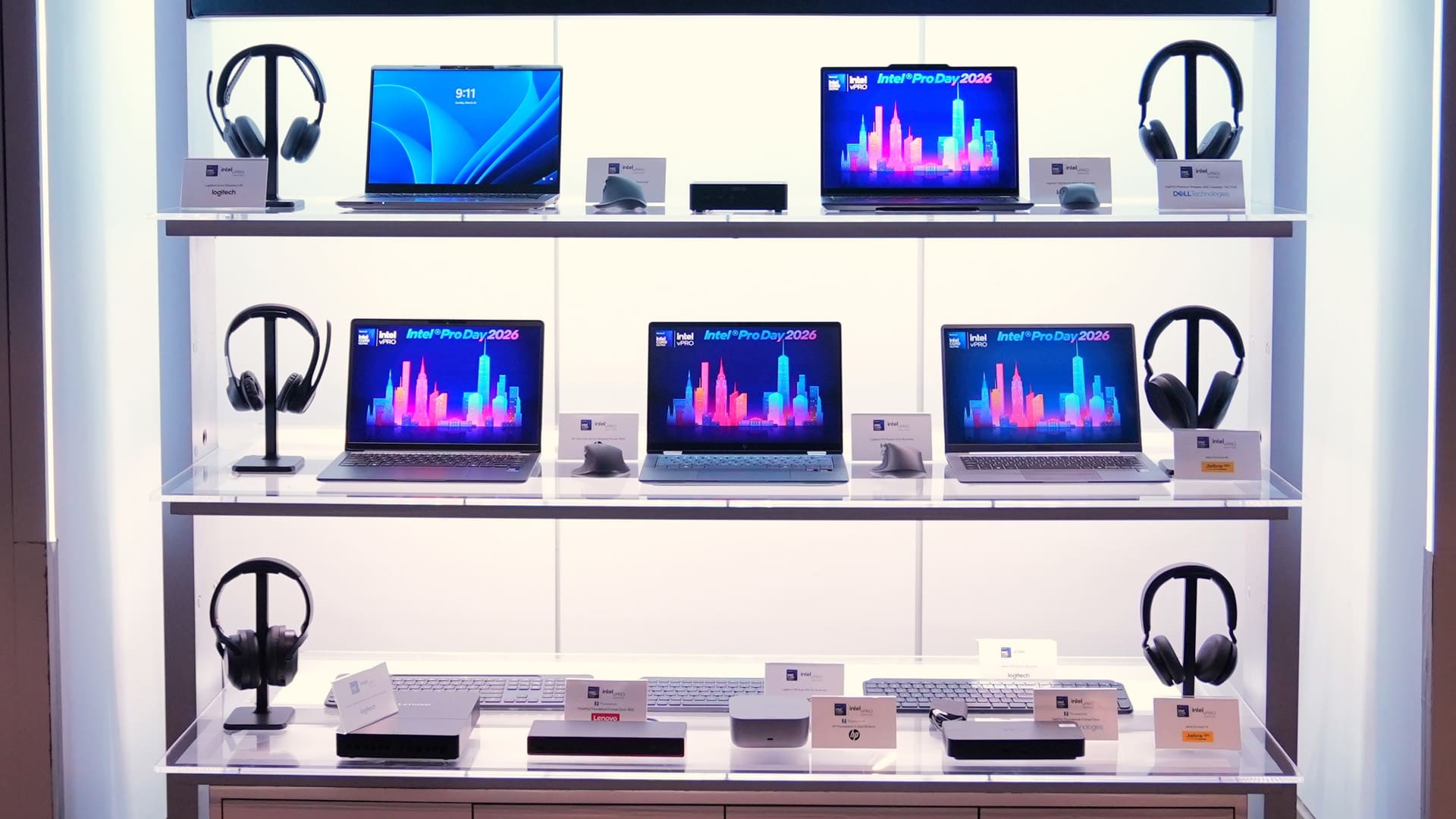
Lenovo leveraged the NVIDIA GTC 2026 showcase to make moves on two increasingly important fronts in professional PCs: local Artificial Intelligence and autonomy. The company announced a new generation of ThinkPad and ThinkStation workstations aimed at design, engineering, data science, and model development, alongside showcasing a testing phase battery that, if commercialized, could become one of the most exciting innovations in professional laptops in the years to come.
The announcement blends several ideas that have been gaining ground in the industry for some time. On one side, the need to run inference, AI generation, and assisted tasks directly on the device without always relying on the cloud. On the other, the pressure to deliver more performance in mobile setups without increasing size, weight, or power consumption. Lenovo aims to address both with a new family of P Series workstations and the ED1000, a silicon anode battery prototype claimed to have a density of 1,000 Wh/L.
More Local AI in Professional Laptops and Desktops
The new lineup includes the ThinkPad P14s Gen 7, ThinkPad P16s Gen 5, ThinkPad P1 Gen 9, and the ThinkStation P5 Gen 2 tower, with configurations available in Intel and AMD versions. Overall, Lenovo offers a range from lightweight mobile stations for students, technicians, and professionals on the go, to a desktop clearly designed for heavy CAD workloads, rendering, medical imaging, simulation, or model development. The core message is clear: bringing AI “where the professional works,” not just to the data center.
In mobile form, Lenovo positions the ThinkPad P14s Gen 7 as its lightest AI-ready workstation, equipped with Intel Core Ultra Series 3 with vPro or AMD Ryzen AI PRO 400 Series processors, depending on the version, and with NVIDIA RTX PRO Blackwell mobile GPUs in certain configurations. The ThinkPad P16s Gen 5 extends this approach to a 16-inch format for users needing more thermal headroom and professional viewing. Meanwhile, the ThinkPad P1 Gen 9 targets a higher tier: up to 16 cores, dedicated RTX PRO Blackwell GPU, and up to 672 TOPS total compute power, according to Lenovo.
On the desktop side, the ThinkStation P5 Gen 2 is the most ambitious product in this launch. Lenovo pairs it with Intel Xeon 600-series processors for workstations and up to two NVIDIA RTX PRO 6000 Blackwell Max-Q Workstation Edition GPUs. This setup is designed for intensive computation, advanced visualization, and local AI development. NVIDIA confirmed during GTC 2026 that Lenovo, Dell, and HP are launching new workstations based on RTX PRO Blackwell specifically for design, simulation, and agent development workflows.
The broader context here is key. Until recently, talking about AI in workstations almost always meant cloud connectivity or relying on external clusters. Lenovo wants to promote the idea that a growing portion of professional work — from inference and model iteration to automation in design tasks — can now be done locally, with lower latency, better data control, and less dependency on connectivity. This isn’t a complete break with cloud computing but an effort to strengthen the hybrid approach the sector has been promoting for months.
Security, Repairability, and Autonomous Agents
Lenovo also emphasizes security and maintenance, which remain crucial in the corporate market. The company highlights the ThinkShield layer, offering BIOS protections, secure erase, and privacy controls, along with certifications like EPEAT Gold, ENERGY STAR 9.0, TCO Certified 10.0, and MIL-STD-810H for its mobile stations. Additionally, they mention a more repairable design, featuring more user-replaceable components and options for memory and storage upgrades.
An interesting detail is support for NVIDIA OpenShell and NemoClaw, parts of NVIDIA’s new open ecosystem for deploying autonomous agents with enhanced control and security. OpenShell acts as a governance runtime for agents, while NemoClaw packages open models and tools for always-on assistants with simplified deployment. Lenovo states that some new workstations, including the ThinkStation P5 Gen 2, will be ready to accelerate such environments. While this isn’t the most headline-grabbing aspect of the announcement, it’s one of the most relevant if local agents begin integrating into real enterprise and engineering workflows.
The ED1000 Battery: A More Significant Promise Than It Seems
The second key highlight is the ED1000, a silicon anode battery Lenovo presents as a proof of concept developed alongside Shanghai Jiao Tong University. The company claims it achieves 1,000 Wh/L energy density—a boost of over 10% compared to previous generations—and can deliver up to 99.9 Wh without increasing its physical size. Lenovo describes it as the first battery of this type for laptops and workstations with such density, though it has yet to announce a commercial product or timeline for market availability.
It’s worth tempering promotional language here and considering why that figure matters. The 99.9 Wh number isn’t picked randomly. The FAA and TSA commonly reference a 100 Wh threshold for lithium-ion batteries in passenger electronics—a limit that has shaped high-performance laptop design for years. Staying just below that maximum allows manufacturers to maximize capacity without entering more restrictive airline transport regulations. If Lenovo manages to turn this proof of concept into a reliable commercial battery, it would address one of the main bottlenecks facing modern high-performance portable workstations.
Additionally, silicon anodes have long been regarded as a promising route to overcome the limitations of traditional graphite anodes, since silicon can store more lithium. However, the tech also faces challenges related to degradation, expansion, and cycle life. Lenovo doesn’t detail these issues in its announcement, so for now, the ED1000 should be seen as a technological direction demonstration rather than a finalized product. Still, the fact that a major professional PC brand is exploring this indicates that the race to improve portable autonomy in high-end mobile stations is accelerating.
A Move Toward the Professional Laptop of the Future
Overall, Lenovo is attempting to stand out in a segment where simply offering a powerful CPU and professional GPU is no longer enough. The current battleground involves combining local AI, enterprise-grade security, repairability, energy efficiency, and new battery architectures. The company’s message aligns with market trends: more users seek computing capacity close to the data, more companies want to reduce cloud dependency for sensitive tasks, and more professionals demand durable machines that can handle long workdays without becoming difficult-to-transport bricks.
It remains to be seen how much of this vision translates into actual products and how much remains on the roadmap. The new workstations are expected to be available between April and June 2026, depending on the model. The ED1000 battery, however, is still in an experimental phase. Even so, the overall impression is clear: the future of workstations isn’t just about raw power but how that power becomes portable, efficient, and more useful for local AI workflows.
Frequently Asked Questions
What new professional devices did Lenovo introduce in March 2026?
Lenovo announced the ThinkPad P14s Gen 7, ThinkPad P16s Gen 5, ThinkPad P1 Gen 9, and the ThinkStation P5 Gen 2, with configurations in Intel and AMD, and NVIDIA RTX PRO Blackwell GPUs across several versions.
What does it mean that these workstations are prepared for local AI?
It means they integrate professional CPU, NPU, and GPU components capable of running inference, model training, automation, and AI-assisted creative tasks directly on the device, reducing reliance on cloud processing for certain workflows.
What’s special about the Lenovo ED1000 battery?
It’s a proof-of-concept silicon anode battery with 1,000 Wh/L energy density, offering up to 99.9 Wh capacity without increasing the device size. Lenovo sees this as a development step toward extending autonomy and performance in future high-performance machines.
Why does the 99.9 Wh figure matter in professional laptops?
Because the FAA and TSA set a general limit of 100 Wh for lithium-ion batteries in portable devices carried by passengers. Staying just below allows maximum capacity while minimizing regulatory restrictions during air travel.
via: news.lenovo
