
HPE announced at GTC 2026 a new wave of advancements in its NVIDIA AI Computing by HPE portfolio, aiming to strengthen its position on two fronts that currently account for a significant portion of infrastructure spending: large-scale AI factories and supercomputing focused on mixed AI and HPC workloads. The company unveiled new options for computing, networking, software, and services designed for service providers, sovereign entities, research laboratories, and large enterprises.
The announcement comes at a time when the market no longer seeks only servers with GPUs but complete architectures capable of supporting training, inference, multi-tenancy, governance, and liquid cooling with reasonably mature integration. HPE is responding to this demand by enhancing its HPE AI Factory portfolio with the NVIDIA Vera Rubin and NVIDIA Blackwell platforms, along with new operational and certification features for cloud, sovereign, and research environments.
One of the most notable moves is in supercomputing. HPE announced one of the first blade computing options with NVIDIA Vera CPU for its HPE Cray Supercomputing GX5000 platform. The new HPE Cray GX240 Compute blade can house up to 16 NVIDIA Vera CPUs and scale up to 40 blades per rack, which corresponds to 640 Vera CPUs and over 56,000 Arm cores compatible with NVIDIA Olympus per rack, according to the company. HPE will also add NVIDIA Quantum-X800 InfiniBand to the GX5000, featuring 144-port switches and 800 Gb/s per port, boosting connectivity for large-scale systems.
Vera Rubin NVL72, GPU density, and sovereign AI factories
Separately, HPE confirmed it will offer a NVIDIA Vera Rubin NVL72 by HPE system tailored for large-scale deployments. This rack-scale system combines 36 Vera CPUs, 72 Rubin GPUs, Sixth-generation NVLink, ConnectX-9 SuperNICs, and BlueField-4 DPUs, along with liquid cooling integration and HPE data center design services. Availability is expected by December 2026.
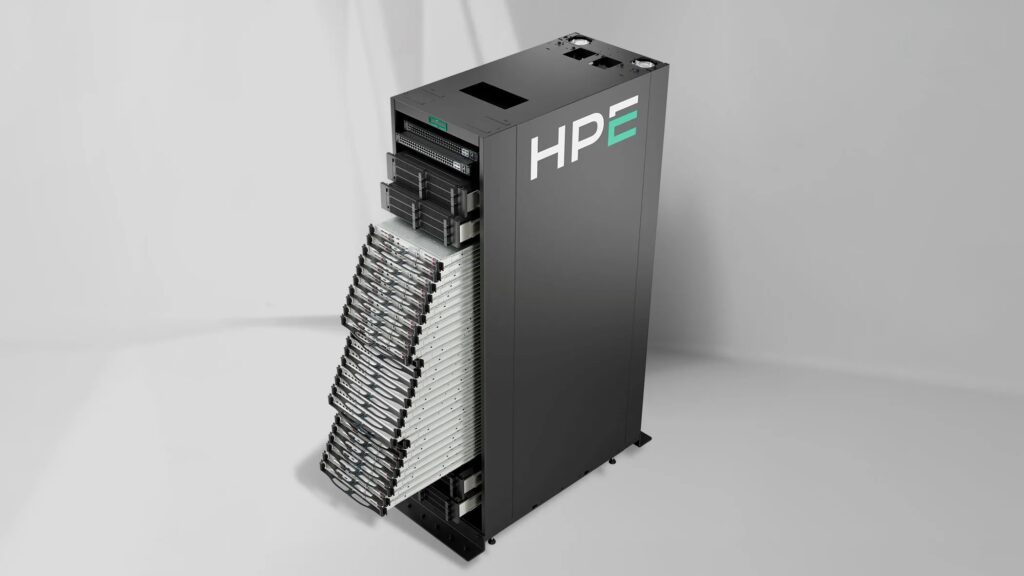
The other major hardware innovation is the HPE Compute XD700, a new AI server inspired by the Open Compute Project and built on NVIDIA HGX Rubin NVL8. HPE states each XD700 rack can host up to 128 Rubin GPUs, doubling GPU density compared to previous generations. This system is aimed at both training and inference, with launch expected in early 2027.
HPE’s commercial messaging emphasizes more than raw performance. The company strongly advocates for AI factories at scale and sovereignty, meaning infrastructures that support not only massive computation but also meet sovereignty requirements, secure resource sharing, and multi-tenant operation. To that end, HPE announced support for multi-tenancy via NVIDIA Multi-Instance GPU (MIG), with options for GPU pass-through to virtual machines and secure namespaces over Kubernetes managed with SUSE Virtualization and SUSE Rancher Prime Suite. This capability is expected in spring 2026.
HPE highlighted that its HPE AI Factory portfolio is ready for validation under the NVIDIA Cloud Partner program, which could facilitate cloud provider certification for deploying these architectures with NVIDIA approval. Additionally, the company will integrate NVIDIA Mission Control into its large-scale and sovereign AI Factory environments—software designed for orchestration, autonomous monitoring, and recovery of AI factories. This support is planned for 2026.
Another key detail for enterprise markets is the integration with Red Hat Enterprise Linux and Red Hat OpenShift, now part of the HPE AI Factory portfolio along with NVIDIA AI Enterprise software. This shift emphasizes aligning with enterprise environments seeking to standardize operations on Linux and Kubernetes rather than more bespoke, lab-oriented setups.
Beyond product lists, HPE is trying to reinforce a clear thesis: the next phase of enterprise and scientific AI will not rely solely on more GPUs but on full stacks that combine accelerated compute, advanced networking, operational software, and liquid cooling. It’s noteworthy that HPE reminds the market of its role in building three of the world’s most powerful exascale supercomputers and cites organizations like Argonne National Laboratory, HLRS, Hudson River Trading, and KISTI as clients in this new era.
Fundamentally, HPE is shifting its message from simply selling servers and clusters toward offering a comprehensive AI deployment platform. The collaboration with NVIDIA grants visibility and access to the industry’s most aggressive roadmap, but it also places the onus on HPE to turn this promise into practical, efficient, and commercially viable systems. The timeline—products from spring 2026 to 2027—indicates HPE’s ambition to move quickly, but the real challenge will be when these architectures move from announcements to deployment in data centers.
Frequently Asked Questions
What exactly has HPE announced alongside NVIDIA?
HPE has introduced new capabilities to its AI Factory and supercomputing portfolio with NVIDIA, including blades with NVIDIA Vera CPU, support for Quantum-X800 InfiniBand, a Vera Rubin NVL72 by HPE system, the new HPE Compute XD700 server, and software enhancements for multi-tenancy, Red Hat, and Mission Control.
When will the Vera Rubin NVL72 by HPE system be available?
HPE has indicated that the NVIDIA Vera Rubin NVL72 by HPE rack-scale system will be available in December 2026.
What role does sovereignty play in this announcement?
HPE presents many of these innovations as infrastructure designed for service providers, sovereign entities, research labs, and large enterprises, adding features for multi-tenancy, cloud certification, and secure operations tailored to those environments.
What changes in supercomputing?
The HPE Cray Supercomputing GX5000 platform will add a compute option with up to 16 NVIDIA Vera CPUs per blade and NVIDIA Quantum-X800 InfiniBand connectivity at 800 Gb/s per port, with availability expected in 2027.
via: hpe