
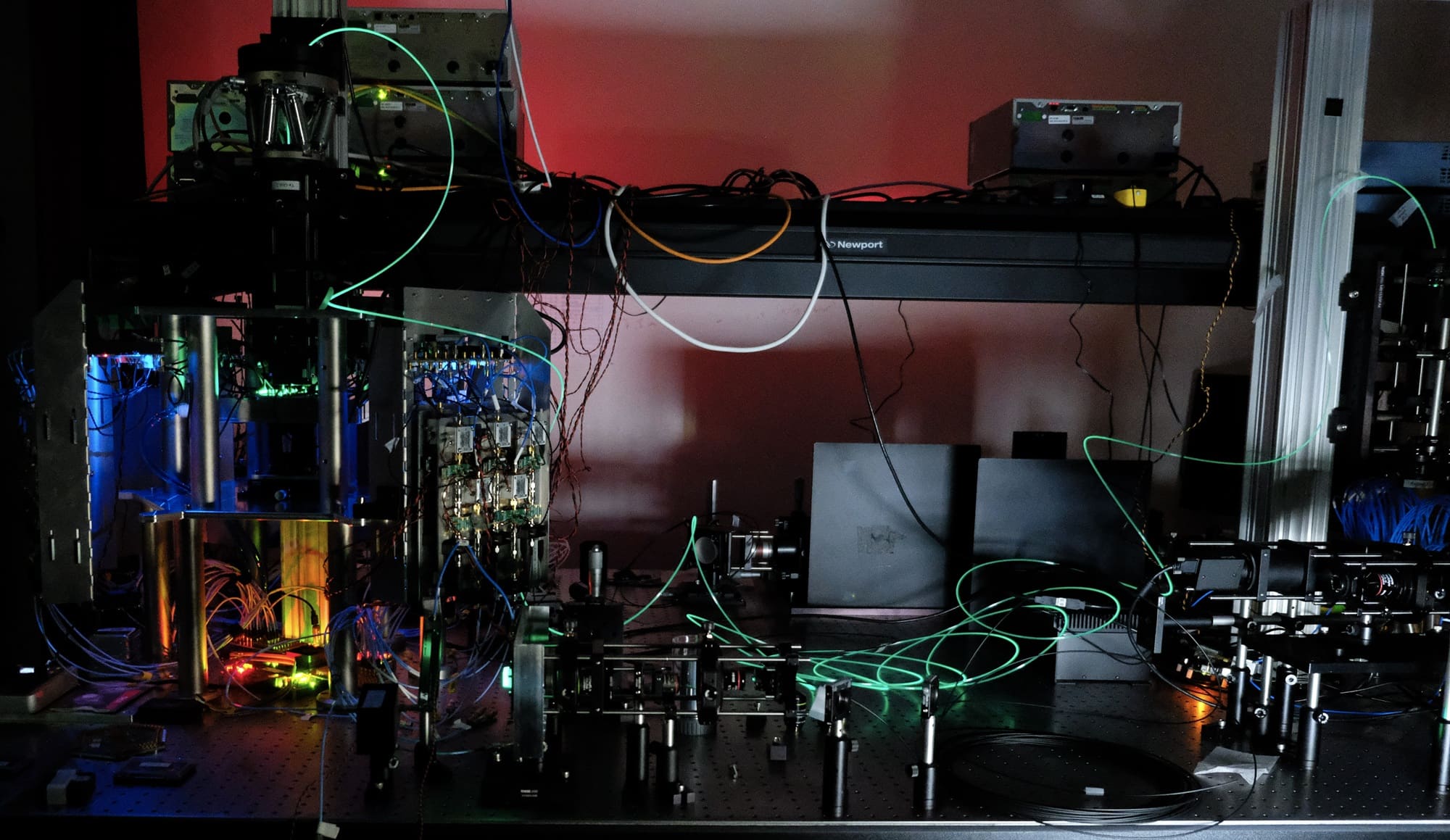
Microsoft believes that one of the next major bottlenecks in artificial intelligence won’t be just the chips but something much less visible: the way servers connect with each other inside data centers. That’s why it has introduced a new interconnection system based on MicroLEDs and imaging fiber, which, according to the company, could start commercial production with industrial partners by the end of 2027.
The proposal comes at a time when the growth of AI and cloud computing is pushing current network technologies to their limits. Microsoft argues that current dominant intra-data center interconnections force a choice between two imperfect solutions: copper, which is reliable and efficient but suitable only for very short distances, and laser optical fiber, which covers longer distances but consumes more energy, is more costly, and is more sensitive to reliability issues.
The new system, developed by Microsoft Research in Cambridge in collaboration with teams from Azure Core, Azure Hardware Systems and Infrastructure, and Microsoft 365, shifts this approach. Instead of using lasers, it employs cheap, commercial MicroLEDs, and instead of conventional fiber, it uses a type of cable known as imaging fiber, which externally looks like a normal fiber but internally contains thousands of cores. This architecture allows many channels to be transmitted in parallel within a single cable.
From “narrow and fast” to “wide and slow”
Paolo Costa, one of the project leaders at Microsoft Research, explains this idea as a shift in philosophy. Current optical interconnections operate with a few very high-speed channels, which Microsoft describes as a “narrow and fast” approach. Their alternative favors many slower channels working simultaneously—a “wide and slow” design that, practically speaking, seeks to maintain total bandwidth while reducing complexity, power consumption, and thermal limitations.
In the peer-reviewed research supporting this project, Microsoft describes this architecture under the name Mosaic. According to this publication, the system achieves 10 times the reach of copper, reduces energy consumption by up to 68% compared to certain current optical alternatives, and offers 100 times the reliability of today’s conventional optical links. The prototype demonstrated by the company uses 100 optical channels at 2 Gbps each, and, according to Microsoft, the architecture can scale up to 800 Gbps or more with reach distances of up to 50 meters.
In the company’s informational piece, Microsoft estimates that when deployed, this system would require about 50% less energy than the most common laser optical cables, based on laboratory tests and product estimates. They also state that manufacturing costs should be lower and lifespan could surpass that of current laser solutions.
Why this matters in the era of AI
The underlying motivation directly relates to AI infrastructure. As the number of GPUs per rack increases and compute density grows, the internal network of the data center becomes a limiting factor. In Microsoft Research material, Costa cites the recent evolution of AI systems, where computation has scaled rapidly but the network and memory are lagging behind — to the point that many workloads, especially inference tasks, become I/O-bound, limited by input/output constraints.
In this context, copper remains very useful for its efficiency and reliability, but its reach is limited to less than 2 meters for high-speed links. This forces many accelerators to be clustered within the same rack or very close together, complicating cooling, mechanical design, and scalability. Microsoft suggests that a MicroLED system with tens of meters of reach and lower power consumption could ease some of these constraints.
The company also claims that it has completed, alongside MediaTek and other suppliers, a proof of concept to miniaturize this technology and integrate it into a transceiver compatible with current data center equipment. That module would be roughly the size of a thumb, facilitating more pragmatic and less disruptive physical adoption.
MicroLED internally and Hollow Core Fiber externally
Microsoft presents this technology not as an isolated solution but alongside another recent network innovation: Hollow Core Fiber (HCF). Unlike traditional fiber, where light travels through glass, HCF transmits signals via a hollow core filled with air, enabling reduced latency or maintaining the same latency over longer distances. Microsoft states that this technology is already in use in some Azure regions and is being deployed more broadly globally.
According to the company, HCF offers up to 47% faster transmission speeds and approximately 33% less latency compared to conventional single-mode fiber. Meanwhile, the new MicroLED solution focuses primarily on inside-the-data-center connections—linking servers and GPUs. In other words, Microsoft is simultaneously working on short-range intra-data center networking and long-range optical connectivity between data centers or regions.
A serious investment, but still in transition
Therefore, this technology should not be viewed as an immediate product but as a medium-term strategy to solve one of AI infrastructure’s major challenges: moving data with less energy, heat, and physical friction. The fact that Microsoft already talks about commercializing it with partners by late 2027 clearly indicates that the project has moved beyond pure experimentation, although it still needs to prove its viability at an industrial scale.
The interesting part is that this innovation is not centered around a new processor or a larger foundational model, but rather the “digital plumbing,” as described by one Azure executive. Perhaps the key lies here: as AI continues to grow, competitive advantage will depend not just on the calculation chip but also on the cable, the optical module, and the network architecture that prevent the computation from bottlenecking due to physical limits.
Frequently Asked Questions
What exactly has Microsoft announced?
Microsoft has introduced a data center interconnection system based on MicroLEDs and imaging fiber, designed as a more efficient alternative to copper and laser optics for certain internal links within the data center. The company expects to commercialize it with industrial partners by late 2027.
What advantage does it have over current optical cables?
According to Microsoft, the system could use around 50% less energy than the most common laser optical solutions. In Mosaic’s research, the company also mentions energy reductions of up to 68%, along with increased reach and reliability.
What is the imaging fiber used in this system?
It’s a type of cable that externally looks like a normal fiber but contains thousands of cores inside, enabling many optical channels to be carried in parallel within a single link.
How does this differ from Hollow Core Fiber?
Microsoft considers both technologies complementary. MicroLED is mainly intended for intra-data center links, while Hollow Core Fiber is suitable for longer distances and is already being deployed in some Azure regions. Microsoft claims HCF can offer up to 47% faster speeds and 33% less latency compared to conventional single-mode fiber.
via: news.microsoft
