
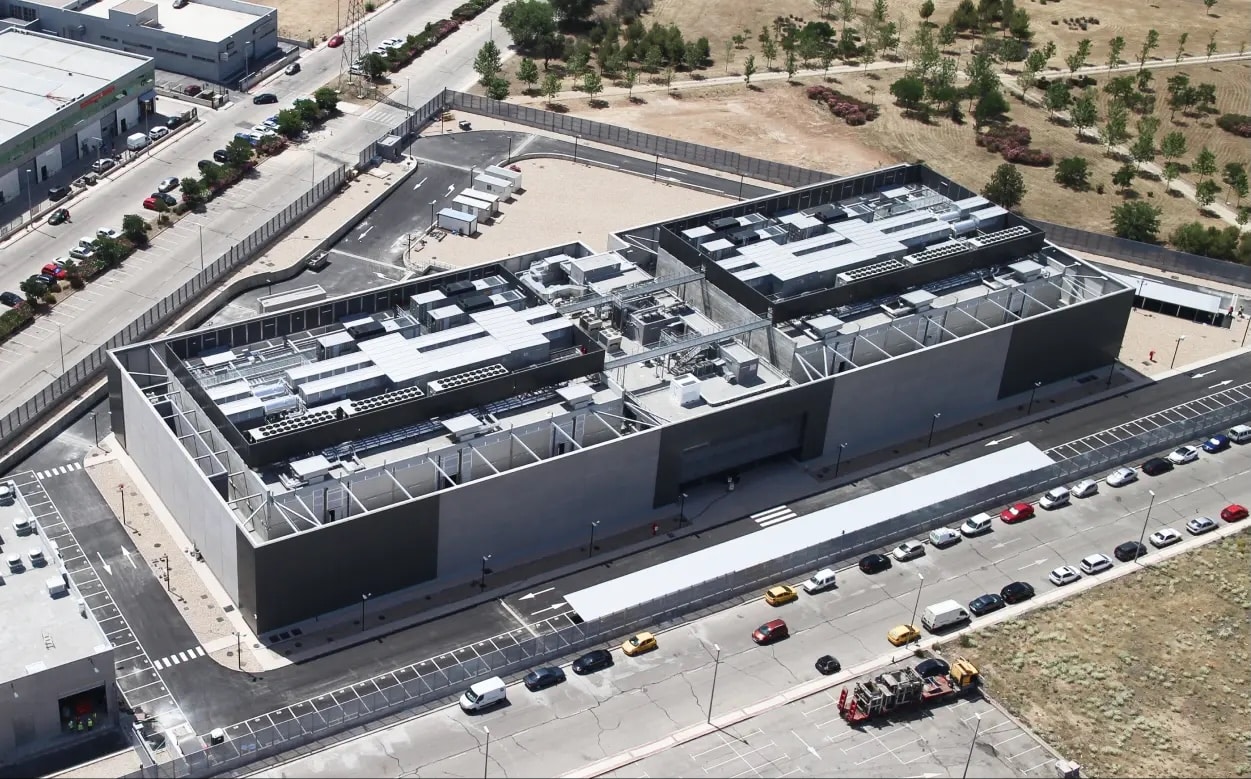
Templus aims to grow faster and faster. The Spanish data center company, which has built an international presence in less than two years, has decided to lift its investment cap to continue acquiring assets and expanding its footprint across Europe. The immediate goal is ambitious: to reach 26 data centers and 80 MW of managed power by 2026, with particular focus on markets like France and Italy, according to its CEO, Ignacio T. Velilla Rincón, in an interview published today by Expansión and shared by the company itself.
The underlying message is clear. The growth of data-related businesses, artificial intelligence, and the need for capacity near the client are accelerating the movement in the European data center sector. And Templus wants to position itself as one of the most regionally extensive players, supported by a strategy combining acquisitions, international expansion, and a network of proximity infrastructures.
According to that interview, Templus currently operates in eight countries — Spain, Portugal, France, Italy, Switzerland, the Netherlands, Denmark, and the UK — with a total of 17 data centers and 65 MW under management. Born through the investment platform Teras Capital and backed by the British fund ICG, the company does not hide its ongoing search for deals to strengthen its position in a time of immense interest in the data center industry.
This growth has not been accidental. In December 2025, Templus announced the acquisition of nine AtlasEdge data centers spread across Spain, the UK, France, Italy, the Netherlands, Denmark, and Switzerland, representing a clear step forward in internationalization. One month later, in January 2026, it added three Grupo Aire data centers in Madrid, Valencia, and Lisbon, increasing its capacity by 6.5 MW and strengthening its presence in the Iberian Peninsula.
These moves explain why the company is now talking about a new scale threshold. In the interview, Velilla states that Templus started with 300 million euros committed, but that investment cap has now been removed. The goal is to continue growing until doubling its current business volume in five years, without losing the identity it has presented to the market: first-class data centers, close to businesses and users, and distanced from a purely hyper-centralized model.
A proximity network amid Europe’s data center boom
One of the most interesting aspects of Templus’s model is precisely that: it does not seek to compete only in the large traditional nodes, but to build a more distributed network of data centers. The company advocates a strategy of regional and proximity data centers, with facilities usually of modest size — between 2 and 10 MW, according to the interview, although Madrid reaches 20 MW — and presence in cities where capacity remains valuable for operators, companies, and digital services.
This approach aligns with an increasingly visible reality in Europe. The European data center market continues to grow, but also faces tensions regarding access to energy, land, and development timelines, especially in major hubs. In this context, owning smaller assets closer to the business fabric can be a competitive advantage, especially for colocation loads, regional cloud, business continuity, or data sovereignty projects.
The company itself already explained in January its aim to become the leading network of regional data centers in Europe, supported by acquisitions and enhancements in capacity, surface area, and energy efficiency of the acquired assets.
France and Italy: markets on the radar
The interest in France and Italy is not surprising. Both countries are part of the natural expansion map for any operator wanting to build a pan-European platform based in the south and west of the continent. For Templus, there is also a prior footprint after acquiring AtlasEdge, which makes subsequent consolidation strategies in markets with room for growth via acquisitions easier.
The company also maintains a discourse aligned with one of the industry’s major themes: data sovereignty. In the interview, Velilla emphasizes the European origin of the group as an additional guarantee in this area, at a time when more and more companies and administrations want to know not just where their data is stored, but under what control and operational framework it lies.
This is no minor message. In Europe, data center industry growth is increasingly measured not just in square meters or contracted power. Proximity to clients, operational resilience, interconnection capacity, and compliance with regulatory or digital sovereignty requirements are becoming equally or more important.
No investment ceiling and no fear of consolidation
The interview also reveals another key point: Templus does not see an immediate bubble in the sector, although it recognizes that there are fewer actual projects than announced ones. The nuance matters. Over the past few months, the European data center market has experienced a surge of announcements, capacity promises, and large plans tied to artificial intelligence, cloud, and critical infrastructure. But not all announced projects materialize at the same pace.
For this reason, a strategy based on selective acquisitions of existing assets can be more realistic and faster than waiting for years to develop new projects from scratch. In fact, Templus combines both approaches: on one hand, acquisitions of operational nodes; on the other, proprietary projects like the Ceuta data center, whose construction began in November 2025 and is scheduled to be operational in 2026.
The challenge, in any case, will not be small. To go from 17 to 26 centers this year and increase its managed capacity to 80 MW, Templus will need to continue executing acquisitions, integrating assets, and raising technical and energy standards across its network. But if it manages to achieve this roadmap, it will have made a very visible step towards becoming one of the most regionally prominent operators in the European market.
Frequently Asked Questions
How many data centers does Templus aim to reach by 2026?
According to the interview published by Expansión and shared by the company, Templus aims to close 2026 with 26 data centers and 80 MW of managed power.
In which countries does Templus currently operate?
As shared by the company in the interview, it operates in Spain, Portugal, France, Italy, Switzerland, the Netherlands, Denmark, and the UK.
What recent acquisitions has Templus made to grow?
In December 2025, it announced the acquisition of nine AtlasEdge data centers, and in January 2026, it bought three Grupo Aire data centers in Madrid, Valencia, and Lisbon.
What growth model does Templus follow?
The company advocates for a network of regional and proximity data centers, supported by acquisitions, enhancement of existing assets, and selective growth into new European markets.
Source: Expansión and LinkedIn
