

Iran remains almost completely disconnected from the internet more than ten days after the new digital blackout that began on February 28, amid escalating military tensions with the United States and Israel. The situation is not due to a technical outage or a simple network issue: monitoring organizations and digital rights groups describe an almost total cut, with international traffic plummeting and millions of people unable to access the global web normally during one of the most critical moments for the civilian population.
The most frequently cited data points all point in the same direction. NetBlocks reported on March 9 that the blackout had entered its tenth day, with connectivity at around 1% of its usual levels. Two days later, Access Now continued to classify the situation as an almost complete blackout that started on February 28, while Human Rights Watch recalled that Cloudflare Radar detected a 98% drop in traffic at the start of the cut. By March 13, the blockade clearly exceeded ten consecutive days.
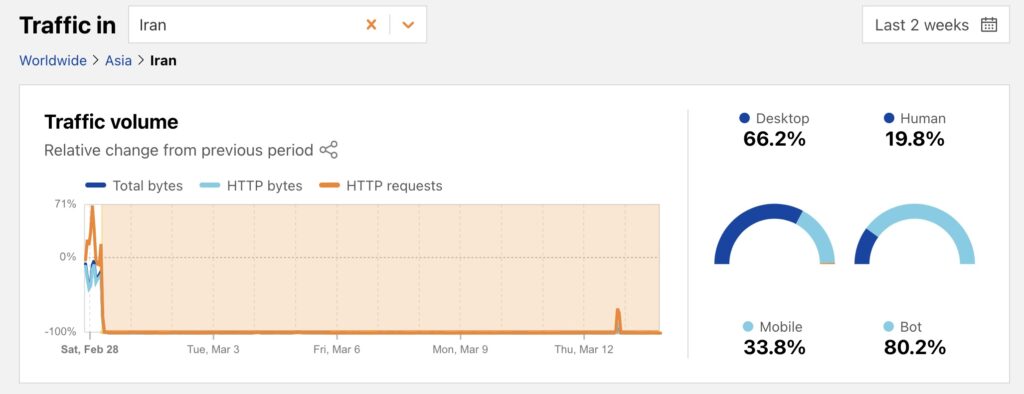
The timing coincidence with attacks launched by the United States and Israel on Iran has turned the blackout into another piece of the current war scenario. Reuters reported on February 28 that both countries launched assaults on Iranian territory, opening a new phase of regional confrontation. In this context, groups like Access Now and Human Rights Watch argue that Iranian authorities have once again used the blackout as a tool for information control and internal isolation.
A disconnected country in the midst of crisis
The most serious aspect of this case is not just the percentage of lost traffic, but what it practically means. When connectivity drops to levels close to 1%, the result is not slow or intermittent browsing, but a country nearly incapable of normal communication with the outside world. In such circumstances, messaging apps, international services, media, work platforms, verification tools, and emergency channels stop functioning or are reserved for a privileged minority with special access or alternative solutions.
Human Rights Watch has warned that this communication shutdown increases risks for the civilian population because it cuts off access to urgent information amid conflict, hampers contact with families, and blocks independent documentation of potential abuses. Access Now shares this concern: a internet blackout during a war not only restricts the freedom of information but can also have direct consequences on the safety, health, and survival of those on the ground.
Additionally, the isolation does not seem to affect the entire digital ecosystem equally. Human Rights Watch pointed out that state-aligned media indicated that only certain pre-approved sites remained accessible through Iran’s National Information Network. This architecture, which Iran has been developing for years, allows the maintenance of a portion of internal services under state control while severing open access to the global internet. It is not chaotic disconnection but a deliberate and selective restriction.
The new cut follows another major blackout in January
This episode is not isolated. Iran had already experienced another prolonged national blackout in January 2026, imposed after anti-government protests. Reuters reported then that the blockade began on January 8 and continued to cause significant damage to businesses and workers for weeks afterward. Human Rights Watch spoke of a 21-day shutdown accompanied by severe communication restrictions. This precedent helps explain why digital rights organizations fear that the country is moving toward an increasingly structural form of isolation.
In January, Reuters already described a situation where Iran’s domestic network only allowed limited access to certain internal services, while a broad connection to the global internet had not been restored. In other words, the model now seen again in March had already been tested before: a sort of internal, filtered, and monitored internet, useful for certain state functions but insufficient for normal digital life for companies, professionals, media, and citizens.
This context also explains why the new blackout is of such concern internationally. It is not merely a temporary measure amidst war but another sign that the regime has mechanisms capable of drastically reducing external connectivity for extended periods. When that capacity is normalized, the blackout ceases to be an exception and becomes a governance tool.
The impact extends beyond politics
The economic and social consequences of these outages are profound, even when no single figure summarizes all damages. Reuters already documented in January the dissatisfaction of entrepreneurs and chambers of commerce over disconnection affecting businesses, exporters, and digital economy workers. When international connectivity disappears, social media or leisure apps go offline; so do payments, commercial communications, authentications, remote work tools, and essential channels for operating internationally.
In March, this problem worsens as the blackout coincides with bombings, regional tensions, and highly sensitive information flows. In such a scenario, the network ceases to be just an economic infrastructure and becomes also a humanitarian one. Without internet, verifying alerts, checking affected areas, informing relatives, or accessing independent information becomes much more difficult. That is why international organizations insist that such blockades should not be treated as mere technical public order decisions.
What is happening in Iran also foreshadows a global debate that goes beyond the country. War, censorship, and digital sovereignty are increasingly intersecting in aggressive ways. When a state can reduce its international traffic to nearly zero and only operate an internally approved network, internet ceases to be an open space by default and increasingly depends on political and military decisions. Iran is not the only place where this risk is discussed, but it is one of the most visible and stark examples of how far such measures can go.
Frequently Asked Questions
How long has Iran been nearly offline from global internet?
The new blackout began on February 28, 2026, and was still active as of March 11, according to Access Now. NetBlocks reported on March 9 that it had already entered its tenth day, so by March 13, it clearly surpassed ten consecutive days.
What level of connectivity does Iran maintain during the blackout?
NetBlocks indicated connectivity around 1% of normal levels on March 9, while Human Rights Watch noted that Cloudflare Radar recorded an initial 98% traffic drop at the start of the cut.
Was the internet outage in Iran a technical failure or a political decision?
Organizations monitoring the situation present it as a measure imposed by Iranian authorities amid war and information control, not as an accidental failure or cyberattack.
Is any internet function remaining inside Iran?
Yes, but very limited. Reuters explained in January that Iran’s domestic network allowed restricted access to some internal services, and Human Rights Watch noted in March that only certain pre-approved sites remained accessible through the National Information Network.
