
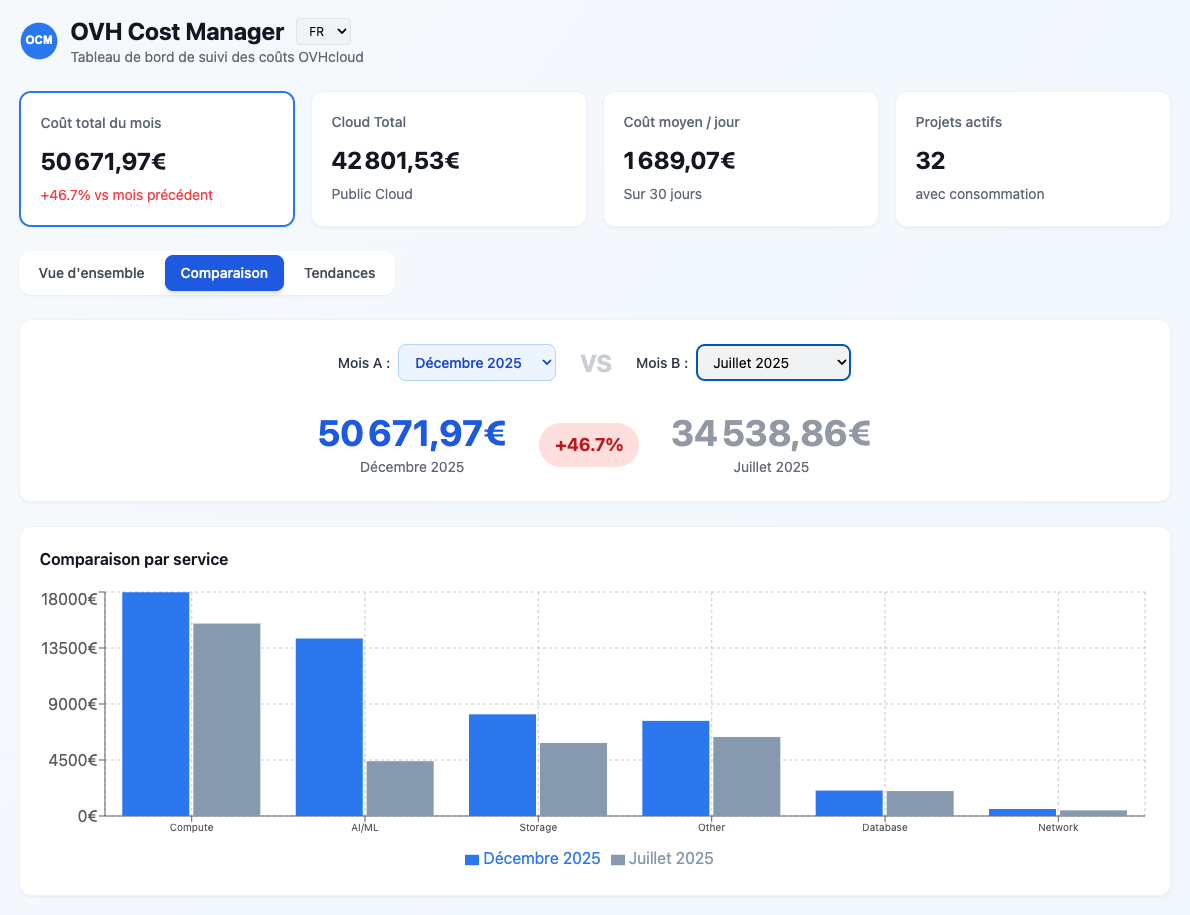
Tracking cloud expenses has become a real necessity for many companies, not just for large organizations with FinOps teams. In this context, small, open-source, easy-to-deploy tools are starting to gain importance compared to more complex platforms. This is where OVH Cost Manager comes in — an open-source project designed to analyze OVHcloud billing via a web dashboard, and which has just released version 2.2.2, featuring improvements focused on deployment, data import, and API usage monitoring.
The project, maintained by Michel-Marie Maudet and published on GitHub under an MIT license, is not an official OVHcloud product but a community tool aimed at simplifying invoice reading, monthly expense tracking, and cost comparison across projects, services, or periods. The latest release also conveys an interesting message: specialized software like this continues to evolve thanks to external contributions, in this case with the addition of Grégoire Bellon-Gervais and Romain Valmori among the recognized collaborators in this update.
A tool designed to bring order to cloud billing
OVH Cost Manager presents itself as an interactive dashboard for OVHcloud billing analysis. According to its repository, it offers summary views, month-to-month comparisons, historical trends, analysis by service type, budget tracking, export options to PDF, Markdown, and CSV, as well as an infrastructure inventory for Public Cloud projects, dedicated servers, VPS, storage, and other resources. All of this operates on a local SQLite database and a web interface built with React, while the backend uses Express and can be deployed either locally or via Docker.
This combination gives it a clear profile: it doesn’t compete with large cloud governance suites but fills a very specific niche for administrators, infrastructure managers, finance teams, or small to medium-sized businesses needing a better understanding of their OVHcloud expenses without setting up a complex platform. The project’s own documentation highlights features such as usage forecasting at month’s end, GPU cost visualization by model, month-to-month comparisons, and resource inventory alerts for expiring services.
Beyond the dashboard, the tool also includes comprehensive, differential, or date-restricted import scripts, along with a set of API endpoints to query available months, grouped costs, current consumption, account balance, or infrastructure summaries. It’s not just a visual layer over invoices but a small economic observability platform for OVHcloud. That nuance is important because it brings the concept of FinOps closer to smaller operational environments.
What’s new in version 2.2.2
The 2.2.2 update doesn’t seem to be a major functional revolution but rather a practical refinement. According to the project author, this version includes three main improvements. The first is API rate limit control for OVHcloud, attributed to Romain Valmori. The second addresses the initial import issue during first setup, a critical point for such tools since a poor initial import can affect user experience from the outset. The third improves the Docker container: the multi-architecture image shrinks from 211 MB to 55 MB thanks to multi-stage building, an optimization driven by Grégoire Bellon-Gervais.
From a technical perspective, container optimization is not a minor detail. Comparing the history between v2.2.1 and v2.2.2 on GitHub shows a change aimed precisely at avoiding QEMU emulation on arm64 during build, running Node natively on the build host, and creating a lighter runtime image. For those deploying internal services across architectures or wanting to containerize auxiliary utilities without sacrificing storage or distribution times, this reduction can make a real difference.
The API rate limit control improvement also has practical implications. Since the tool relies on OVHcloud API calls to fetch invoices, usage, or inventory data, monitoring request volume helps reduce errors and makes behavior more predictable. While it doesn’t turn OVH Cost Manager into a security solution, it does make it more robust in a fundamental way: preventing crashes or degradation caused by unoptimized API access.
A small project, but useful for everyday management
Sometimes, the value of an open-source tool isn’t in its size but in its focus. OVH Cost Manager doesn’t boast a massive community: the GitHub repository currently has around 18 stars, 5 forks, and displays 6 releases, with version v2.2.2 published on March 2, 2026. But that’s part of its appeal — it’s not inflated by trends but a practical utility that solves a very specific problem for those working with OVHcloud who need a clearer view of expenses.
It’s also noteworthy that the project has expanded its scope beyond simple invoice downloads. The current README mentions dedicated tabs for Public Cloud, infrastructure, backups, GPU analysis, and even deployments with SSO supported by LemonLDAP-NG and Traefik. While it’s not at the level of a full-scale corporate cloud governance solution, it has evolved from a utility script to something more akin to an internal dashboard for monitoring costs and resources.
In an environment where cloud expenses are once again a priority — especially due to GPU, storage, and distributed services — tools like this hold clear value. Not everyone needs a comprehensive financial governance stack. Sometimes a simpler, transparent, and quick-to-deploy solution that provides reliable cost insights and early anomaly detection can be enough to avoid surprises on the monthly invoice.
Version 2.2.2 of OVH Cost Manager doesn’t overhaul the project but strengthens its core proposition: being an open, useful, and increasingly polished tool to better understand the costs of operating on OVHcloud. In today’s cloud landscape, that’s already a significant achievement.
Frequently Asked Questions
What is OVH Cost Manager and what is it used for?
OVH Cost Manager is an open-source tool for analyzing OVHcloud billing from a web dashboard. It allows you to view costs by month, service, or project, review trends, export reports, and consult infrastructure inventory.
Is OVH Cost Manager an official OVHcloud product?
No. The project is published on GitHub by Michel-Marie Maudet under an MIT license and is not an official OVHcloud software.
What’s new in OVH Cost Manager 2.2.2?
The 2.2.2 release adds API request rate limiting control, fixes the initial import issue during first setup, and reduces the multi-architecture Docker image size from 211 MB to 55 MB through multi-stage build.
Can OVH Cost Manager be deployed with Docker?
Yes. The project provides Dockerfile, docker-compose, and documentation for easy deployment, including support for SSO, along with multi-architecture support for version 2.2.2.
