
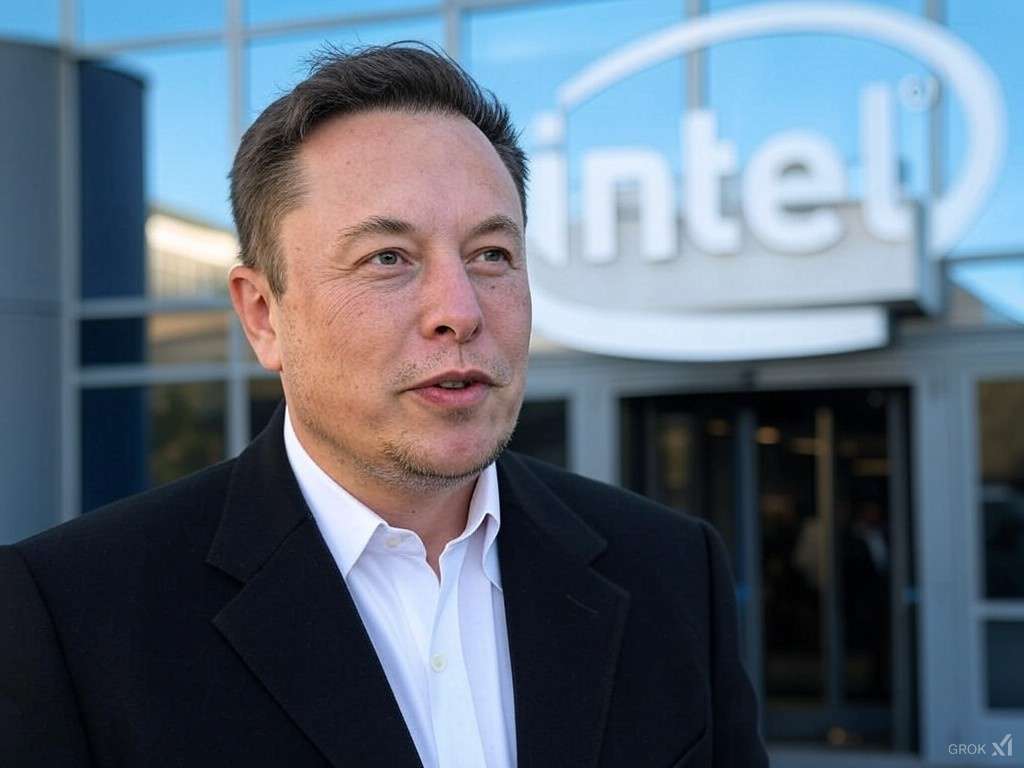
Elon Musk has once again shifted the AI landscape with a bold announcement that blends provocation, ambition, and industrial strategy. The project is called Macrohard, a name that clearly plays on the Microsoft brand, and it was introduced as a joint initiative between Tesla and xAI aimed at building an agent capable of performing complex computing work as if it were a person sitting in front of a computer. The goal is not just to generate text, write code, or answer questions, but to observe what’s happening on the screen, understand the context, and execute actions within real applications and systems.
For a tech-oriented outlet, what matters isn’t so much the name but what it signifies. Macrohard fits squarely into the new race for so-called AI agents: systems that no longer just suggest tasks but attempt to complete them on their own. In Musk’s narrative, xAI provides Grok as the core brain of the system, with Tesla deploying the agent that interacts with the PC, interprets real-time screen video, and acts using mouse and keyboard. If this architecture matures, we could be looking at a step beyond the classic conversational assistant, closer to an automation layer that operates directly on existing software.
Moreover, the proposal isn’t coming out of nowhere. Tesla confirmed in its Q4 2025 financial update that it has agreed to invest approximately $2 billion in Series E preferred shares of xAI. The same documentation states that both companies have signed a framework agreement to explore AI collaborations. This detail provides a much stronger foundation than a mere social media remark: the integration between Tesla and xAI exists on paper and is part of a business relationship Musk intends to deepen.
An agent that aims to use the computer like a human
The most intriguing aspect of Macrohard is the technical approach. Musk envisions a system combining foundational models, real-time vision of the screen, and direct execution capabilities. This means the AI wouldn’t need perfect integration with each application via APIs to start operating but could work over the same interface used by any employee. In theory, this opens the door to automating tasks in legacy tools, internal dashboards, non-modern connectors, or enterprise workflows still heavily reliant on clicks, forms, and manual validations.
This approach offers a clear advantage and an equally clear challenge. The advantage is flexibility: if the agent can “see” and “act” on the screen, it could work across almost any software. The problem lies in reliability. Interfaces change, pop-up windows appear, workflows break, permissions shift, and a small mistake could trigger unintended actions. Therefore, while Musk’s vision is powerful, there’s no public evidence yet that Macrohard can independently replace entire software companies. Today, it’s more prudent to view this as a serious bet on agent-based automation—yet far from a finished product capable of replacing entire departments without oversight.
It’s important to temper expectations. A software company isn’t just code. It also involves architecture, product, support, compliance, security, change management, incident handling, and decision-making. So, Musk’s statement about “replicating entire companies” works well as a headline, but technically it currently sounds more like a strategic horizon than a demonstrated capability. In the short term, the most plausible scenario is systems automating increasing portions of digital work—from repetitive tasks and testing to support, analysis, and maintenance.
Tesla and xAI aim for a new software layer
Macrohard also sheds light on the current phase for Musk’s companies. Tesla has long been working to position itself not just as an electric vehicle manufacturer but as an AI, robotics, and software firm. xAI, meanwhile, needs to prove it can go beyond chatbots and compete in a category with much greater economic potential: agents performing useful work within enterprise systems. In this context, Macrohard is not just a playful jab at Microsoft but a way to fully enter the battle for the next user interface of software.
According to Reuters, Musk explained that the project combines Tesla’s AI4 chips with NVIDIA’s GPU infrastructure within xAI, a mix he believes could be cost-competitive compared to traditional data centers. The rationale makes sense on paper: Tesla contributes inference expertise, vision, and real-world agents, while xAI provides models, training, and scalability. The big unknown isn’t just raw power but the system’s robustness when operating in complex, real-world environments.
Not everything points to a frictionless development. Business Insider reported this week that Macrohard within xAI has experienced pauses, leadership changes, and internal issues related to model quality and data collection. These challenges aren’t deterring the initiative but do paint a more complex picture than a fully ready product poised to disrupt the market. Like many of Musk’s ventures, the vision outpaces what’s visibly achievable at this stage.
The real significance is that Macrohard confirms a deeper trend: AI is starting to transition from a supporting tool to an operational layer that aims to use software directly on behalf of the user. If this shift solidifies, its impact won’t be limited to developers but will extend to SaaS, BPO, technical support, back-office functions, and internal processes across countless companies. Musk’s choice of a bold, attention-grabbing name underscores the importance of this technological thesis: the next big leap won’t just be chatting with AI but enabling it to work inside our computers.
Frequently Asked Questions
What is Macrohard by Tesla and xAI?
Macrohard is the name Elon Musk has given to a joint project between Tesla and xAI to develop an AI agent capable of using a computer like a person, combining Grok with a system that controls the screen, mouse, and keyboard.
Is Macrohard already available as a commercial product?
There is no public record of a full commercial launch. The information so far comes from Musk’s statements, reports from outlets like Reuters, and the formal framework agreement between Tesla and xAI.
Can an AI truly replace a software company?
Currently, there’s no public evidence that Macrohard can do so entirely. What seems plausible is that systems like this could automate increasingly complex digital tasks within tech companies and operations departments.
What is the official relationship between Tesla and xAI?
Tesla confirmed in its 2026 financial documents an investment of around $2 billion in xAI and a framework agreement to explore collaborations in AI.
