
Barcelona has once again become the showcase where manufacturers try to define the next cycle of the PC. But at Mobile World Congress (MWC) 2026, Lenovo played a different hand: instead of just showcasing more power or better design, the company focused on an idea it aims to make standard: Artificial Intelligence as a system layer, capable of accompanying users across devices, anticipating tasks, and reducing friction in daily life.
This approach materializes in two fronts. On one side, the announcement of the initial rollout of Lenovo Qira, a “personal ambient intelligence” integrated at the system level in Lenovo and Motorola devices. On the other, a series of modular concepts and new hardware ideas—from a modular business-oriented laptop to a glasses-free 3D laptop and a foldable console—exploring how working, creating, or gaming will look when devices are designed to adapt to the context, not just run in it.
Qira: the AI that wants to live between your laptop, tablet, and mobile
The centerpiece of this announcement is called Lenovo Qira. Lenovo describes it as a “Personal Ambient Intelligence” that doesn’t install as a standalone app but integrates into the system and extends across various device types. The goal is clear: maintain continuity between tasks and devices, and assist users according to their intent, without forcing them to “restart” work every time they switch screens.
The initial deployment, according to the company, will arrive “in the coming weeks” on more than 20 devices from its PC portfolio, including the Yoga, IdeaPad, Legion, and ThinkPad lines, via a combination of OTA updates and devices already pre-installed. In tablets, Idea Tab Pro Gen 2 will be the first model to incorporate Qira as part of this experience. Lenovo also anticipates that throughout 2026, Qira will expand to more languages and reach Motorola smartphones, aiming for a unified AI experience across both brands.
An important detail with clear implications for adoption: the first Qira rollout will support six languages across nine regions, including Spanish for both Spain and the US/Latin America, along with English, French, Italian, German, and Portuguese (Brazil). This choice suggests Lenovo wants this feature to move beyond an early adopter experiment and become a standard function.
Modular PC as “extended lifespan”: carry small, use big
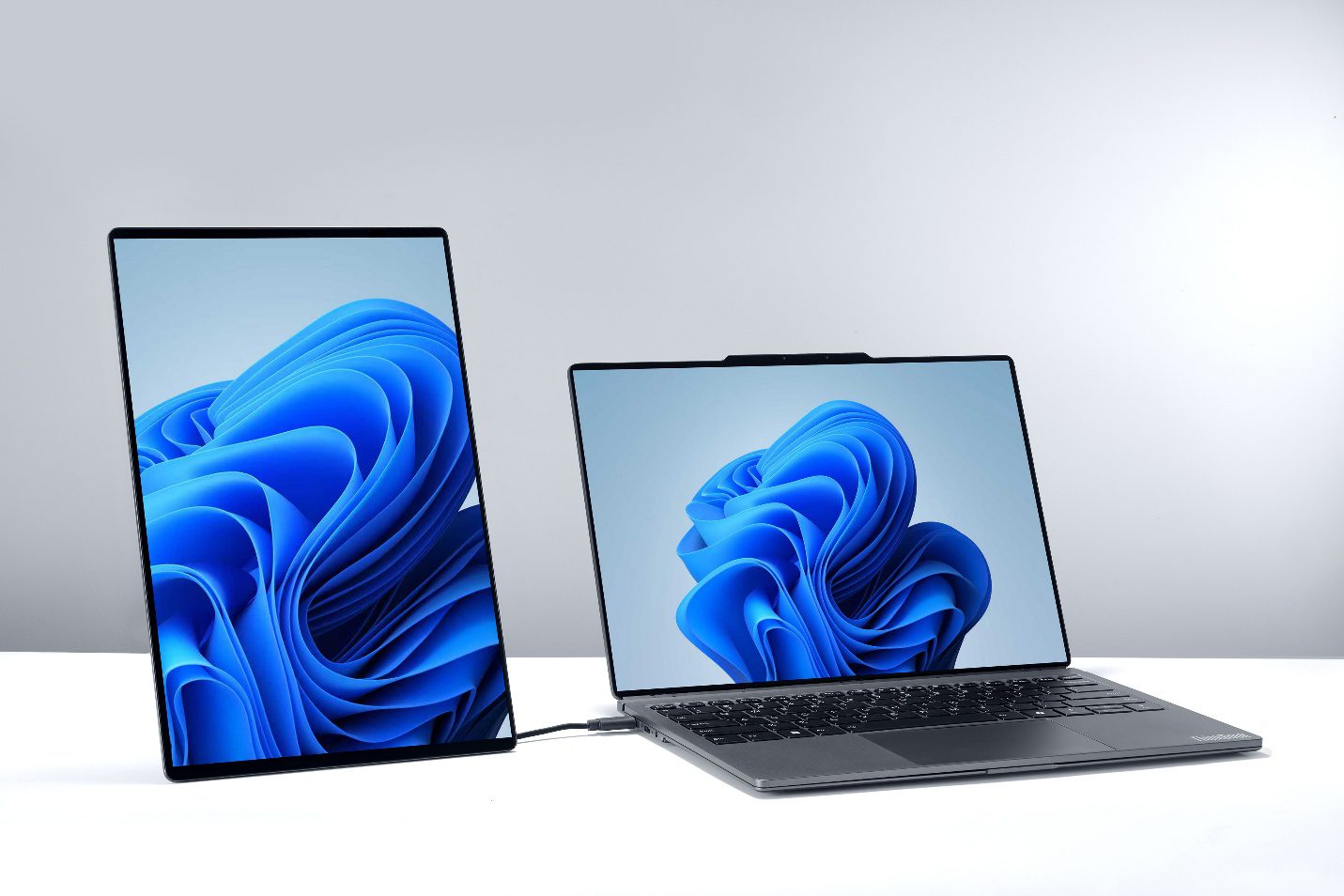
Beyond software, Lenovo has showcased a concept with the ThinkBook Modular AI PC Concept, designed for work and mobility with a clear premise: “carry small, use big”. The base would be a slim 14-inch device, to which modules can be attached: secondary screens in various orientations, removable input elements, and a modular approach to I/O.
The promise is twofold. The first is functional: turning a mobile work session into a setup close to 19 inches of screen real estate when multitasking requires it. The second is strategic: if the PC can be reconfigured, it can also extend its lifecycle in business environments, adapting to different needs without replacing the entire device.
Meanwhile, several media outlets highlighted the appeal of the approach: modularity without turning the laptop into a “Frankenstein” difficult to maintain, with specific modules (screen, keyboard, ports) tailored to real use cases.
Glasses-free 3D and foldable console: Lenovo pushes the limits of the format
The second concept Lenovo introduced in Barcelona, the Yoga Book Pro 3D Concept, targets creators: a laptop providing glasses-free 3D experience based on dual screens, AI-powered 2D-to-3D conversion, and gesture controls. Essentially, Lenovo aims to reduce friction for immersive creation and depth-based work on screen, an area still full of “wow” moments but lacking standardization.
The third impactful idea is the Legion Go Fold Concept, a foldable gaming console/PC that transitions from a compact form to a larger screen and supports various usage modes: portable gaming, multitasking with an extended display, and a sort of “desktop-like” interaction. Media who saw it at MWC mention a POLED display that unfolds from about 7.7 to 11.6 inches and a focus on combining gaming with light productivity. However, as a concept, questions about durability and final experience remain reasonable.
Commercial focus: More repairable ThinkPads and an “AI-ready” fleet
Lenovo also used MWC to reinforce its corporate message: updates to ThinkPad T-Series with improvements oriented toward serviceability, usability, and “AI readiness,” along with recognition of models with high repair scores on iFixit. Additionally, it introduced the ThinkPad X13 Detachable—more portable with replaceable components—and the ThinkTab X11, a hardened Android tablet designed for industrial and frontline environments.
In consumer offerings, Lenovo expanded its lineup with creative and productivity devices (such as the Yoga 9i 2-in-1 Aura Edition, Yoga Pro 7a, IdeaPad Slim 5i Ultra) and gaming additions (Legion 7a, Legion Tab). The overarching goal remains: to build a “broad” portfolio where AI isn’t an isolated feature but a common layer across different formats.
Summary table of Lenovo’s announcements at MWC 2026
| Announcement / Concept | What it offers | Target audience |
|---|---|---|
| Lenovo Qira | Integrated system-level ambient AI, seamless device continuity | Users and businesses working across multiple devices |
| ThinkBook Modular AI PC Concept | Modular “carry small, use big” laptop, expandable with modules | Professionals and corporate fleets |
| Yoga Book Pro 3D Concept | Glasses-free 3D, AI-based 2D-to-3D conversion, gesture control | Creators and spatial experiences |
| Legion Go Fold Concept | Foldable gaming console/PC with multiple modes | Gamers and hybrid mobility users |
| ThinkPad / ThinkTab updates | Repairability, fleet management, suitable for demanding environments | Enterprise IT and industry sectors |
Lenovo’s clear message for 2026 is that the PC enters a phase where hardware becomes more flexible and AI begins to behave as part of the system, not just an isolated function. Success, however, will depend on the usual: whether Qira proves useful without being intrusive, whether concepts turn into sustainable products, and whether “adaptation” is more than just a buzzword—translating into tangible improvements in daily work.
Frequently Asked Questions
What is Lenovo Qira and how does it differ from a typical assistant?
Qira is designed as system-level AI, integrated to maintain task and device continuity, not as a standalone app.
Which devices will get Lenovo Qira first?
Lenovo states it will be available on more than 20 devices from Yoga, IdeaPad, Legion, and ThinkPad lines, with Idea Tab Pro Gen 2 being the first tablet to feature Qira.
What is the real benefit of a modular laptop in a business setting?
Modularity can extend the device’s lifespan by allowing upgrades (screen, keyboard, ports) and adapt to different roles without replacing the whole device.
Will the Legion Go Fold be available for purchase as is?
Currently, it’s a concept; there’s no confirmed launch date or price, and analyses note remaining questions about durability and maturity of the format.
via: news.lenovo
