
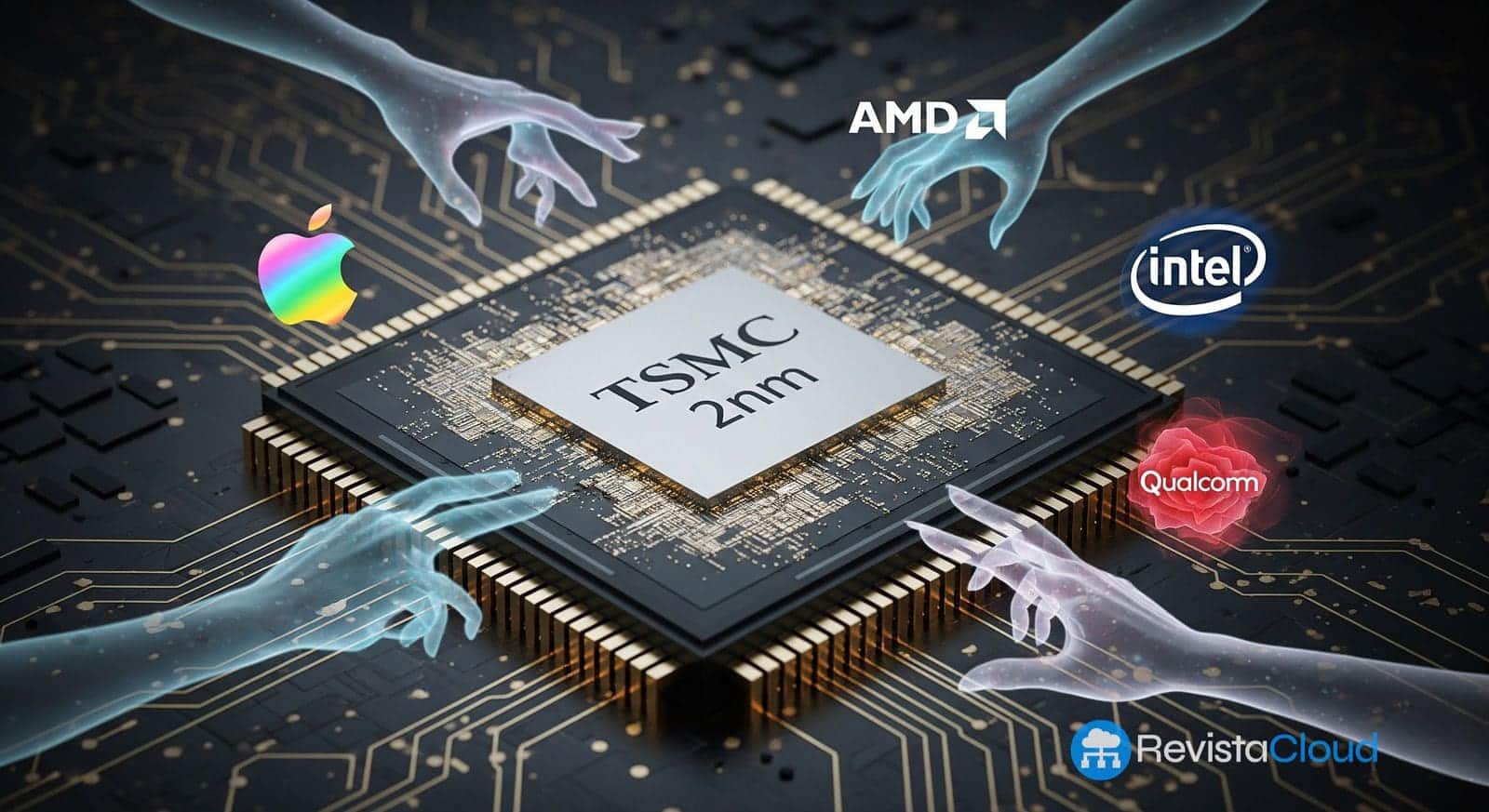
The race for the most advanced node is no longer decided solely in laboratories but also on spreadsheets. According to information published this week by analyst Tim Culpan on Culpium, TSMC is asking its customers to define their production needs for 2 nm (N2) at least through the second quarter of 2027, in a context where most capacity slots for the next two years are “almost sold out”. The industry-wide message is clear: those who don’t secure their spot early risk falling behind when their window of opportunity arrives.
It’s not just an abstract alarm. 2 nm represents TSMC’s next leap after 3 nm, and its significance goes far beyond marketing: it’s the process aiming to deliver more density, better energy efficiency, and performance for chips that will end up in premium smartphones, PCs, and increasingly, in the realm of Artificial Intelligence. The company had already begun volume production of N2 in Q4 2025, marking the start of industrial ramp-up and, at the same time, the most delicate capacity allocation phase.
The key point for 2026 is that this ramp-up is happening in a market that looks different from previous cycles: demand has shifted strongly toward AI computing and high performance, and the pressure on advanced nodes isn’t just about how many chips are produced but also about how much “space” they occupy.
Why is 2 nm filling up early: AI, silicon size, and rising prices
Culpan argues that the situation is “more acute than ever” due to a confluence of factors. A primary factor is physical: AI GPUs and accelerators tend to occupy much larger silicon areas compared to other chips, consuming capacity disproportionately. On top of that, economic elements come into play: the value of these products is so high that many customers are less willing to cut costs, accepting higher rates to secure volume.
This dynamic shifts the power balance. When major clients lock in commitments for several quarters—and in some cases, multiple years—the window for smaller companies or secondary projects automatically narrows. In fact, the industry has experienced similar situations with other advanced nodes: Culpan recalls that market analysts had pointed out that 3 nm (N3) was largely booked for 2027, and now 2 nm is beginning to approach that same pattern.
Reservation no longer a “best practice”: it’s a requirement to participate in the leading node
The most troubling aspect for chip designers and product managers isn’t just scarcity but also the schedule. According to Culpium, reservation lead times can stretch to six quarters (a timeframe that complicates planning of their own roadmaps). And TSMC’s allocation process, as described by Culpan, leaves little room for improvisation: foundries ask clients to specify how many wafers they’ll need per quarter; based on that forecast, they plan capacity allocation; and then require payment to lock in the capacity.
Moreover, the real timeline doesn’t end there. Culpan explains that this decision is typically made about six months before manufacturing begins; and between fabrication and packaging, the cycle can add an additional four to six months. Practically, this pushes designers to determine their needs approximately 12 months in advance of delivery. The only “fast track” options are the so-called hot lots or hot runs, last-minute requests that come with premium charges and don’t guarantee availability.
The result is an industry where the bottleneck isn’t solely technological but also logistical: if the 2 nm window for 2026–2027 narrows, a product launch could be delayed, a family of products might switch node at the last minute, or a company may have to compete with less energy-efficient chips than its competitor.
N2, N2P, and A16: TSMC’s roadmap for 2026
The pressure isn’t limited to the “base” N2 node. Culpan quotes C.C. Wei stating that N2P (a variant promising about 5% more performance at the same power) should enter volume production in the second half of 2026, as well as the A16 node, aimed at high-performance chips. This timeline is significant because, in many roadmaps, “2 nm” isn’t just a single point but a family of technologies staggered to serve different product profiles.
Meanwhile, TSMC has confirmed publicly that volume production of N2 started in 4Q 2025, reinforcing the idea that 2026 will be the pivotal year to determine who gets in on time and who remains on the waiting list.
Is this another bottleneck like the pandemic?
The pandemic comparison is almost inevitable, but the pattern isn’t exactly the same. In 2020–2021, sectors like automotive discovered too late that the supply chain was fragile. Now, the issue stems from a different phenomenon: a structurally high demand in high-end sectors (AI, HPC, premium devices) competing for the same resource: advanced capacity, not just in lithography but also in downstream processes.
What remains consistent is the lesson: early visibility and reservation are strategic. Those without secured contracts or allocations risk launching later, on a less advanced node, or paying premiums.
Expanding 2 nm isn’t an on-off switch
From an outsider’s perspective, the temptation is to think “just build more.” But capacity at advanced nodes isn’t scaled like data centers; it requires specialized facilities, tools, ramp-up time, yields, and complex industry coordination. Still, TSMC is expanding.
A recent TrendForce report, citing Taiwanese press, notes that Fab 22 in Kaohsiung—TSMC’s core 2 nm facility—has several phases underway: one reportedly began volume production in the second half of last year, another is in testing, and additional construction is ongoing, with the goal of having all phases fully operational by the end of 2027. Additionally, new investments in Tainan are planned to increase 2 nm capacity, though subject to environmental approvals and construction schedules.
Internationally, expansion is happening, but its timelines don’t ease the short-term crunch: much of the planned advanced manufacturing outside Taiwan is slated for the late 2020s, so the 2026–2027 bottleneck, if confirmed, will be decided by current capacity and ongoing ramp-ups.
A node turned geopolitical resource
The collateral effect is evident: if 2 nm capacity is allocated two years in advance, competitive advantage depends equally on engineering prowess and on financial muscle and commitment ability. For giants with huge volumes, reserving is a routine process. For mid-sized companies, it might mean accelerating investments, reorganizing roadmaps, or accepting alternative nodes.
In an industry where “late to the game” usually means losing margins, TSMC’s warning serves as an uncomfortable reminder: the most advanced node isn’t purchased when the product is ready—it’s bought when that product is still just an Excel sheet.
Summary table: what it means that 2 nm is nearly booked out
| Impact | Practical Change | Who Suffers Most |
|---|---|---|
| Roadmaps | Planning wafers up to 12 months ahead to ensure chip availability | Designers without stable volume commitments |
| Cost | Higher premiums due to urgency (hot lots) and reduced bargaining power | Mid-sized companies and startups |
| Competitiveness | Risk of launching on a less advanced node (less efficiency) | Premium hardware and AI sectors |
| Supply chain | Factory expansion takes time; short-term relief limited | Entire ecosystem |
Frequently Asked Questions
What exactly does it mean that 2 nm capacity is “almost booked out” for 2026 and 2027?
It means that most of the major production slots have already been allocated, and clients need to request capacity through at least Q2 2027 to secure space, according to information published by Culpium.
How do N2, N2P, and A16 differ within TSMC?
N2 is the base 2 nm node; N2P is a variant that offers around 5% more performance at the same power; and A16 targets high performance, with volume entry expected in the second half of 2026.
Why is AI putting so much pressure on advanced nodes?
Because AI accelerators tend to use much more silicon per chip, and their high value leads buyers to accept higher costs to secure supplies, increasing pressure on capacity.
What can a company do if it can’t secure 2 nm reservation in time?
Adjust the roadmap to alternative nodes (e.g., 3 nm), optimize designs for area and performance, and secure capacity agreements earlier; in some cases, prioritize products where the leading node isn’t critical.
