
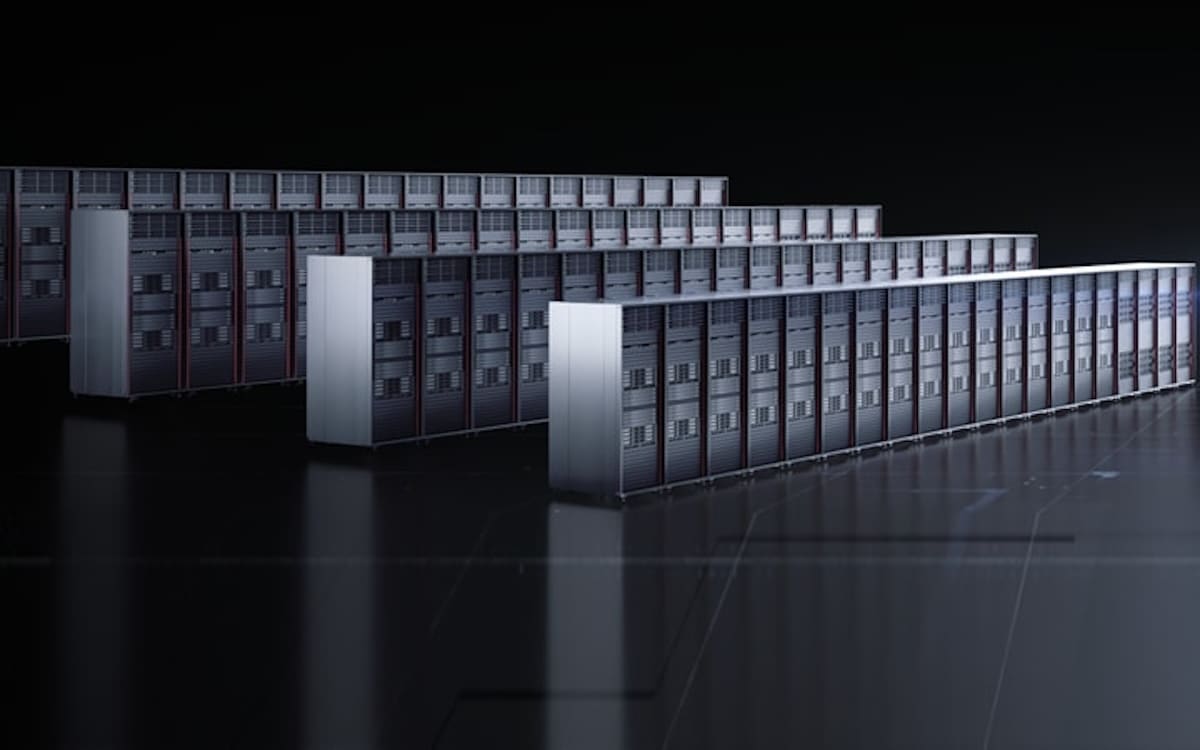
At the 2026 Barcelona Mobile World Congress (MWC), Huawei aimed to place a key idea at the center of the tech conversation: the future of connectivity and Artificial Intelligence doesn’t rely solely on faster networks, but on how the computing infrastructure powering increasingly larger models is built. Their response comes in the form of a SuperPoD portfolio—a proposal that combines cluster architecture, high-speed interconnection, and an increasingly persistent narrative about open collaboration.
The company debuted globally its new Atlas 950 SuperPoD and TaiShan 950 SuperPoD platforms, along with other computing solutions designed for AI training and inference. The message, reiterated throughout the announcement, is that trillion-parameter models and the surge of agentic AI are driving large-scale computing demand, while also demanding lower latency and greater operational stability. In this context, Huawei argues that “classic” horizontal scaling begins to show cracks: as a cluster grows, its effective utilization can decrease, and the risk of interruptions during long training sessions increases.
UnifiedBus and the “cluster + SuperPoD” concept
To address this bottleneck, Huawei advocates for its interconnection UnifiedBus as the backbone of its SuperPoD solutions. Essentially, the argument is that adding more accelerators alone isn’t enough: the way they communicate, share resources, and maintain efficiency as the system scales must also improve.
The flagship product of the announcement, Atlas 950 SuperPoD, exemplifies this approach with a figure designed to impress infrastructure managers: it can connect up to 8,192 NPUs via UnifiedBus, offering Huawei’s claims of ultrahigh bandwidth, ultralow latency, and unified memory addressing. Huawei describes it as a single “logical computer” capable of learning, reasoning, and processing—presenting the cluster as a coherent unit, rather than a collection of nodes vying for resources.
Alongside the Atlas 950, Huawei also mentions the Atlas 850E as part of the same portfolio, aimed at supporting a variety of training and inference scenarios. The declared goal is to offer a “system” rather than a standalone piece: a cluster, interconnection, and software that are aligned.
TaiShan 950: a general-purpose SuperPoD
The second key element is the TaiShan 950 SuperPoD, which Huawei presents as the sector’s first general-purpose SuperPoD. This initiative extends beyond pure AI: it targets enterprise workloads, from intensive tasks to more traditional use cases, complemented by new servers like TaiShan 500 and TaiShan 200 to broaden the offering.
Subtextually, Huawei appears to be covering both sides of the same coin: on one side, large-scale AI infrastructure; on the other, general computing prepared for the evolving demands—where everything touches data, analytics, and automation.
“A new option” globally… with an open narrative
One element Huawei emphasizes repeatedly is open source and open collaboration. The company underscores its central role in openEuler, an open-source operating system driven by the OpenAtom Foundation for digital infrastructure across servers, cloud, and edge, supporting multiple architectures. Simultaneously, Huawei claims to have fully open-sourced its heterogeneous computing architecture CANN (Compute Architecture for Neural Networks), based on a layered decoupling approach that makes software components (libraries, acceleration, graph computation, languages) accessible to developers.
The strategic reasoning is clear: if the AI market organizes around software ecosystems (tools, compilers, libraries, runtimes), then control over that layer yields real influence. Against this backdrop, Huawei emphasizes compatibility and collaboration with open-source projects and communities, citing well-known names such as PyTorch, vLLM, Triton, TileLang, or verl. The goal is to reduce friction for developers and accelerate adoption: Huawei aims not just to sell hardware, but to make sure software reaches and functions on their systems.
It’s no coincidence that some tech commentators have interpreted Atlas 950 coupled with CANN as Huawei’s move to offer an alternative in the AI infrastructure market, traditionally dominated by other ecosystems. At MWC 2026, Huawei presents this as a “resilient” and globally oriented offering.
The real challenge: efficiency, tools, and adoption
Beyond the headline impact, the real test is practical: connecting thousands of NPUs and promising behavior “like a single logical computer” sounds promising, but success depends on:
- Mature tools for deploying and managing clusters at this scale.
- Software ecosystems capable of attracting developers beyond their usual circles.
- Operational reliability (avoiding training interruptions and maintaining high utilization).
- Total cost: energy, cooling, networking, maintenance, and support.
Huawei positions this announcement as a response to this new industrial reality: AI isn’t just about models; it’s about infrastructure, and infrastructure decisions are happening now. Barcelona, once again, becomes a showcase—not just to demonstrate gadgets but to present an architecture.
Summary table of the announcement (MWC Barcelona 2026)
| Element | What Huawei Presented | Key Point |
|---|---|---|
| Atlas 950 SuperPoD | SuperPoD for AI based on UnifiedBus | Up to 8,192 NPUs, low latency, and unified memory addressing |
| Atlas 850E | Platform for diverse scenarios | Designed for training and inference across various deployment sizes |
| TaiShan 950 SuperPoD | General-purpose SuperPoD | Broader focus beyond AI: enterprise workloads and general compute |
| Software and community | openEuler + CANN open-sourced | Building an ecosystem and reducing barriers for developers |
Frequently Asked Questions
What is a SuperPoD and how does it serve AI infrastructure?
A SuperPoD is a cluster design packaged as a system, intended to scale computation (AI or general) with high-speed interconnection, low latency, and more integrated operation.
What does it mean that the Atlas 950 connects 8,192 NPUs?
It means the platform can group thousands of accelerators into a single logical system (per Huawei), aiming for higher internal bandwidth, lower latency, and better coordination for training and inference.
What is CANN and why is it important for AI developers?
CANN is Huawei’s neural network computing architecture. The company claims to have open-sourced it to facilitate access to libraries and components, supporting integration with tools and open-source projects.
Is openEuler just a “more” Linux distro or something else?
openEuler is an open-source operating system focused on digital infrastructure (servers, cloud, edge) governed as a community by the OpenAtom Foundation, supporting multiple architectures.
