
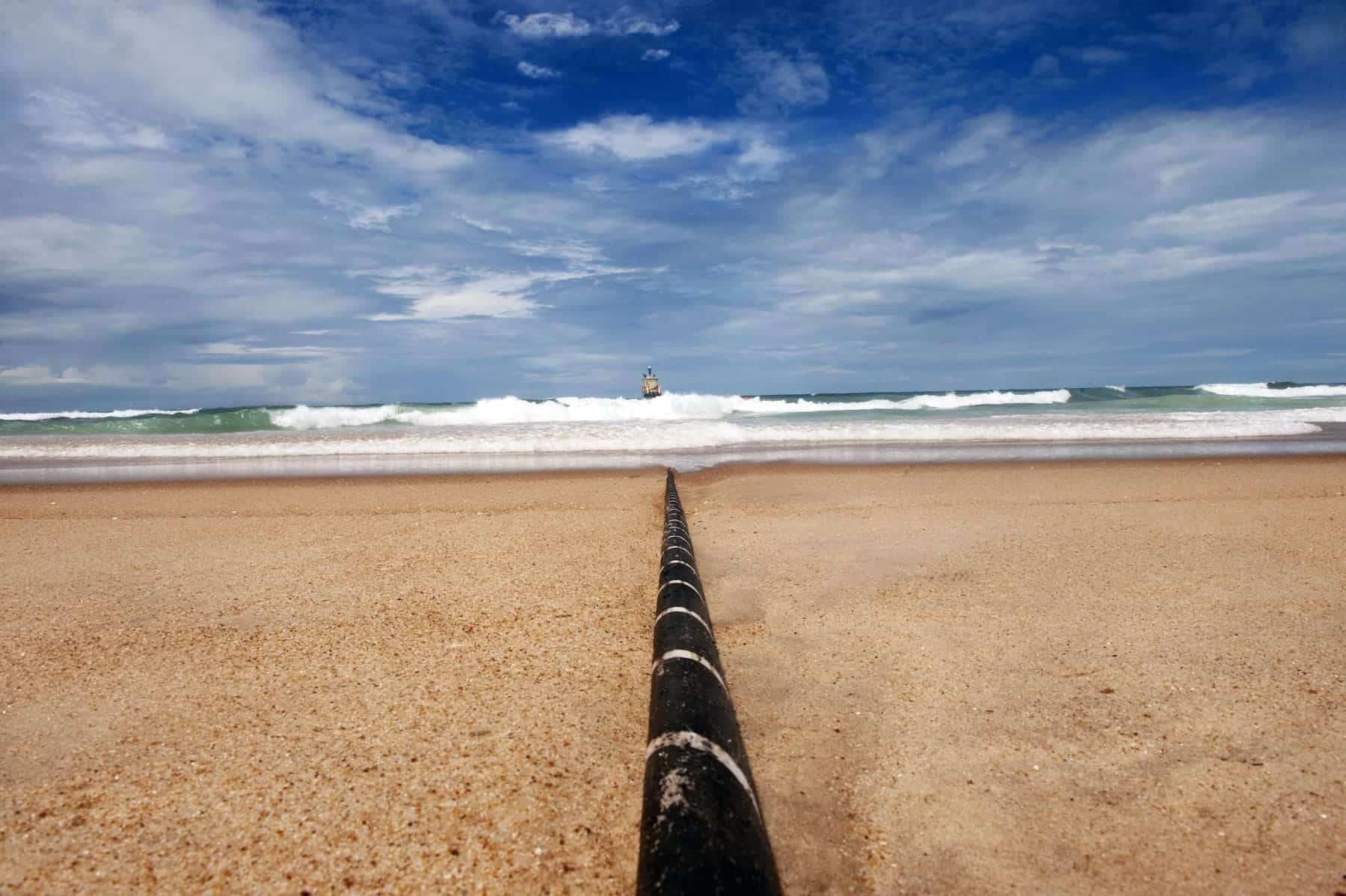
For decades, the world has taken for granted that global connectivity “just exists,” as if video calls, online payments, or email were meteorological phenomena. But beneath the Atlantic—and under many myths—there is a physical infrastructure that sustains this normality: kilometers upon kilometers of cables that, in their day, represented the technological frontier. Now, that frontier is being dismantled through an operation that seems more fitting for the 19th century than the cloud era: a hook, precise coordinates, and skilled hands “fishing” fiber optic cable from the seabed.
The protagonist is TAT-8 (Trans-Atlantic Telephone 8), the first transatlantic fiber optic cable. It went into service on December 14, 1988, connecting the United States and Europe with technology that was then nearly science fiction. Thirty-seven years after its debut—and more than two decades after its decommissioning—the cable is being recovered from the seabed near Portugal for recycling, in an operation led by Subsea Environmental Services, one of the few companies specialized in removing and recycling decommissioned submarine cables.
The cable that proved fiber was the future… in just 18 months
TAT-8 wasn’t the first transoceanic system across the Atlantic, but it was the first to change the rules: for the first time, traffic stopped traveling over copper and instead moved via light pulses through fiber optics. It was such a leap that, at the inauguration, Isaac Asimov participated via videoconference from New York with audiences in Paris and London, celebrating the milestone as a sort of “first journey” over a beam of light. The image was powerful: the Atlantic no longer separated—it connected.
What was most revealing came afterward. At a time when there was still debate about whether more cables would be needed, TAT-8’s capacity was exhausted in just 18 months. That was an industrial response in itself: fiber optics was no longer a curiosity but the way forward. The TAT series continued to grow, and by 2001, there were 14 in total. However, success did not guarantee eternal life: the system eventually suffered a failure that was uneconomical to repair and was retired from service in 2002. Since then, it has sat on the ocean floor like a technological fossil resting on the Atlantic.
“Fishing” a cable from the seabed in 2026
The removal of TAT-8 isn’t a ceremonial ending. It’s hard logistics: specialized ships, meticulous planning, and constant physical effort. According to details published by WIRED, the operation relies on a recovery and transportation vessel, the MV Maasvliet, which has been unloading cable sections at the Portuguese port of Leixões, outside Porto.
During one of these stops, the ship arrived with its crew delayed by an especially active hurricane season—having to dodge storms and recover less cable than planned. Still, the numbers are impressive: up to 1,012 kilometers of TAT-8 was unloaded in a single rotation, before reloading and heading back to continue. This scene shatters the myth of “invisible” infrastructure: extracting a submarine cable involves no automation; it’s a craft.
And it’s no minor operation in impact. The seabed is busier than it appears, and removing old cables helps to free up tested routes for new installations, avoiding entirely new paths and minimizing unnecessary disruptions. Additionally, there’s a tangible incentive: cables contain steel, copper, and polymers—valuable materials. While fiber itself is difficult to reuse industrially, the remaining components have a second life in industry.
The myth of sharks and the human reality of maintenance
Few topics have generated more curious headlines than the supposed “war” between sharks and cables. The story exists, but in many cases, it has been exaggerated into technological folklore. WIRED emphasizes that the real story of submarine cables isn’t sabotage or bites, but the people who build, maintain, and now recover this infrastructure: crews, engineers, operations managers, and specialists who work with route lists where each splice and repair is documented with coordinates and dates.
Moreover, this knowledge is fragile: it’s not always in manuals; often, it’s in the accumulated experience of those who have spent years on cable-laying ships. That’s why the removal of TAT-8 is also a generational reminder: global internet relies on very physical technical skills and on know-how that isn’t improvised.
Bell Labs, an iconic building and 18 km forgotten in a basement
TAT-8 was more than just a cable: it was a milestone of innovation for its time. Part of that history was written at Bell Labs in Holmdel, New Jersey, where key fiber submarine cable technologies were developed and tested. Today, that complex has been repurposed as Bell Works. It’s known for a curious cultural twist: it has become a filming location associated with the aesthetic of the series Severance.
The anecdote takes on a nearly literary quality: during renovations, 18 kilometers of early test cable related to the trials preceding systems like TAT-8 were found. An abandoned relic, rolled up in a basement—as if the building unintentionally preserved a physical fragment of the birth of modern connectivity.
A farewell that explains the present
That the first major transatlantic fiber optic cable is being dismantled doesn’t mean the era of cables is over; quite the opposite. It indicates that the infrastructure ages, is renewed, and is reoptimized for a planet that today depends more than ever on those tendons. While satellites and new constellations are discussed, the reality remains: global connectivity’s capacity and stability continue largely resting on submarine cables.
TAT-8 was the proof of concept that ignited the spark. Its removal, nearly four decades later, stands as a perfect metaphor: technological progress isn’t just built; it’s also dismantled, recycled, and made space for what’s next.
Frequently Asked Questions (FAQ)
What was TAT-8 and why is it considered the first major transatlantic fiber optic cable?
TAT-8 was the first transatlantic system transmitting traffic via fiber optics between the U.S. and Europe. It launched on December 14, 1988, demonstrating the potential of light-based transmission in submarine cables.
Why was TAT-8 retired in 2002, and why has it remained on the seafloor for decades?
The system suffered a failure that was too costly to repair, leading to its decommissioning in 2002. Like many retired cables, it remained on the ocean floor for years until recovery efforts began to free routes and recycle materials.
How is a submarine internet cable recovered, and what role does a vessel like MV Maasvliet play?
Recovery involves locating the cable with accurate coordinates, engaging it with grapnel tools, and raising it for transport and disposal. Specialized ships like the MV Maasvliet are designed to handle cable safely and perform this large-scale logistics.
What materials are recycled from a fiber optic submarine cable, and which parts are less reusable?
Mainly metals (steel, copper), protective materials (like armor), and polymers are recovered. The fiber itself is difficult to reuse industrially, but the rest of the cable has a second life in industrial applications.
via: tomshardware and History of TAT-8
