
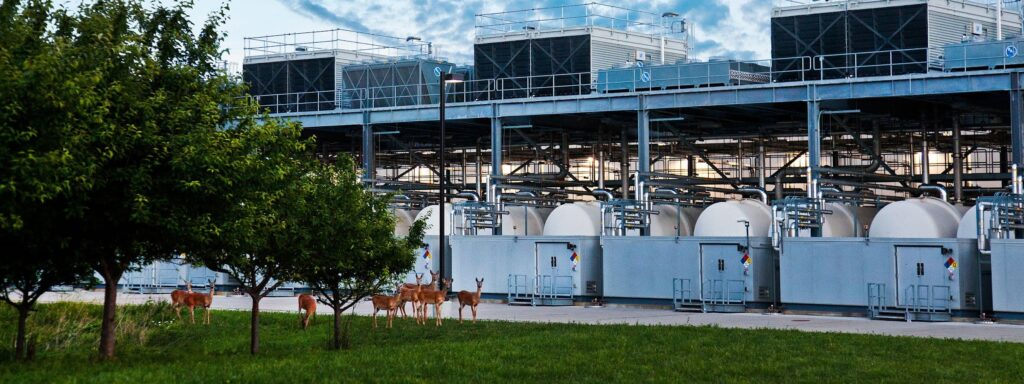
Google has begun construction of a second data center campus in the Kansas City (Missouri) area, a move that confirms the region’s growing importance as a digital infrastructure hub in the United States. The project, publicly known as “Project Mica”, is located on approximately 500 acres of land in Clay County, near the intersection of I-435 and US-169. It is designed to house five data center buildings totaling 1.56 million square feet (about 144,928 m²) with an associated power capacity of up to 700 MW, according to port authorities and industry media sources.
While Google has not provided a specific timetable, it has reiterated a common pattern for such developments: projects moving at an “average” pace usually take 18 to 24 months, depending on factors like workforce availability, supply chain, weather, and electrical connection timelines. Meanwhile, the company continues to operate its first campus in Missouri, announced in 2024 and still under construction, demonstrating that Kansas City is not just an “experiment” but a continued investment in large-scale capacity.
The new bottleneck: power, contracts, and “bulk load rates”
The news arrives at a moment when the data center industry is restructuring around a factor that was once “infrastructure” and is now “strategy”: electricity. The scale of anticipated loads (hundreds of MW) is pushing utilities and regulators to create specific tariffs for large consumers, with mechanisms to prevent the costs of network upgrades and new generation from being passed on to the rest of the customers’ bills.
In the region, Evergy (a major electric provider) has promoted high load tariffs that generally require long-term commitments, pass direct infrastructure costs onto large users, and include components to fund network and generation upgrades. This approach is being adopted in several states within the “data center belt” and reflects a broader trend: if data centers want power quickly and at a large scale, they must accept stricter rules regarding permanence and capacity payments.
Million-dollar incentives and local ROI: the story debate
As with other mega-projects of this size, public incentives play a central role in the discussion. For Project Mica, Kansas City’s Port Authority (Port KC) approved a structure of incentives and funding described locally as up to $10 billion in tools tied to development, including long-term tax incentives (significant reductions in property taxes for decades) and exemptions related to materials and equipment during construction. In exchange, the project commits to contributions toward local educational and professional training organizations.
For Google, the message is clear: the campus “not only” supports digital services but also aims to position itself as a driver of employment, civil works, local hiring, and “economic growth,” a language repeated in nearly all data center announcements since AI demand accelerated expansion plans.
Political background: who pays for the AI boom?
With AI’s electricity demand at the center of the debate, political pressure is also rising. In the U.S., legislative proposals are circulating to shield consumers from the possibility that new electric infrastructure costs, driven by data centers, could ultimately be passed on to households and small businesses. A recent example is a bill sponsored by Senator Josh Hawley to restrict the transfer of energy costs from data centers to consumers, reflecting a regulatory climate increasingly attentive to AI’s impact on electricity bills.
Kansas City, increasingly a “map” of data centers
Project Mica is not an isolated case. Google has already filed (and received permits for) development on another large parcel in north Kansas City in recent years, and the market has long been linking the company to more land purchases and additional plans in the area. Between permits, sites, and projects with code names, the pattern repeats: the region offers space, connectivity, and a favorable environment, but the actual pace of development depends on a crucial factor: when power infrastructure arrives (and under what contractual conditions).
Overall, the launch of the second campus confirms a trend that is no longer solely explained by “cloud,” but by AI and industrial-scale data movement. The data center has ceased to be just a technical facility and has become a strategic asset where local economy, energy policy, tax incentives, and global technological competition intersect.
Frequently Asked Questions
What is “Project Mica” and why is it important?
It’s the name for Google’s second data center campus in Kansas City. It’s significant because of its scale (multiple buildings, large footprint, high electricity demand) and the energy and regulatory context surrounding it.
What are the implications of a campus up to 700 MW?
It represents a power demand comparable to major industrial facilities and requires careful planning of grid connections, substations, and new generation capacity or supply contracts with stricter requirements.
Why do data centers receive tax incentives?
Governments often justify these incentives through direct and indirect investments, job creation, local contracting, and economic activity. However, these incentives are debated, especially if communities perceive impacts (noise, construction, strain on services) without proportional benefits.
What is changing in electrical regulation due to AI expansion?
An increasing number of tariffs are being introduced for “large loads” (data centers) to ensure they bear the costs of connection and network reinforcement, while political initiatives aim to prevent these costs from being passed on to consumers.
via: kshb
