
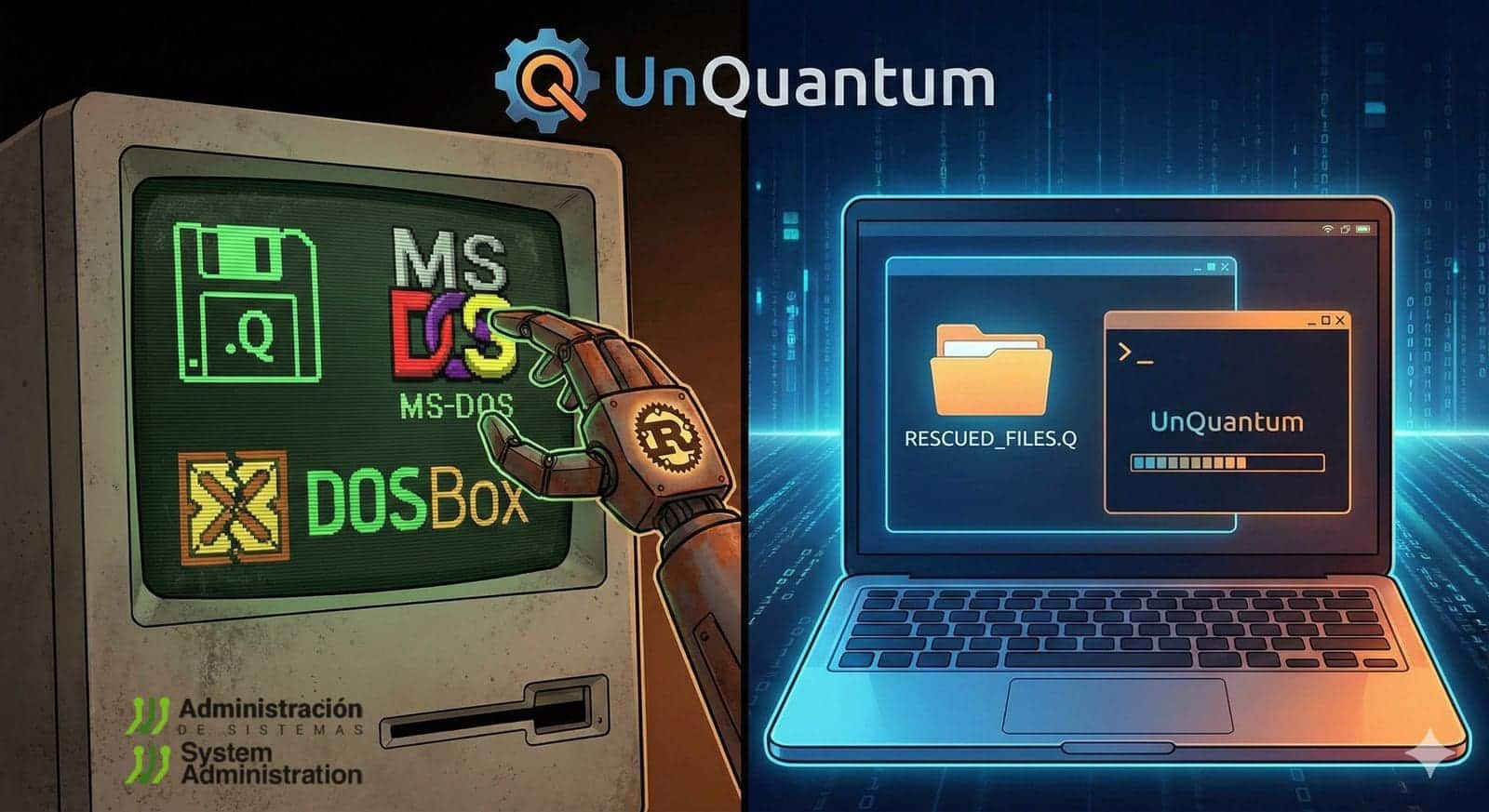
For years, thousands of compressed files with the extension .Q have been stuck in a technological limbo: they exist in archival collections, old CDs, and stored repositories, but actual access depended on reconstructing an ecosystem that no longer exists today. The format, known as Quantum, was created by David Stafford at Cinematronics (Austin, Texas) between 1993 and 1995. It was considered an advanced compression solution for its time, with a technical approach different from the most popular compressors of the nineties.
The problem wasn’t just its age, but the practical barrier: .Q files were decompressed using tools like UNPAQ.EXE, a 32-bit DOS executable that required a Borland DPMI extender. In practice, this meant using DOSBox or another emulator to recover data—manageable for enthusiasts, but unrealistic for modern workflows, preservation, or digital research.
This bottleneck is what UnQuantum aims to eliminate—a project that serves as a native, modern decompressor for the Quantum standalone (.Q) format, reimplemented in Rust and designed to run directly on Linux, macOS, and Windows.
A format ahead of its time… then forgotten
Quantum wasn’t “just another ZIP.” While many compressors of the era relied on schemes like Huffman coding, Quantum used a combination of LZ77 and arithmetic coding. This decision made it a competitive solution in compression ratios at the time.
Its scope was greater than its current obscurity suggests: the algorithm was licensed by Microsoft and integrated into the Cabinet (.CAB) ecosystem. It also attracted interest or adoption from other players like Borland or Novell, according to the project’s documentation.
However, the .Q format as a standalone archive became obsolete over time. Partly because development stopped at version 0.97; and partly because the software world moved toward other standards, leaving Quantum as a technical capsule of its historical moment.
The detail that broke extractions… and the reverse engineering that uncovered it
In reconstructing an old format, the challenge is often not “understanding the theory,” but grasping the nuances. In the case of UnQuantum, the first major clue was perplexing: single-file archives decompressed fine, but multi-file archives began to corrupt after the second file.

The initial diagnosis pointed to the arithmetic decoder, but tests ultimately ruled it out: the behavior was similar to implementations known in other contexts. The real rupture was in how the standalone format delimiting files inside the compressed stream.
The key discovery was a detail not clearly documented: between each file, the format inserts 16 bits (a checksum) directly into the raw bitstream, outside the arithmetic decoder. That means if these 16 bits aren’t consumed at the right moment, the subsequent reading becomes desynchronized.
This detail is further emphasized by an important particularity: the state of the coder and adaptive models are preserved across files. It’s not a “re-initialize per file,” but a continuous stream with subtle boundaries.
What UnQuantum contributes to preservation (and real-world use)
UnQuantum’s goal isn’t just about “opening an old file,” but reducing the operational cost of recovering it. Practically, the project aims to handle a .Q file as any modern compressed file: list its contents, check integrity, and extract, without requiring a full DOS environment.
There is also a clear focus on portability: the project describes itself as cross-platform and seeks native execution on modern systems.
Technically, the GitHub README details the algorithm (LZ77 + arithmetic coding with multiple adaptive models) and the file structure, including the signature (“DS”), configurable window sizes, and the critical inter-file checksum.
On a “human” level, the project aligns with a strategic idea that, by 2026, no longer sounds nostalgic but essential: preserving data isn’t about storing disks on a shelf; it’s about ensuring they can be read in 10, 20, or 30 years—without relying on fragile tools or emulated environments that might become unsupported, unsafe, or unfeasible.
Frequently Asked Questions (FAQs)
What is the .Q (Quantum) format, and why was it important?
It’s a MS-DOS compression format from the 1990s that combined LZ77 with arithmetic coding. It was significant enough for Microsoft to license it and incorporate it into their compression ecosystem (including CAB files).
Why is it so difficult to decompress .Q files today?
Because they depended on old tools like UNPAQ.EXE, a DOS executable requiring a DPMI extender, which means using emulation like DOSBox to recover content.
What caused multi-file .Q archives to become corrupted in modern implementations?
A key detail: between files, a 16-bit checksum is inserted into the raw bitstream, outside the arithmetic decoder. If not consumed correctly, the stream loses synchronization and extraction fails.
Who benefits from using UnQuantum today?
Anyone working with historical collections (old CDs, archived BBS, classic repositories) or needing to extract data from .Q files on modern systems without relying on DOS emulation.
