
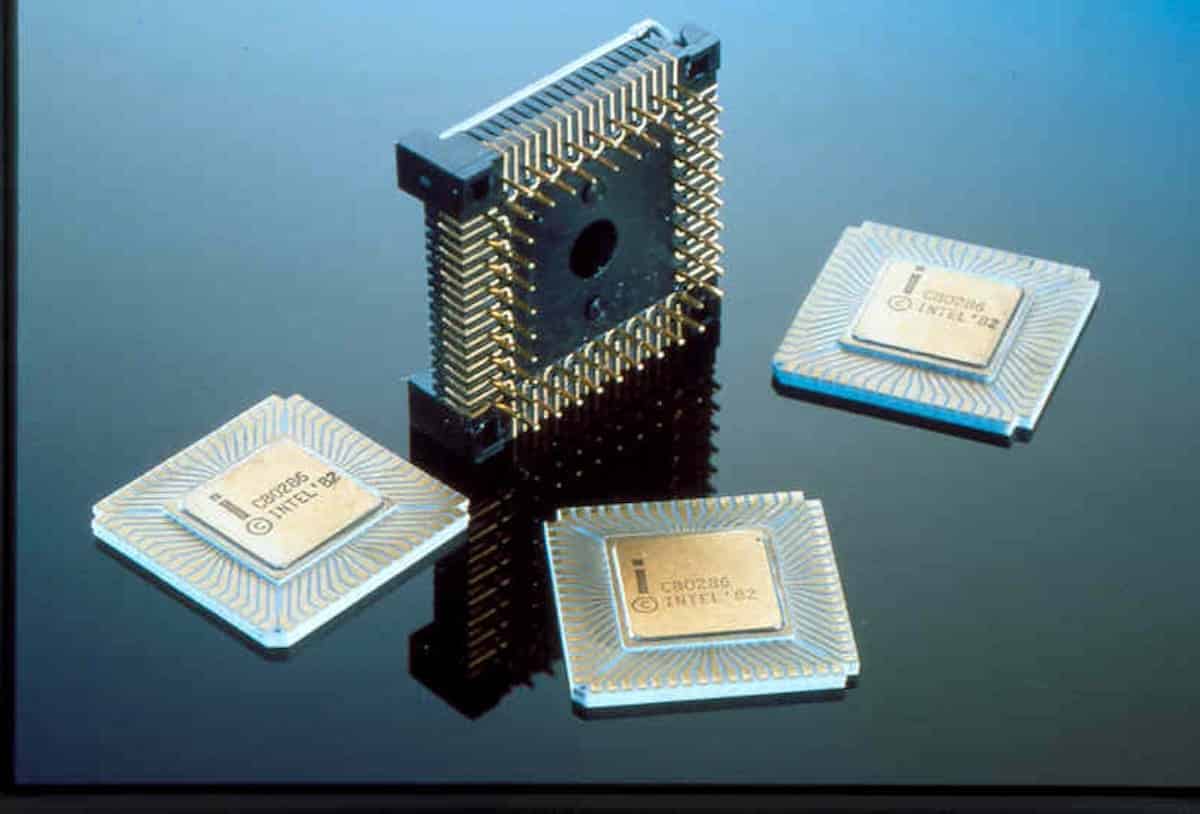
There was a moment when the personal computer ceased to be, in the eyes of many companies, a limited tool for basic accounting and texts, and began to hint at something more ambitious: true multitasking, more memory, and controls to prevent programs from “overlapping” each other. That inflection point is associated with a processor that today sounds like a museum piece, but which for years drove office computing: the Intel 80286, introduced on February 1, 1982.
The 286 wasn’t just “another x86.” It was the first major attempt to bring concepts from more serious systems—such as memory protection and advanced management—to the PC market, which was about to explode with clones, standards, and, most notably, with a word that would define an era: AT.
From 1 MB to 16 MB: when memory stopped being a cage
If the 8086/8088 (the basis of the original IBM PC) represented the gateway, the 80286 aimed to open the entire room. With a 24-bit address bus, the chip could address up to 16 MB of physical memory, far beyond the 1 MB limit that constrained early IBM PCs and compatibles.
Technically, that leap wasn’t just a catalog number: it meant that the PC could handle more demanding workloads and operating systems with better foundations. The 286 introduced the “protected mode”, with mechanisms to separate and safeguard areas of memory, key for building more robust multitasking environments.
In theory, the path was clear: boot up, switch to protected mode, and stay there. In practice, the real world had a giant problem: MS-DOS and a mountain of applications written for “legacy” mode weren’t ready for that transition.
The big “but” of the 286: entering was easy, exiting wasn’t so straightforward
Here’s one of the reasons why the 80286 is remembered with a mix of admiration and frustration. The chip could enter protected mode… but it wasn’t designed to easily return to real mode (the mode compatible with 8086) without a reset of the processor. In the PC/AT, IBM relied on circuitry and BIOS routines to enable that switch, but it wasn’t an elegant or simple solution.

This technical detail influenced something very human: software and markets tend to favor what doesn’t break the past. The 286 pushed toward the future, but the ecosystem continued living in the present (DOS).
The eye-catching moment: IBM PC/AT and the standard that changed everything
The 80286 gained widespread traction when IBM put it at the heart of their IBM PC/AT, introduced in 1984. The AT was not just “a faster PC”: it became a benchmark for business, featuring a hard drive as a more common element and inspiring a wave of compatible machines.
The result was cultural and economic: the PC stopped being a “young” invention and became infrastructure. When infrastructure standardizes, the market of clones, peripherals, and expansions appears—and with it, rapid growth.

It’s no coincidence that Intel highlights that period as a key moment in popularizing the PC: according to the company’s virtual museum, by 1988, 10 million units of the 286 had been shipped.
Performance and numbers: the 286 in brief
Although the story of the 286 isn’t just “more MHz,” it also involved design and efficiency improvements over its predecessors. Still, its specifications help understand why it was so widely used for so many years.
| Key Data | Intel 80286 |
|---|---|
| Launch Date | February 1, 1982 |
| Architecture | 16-bit x86 |
| Addressing | 24 bits (up to 16 MB) |
| Optional Co-processor | Intel 80287 |
| Maximum Frequency (family) | up to 25 MHz |
For the user at the time, the simpler takeaway was: with an AT and a 286, “you could get work done.” And for a long time, that was enough.
The successor: when Windows and software started demanding more
The 80286 dominated a crucial part of the 1980s, but its reign was limited: newer, more flexible processors like the 80386, along with evolving software, soon replaced it.
A symbolic milestone was Windows 3.1, which eliminated support for Real Mode and only ran on 80286 or later, indicating that the ecosystem was moving beyond backward compatibility.
However, the industry quickly shifted toward the 386, which offered a leap that the 286 hinted at but never fully delivered: a more “usable” protected mode and a stronger foundation for the future of the PC.
Why the 286 still matters in 2026
Looking back, the Intel 80286 encapsulates a recurring dilemma in technology: innovate without breaking. It was an advanced processor for its time—introducing protected mode and memory management—but constrained by its ecosystem (DOS and legacy applications) and design decisions that later proved to be practical limits.

Yet, its impact is undeniable. If the PC became a global business standard, it was thanks to components like the 286 and platforms like the PC/AT, which proved that personal computers could be reliable, expandable, and “serious” in offices and organizations.
Frequently Asked Questions
What did the Intel 80286 bring compared to the 8086/8088 used in the first IBM PCs?
mainly the jump to up to 16 MB of addressable memory and the protected mode, designed for more robust, multitasking systems, along with performance and architectural improvements.
Why is the “protected mode” of the 286 so discussed?
Because it was the PC’s first major step toward concepts of security and memory isolation, essential for more advanced operating systems. The issue was that the DOS ecosystem wasn’t ready to leverage it widely.
What does the 80286 have to do with the IBM PC/AT and “clones”?
The IBM PC/AT (1984) popularized the 286 in the business market and established a standard that inspired a wave of compatibles, accelerating the expansion of the PC as the dominant platform.
When did the 286 start to lag behind for the average user?
As software and operating systems began to demand more, and processors like the 386 offered a more practical protected mode. As a milestone, Windows 3.1 no longer supported Real Mode and required at least a 80286.
Images via Intel.
