
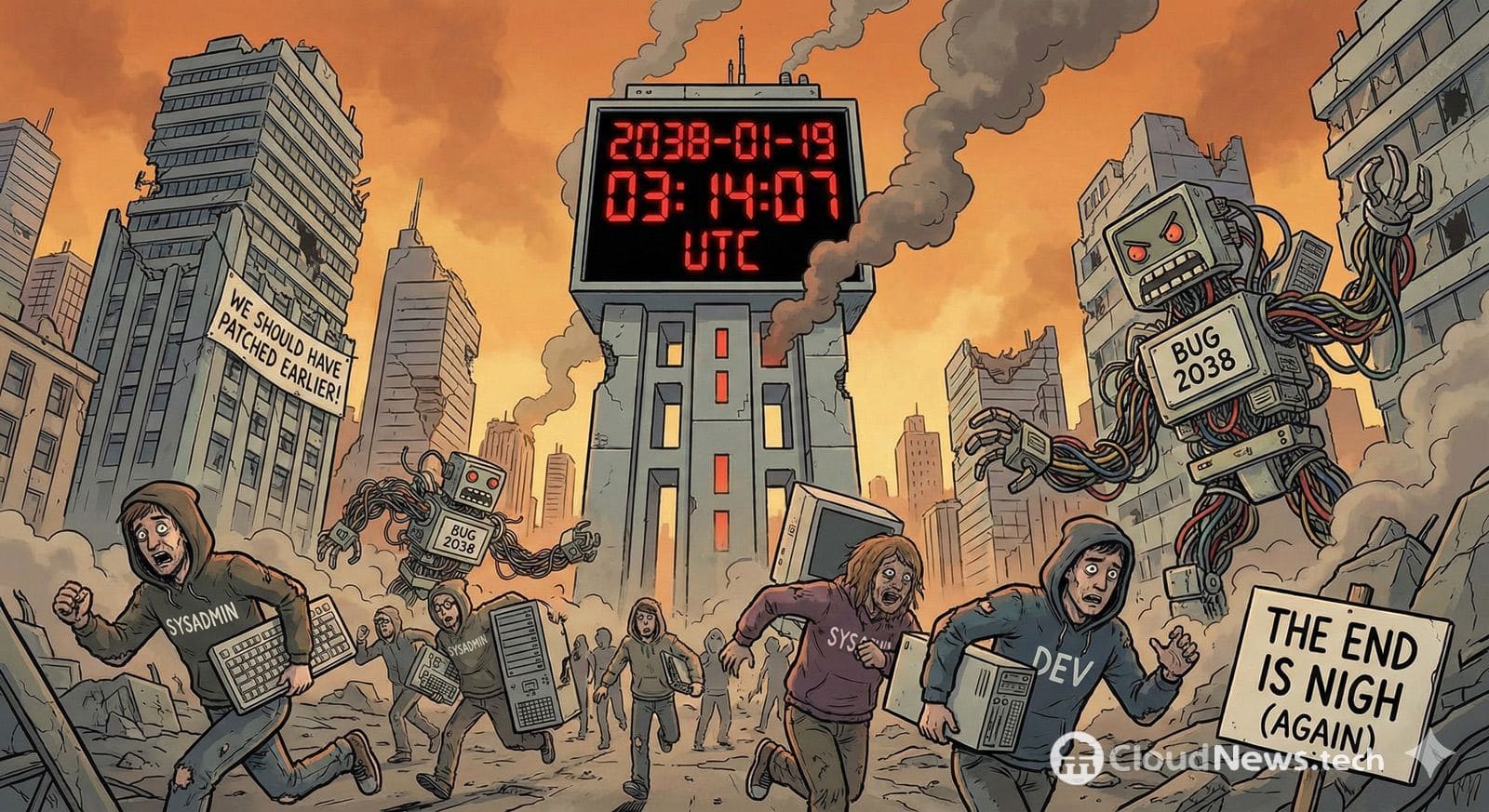
On January 19, 2038, at 03:14:07 UTC, a portion of legacy Unix-based software will encounter a very specific mathematical limit: if time is stored as a signed 32-bit integer counting seconds since January 1, 1970, the counter reaches its maximum and, when adding one more second, it “wraps around” and jumps to a date in 1901. This is the Year 2038 problem (Y2038), a time representation bug that doesn’t “break the Internet” by magic, but can cause everything from silent logical errors to complete service outages in systems that depend on future dates, expirations, validations, or planning.
The reason this topic is back in the headlines isn’t due to a lack of solutions: in modern platforms, the transition to 64-bit time values is well underway. The real challenge lies elsewhere: many long lifecycle environments remain (OT/industrial systems, appliances, routers, cameras, medical equipment, terminals, embedded systems, and “set-and-forget” software) where change is costly, slow, or outright impossible without replacing hardware.
The key nuance: there’s no “magic patch,” but a clear strategy
Talking about “chaos” can grab attention, but technically speaking, the correct stance is:
- There’s no single button to convert all 32-bit software to “2038 safe”.
- The solution involves migrating temporal representations to 64 bits (in code, libraries, ABIs, formats, and data) and rebuilding components where necessary.
- Where rebuilding isn’t possible (closed firmware, unsupported devices, legacy applications without source code), the approach is containment (isolation, planned replacement, front-end proxies, platform change).
That’s why serious projects have been working “layer by layer”: kernel and system calls, libc, toolchains, packages, even utilities and traditional formats.
Linux and the transition: the often-forgotten detail
In Linux, the Y2038 debate isn’t just “kernel vs. userland.” There’s a particularly delicate component: the ABI and C libraries.
A practical example of how the GNU/Linux ecosystem is addressing this is the approach of recompiling 32-bit software with time_t set to 64 bits wherever possible. In glibc (from recent branches), this is done via build macros like _TIME_BITS=64 and through time64 interfaces, aiming to reduce overflow risks and standardize migration to 64 bits without waiting for entire systems to become purely 64-bit.
Friction arises in unexpected places: not only in your application, but also in system tools, audit utilities, log formats, and databases that have historically assumed 32-bit timestamps.
Concrete case: distributions already moving forward (and what it means for sysadmins)
Debian’s documentation for its testing/next branch precisely reflects this kind of transition: the project treats the move to 64 bits as a broad modernization, affecting traditional packages and tools, with measures to prevent legacy parts from clinging to 32-bit assumptions.
For system administrators, this means two things:
- Good news: In updated environments, much of the risk is mitigated through the normal update cycle.
- Bad news: If 32-bit islands (or legacy software) are kept “because it works,” the risk concentrates there, and the cost of migration tends to grow the longer it’s postponed.
What can truly go wrong (beyond headlines)
The failure doesn’t always manifest as an immediate crash. In many environments, the danger is silent:
- Validations that no longer make sense: “expired/not expired,” “before/after,” maintenance windows, holds.
- Schedulers and automation: scheduled backups, rotations, deferred tasks, renewals.
- Cryptography and certificates: expiration checks and validity assessments with future-dated timestamps.
- Observability: metrics with corrupted timestamps, disorganized logs, SIEM systems “losing” the timeline.
- Persistent data: database schemas storing epoch in 32 bits, legacy binary formats.
Even when the system avoids outright failure, some APIs in 32-bit environments might return errors due to overflow when handling out-of-range dates—something explicitly documented in time interfaces.
Practical checklist for sysadmins and dev teams in 2026
1) Inventory: locate 32-bit systems and legacy software
- Identify real 32-bit systems (hardware or userland) and containers/VMs with 32-bit userland.
- List appliances (old NAS, routers, CCTV, OT devices) and their update policies.
- Map critical dependencies: DNS, NTP, PKI, authentication, logging, queues, middleware.
2) Risk assessment by function, not by “brand”
Prioritize where timing is critical:
- Authentication/authorization, auditing, traceability
- Billing and compliance
- Expirations (certificates, tokens, licenses)
- Log retention and evidentiary archives
3) “Time-travel” testing
- Perform integration tests with simulated clocks in the lab to detect:
- Date comparisons
- Serialization/deserialization
- Sorting and retention issues
- Pay particular attention to components that use custom integers for epoch storage.
4) Guidelines for developers: simple rules to prevent disasters
- Avoid storing epoch in
int32; use moderntime_tor explicit 64-bit types. - Don’t assume size of
time_t. - Review formats on disk and in network (protocols, binary files, data structures).
The message for the tech media: 2038 isn’t tomorrow, but already influences decisions today
By 2026, Y2038 acts as an uncomfortable reminder: much of the digital infrastructure outlives the typical IT refresh cycle. Serious work involves reducing legacy time representation debt, identifying inherited islands, and fitting migration windows into feasible change periods. In modern systems, the issue often becomes routine maintenance; in embedded or unsupported systems, it’s a matter of business continuity.
