
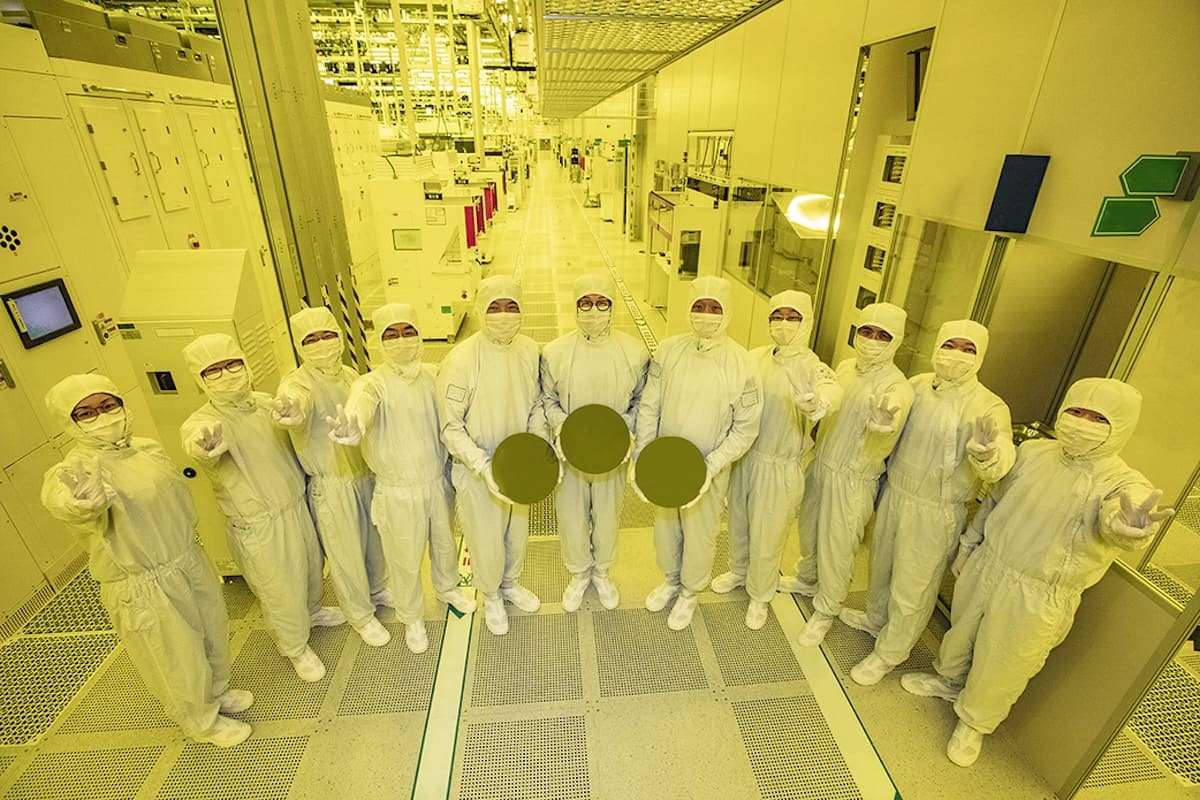
The Samsung Foundry business — the division that manufactures chips for third parties — closed 2025 with an uncomfortable signal for any manufacturer aspiring to compete at the top tier of silicon: some of the expected demand from China evaporated before reaching production. According to industry sources in Korea cited by specialized press, several Chinese clients who had planned to turn to Samsung Foundry abandoned projects at a particularly sensitive time—just as the schedule was approaching the industrialization phase and regulatory uncertainty was at its peak.
The explanation, in this case, cannot be understood without considering the geopolitical landscape. U.S. pressure on the Chinese tech ecosystem — through export controls, licenses, and restrictions on critical tools and technologies — has made chip planning a risky exercise. Designing, validating, and preparing a production run takes months of work and significant financial commitments. If, midway through this process, access to IP, EDA tools, advanced packaging, or even certain supply chains becomes uncertain, a project can shift from “viable” to “toxic” in a matter of weeks.
A blow at the worst moment: the “moment of truth” for tape-out
The industry typically measures announcements by their media buzz, but the real decisions occur in specific phases: capacity agreements, tape-outs, testing, yields, and ramp-up. It is precisely in this zone — when the design stops being a promise and begins consuming wafers — where, according to market reports, Samsung suffered the most client pullback from China in 2025.
For Samsung, the problem isn’t just the sudden loss of a contract. In a business where the fixed costs of a factory are enormous, capacity utilization is key. When projects fall near production, the damage manifests as workload gaps that are difficult to fill in the short term. And, in a context where the company is trying to catch up with TSMC and solidify its roadmap in advanced nodes, every percentage point of utilization counts.
Export controls and domino effect: uncertainty slowing down investments
Throughout 2025, the tightening — or the threat of tightening — of export controls has been a factor that, according to various analysts and industry sources, has impacted both suppliers and clients. The pattern repeats: in a volatile regulatory environment, companies tend to delay decisions, fragment risks, or rethink technological partnerships.
The situation worsened with debates over permits and licenses for operating with key tools and technologies. By the end of 2025, Reuters reported that the U.S. granted Samsung and SK Hynix an annual license to send manufacturing equipment to their facilities in China during 2026 — a temporary relief following previous changes in authorization frameworks. For the market, this serves as a thermometer: even when pathways to sustain operations are approved, a sense of provisionality persists. And this feeling influences client decisions, who prefer not to risk launching a chip amid regulatory surprises.
Samsung Foundry, in full reconquest: between mature nodes and the race for 2nm
The slowdown from China arrives as Samsung attempts to rebalance its foundry business with two strategies: strengthening mature nodes — where chips for automotive, industrial, or consumer electronics are manufactured — and simultaneously demonstrating real traction in flagship nodes, where major contracts in high-performance computing and AI are at stake.
In 2025, Samsung signed a manufacturing deal valued at $16.5 billion with an unidentified global client, a move interpreted by the market as a sign that the company was still capturing significant volume. However, analysts also note that execution challenges — and especially the ecosystem’s confidence in yields and schedules — are critical factors for attracting high-demand workloads.
Meanwhile, the AI cycle is reshaping priorities: it’s not just about making faster chips but ensuring availability, advanced packaging, interconnection, and a reliable supply. This “all-in-one” approach favored by AI benefits those who can guarantee a reliable end-to-end supply chain, and competition in this area is fierce.
Stabilization by year-end? What “returning to normal” means in 2026
When the industry talks about “stabilization,” it doesn’t mean going back to the way things were, but rather regaining visibility. The current idea is that Samsung might see gradual improvement toward the end of 2026 if several factors align: clearer regulatory landscape, resumption of frozen projects, and a backlog capable of keeping factories running smoothly.
But “stabilization” also entails accepting a new reality: China will remain a huge market, albeit more conditioned; the U.S. will continue to tighten or moderate controls based on strategic priorities; and customers will seek designs that can “move” between suppliers or nodes with less friction. In other words, sector stability will no longer depend solely on technology and price but also on geopolitical risk.
For Samsung, the takeaway is twofold: on one hand, the Chinese pullback in 2025 illustrates how quickly demand can evaporate when uncertainty crosses a line. On the other hand, the debate over technological sovereignty and supply chains opens opportunities for those able to offer diversified manufacturing, compliance, and continuity guarantees.
A battle that’s not just about chips: it’s about trust
Ultimately, what’s at stake for Samsung Foundry isn’t just attracting more clients but building market trust in its ability to execute at scale and on time, even when political environments complicate planning. The exit of Chinese projects in 2025 serves as a reminder: in semiconductors, demand alone isn’t enough; certainty is essential.
And in 2026, that certainty is nearly as valuable as silicon itself.
Frequently Asked Questions
Why did some Chinese clients abandon projects with Samsung Foundry in 2025?
Due to increasing regulatory uncertainty related to U.S. export controls and the risk of projects being blocked or limited just before entering production.
What is the impact on Samsung Foundry when projects are canceled near production?
It usually affects factory utilization and capacity planning, as last-minute workload gaps are hard to fill and can pressure margins.
What does it mean that Samsung expects stabilization by the end of 2026?
It implies regaining order visibility and operational continuity, with a more stable project pipeline and fewer decisions frozen by regulatory uncertainty.
How do export controls influence the semiconductor industry?
They impact manufacturing tools, licenses, IP, and supply chains, increasing the risk of launching chips for markets or clients exposed to restrictions.
