
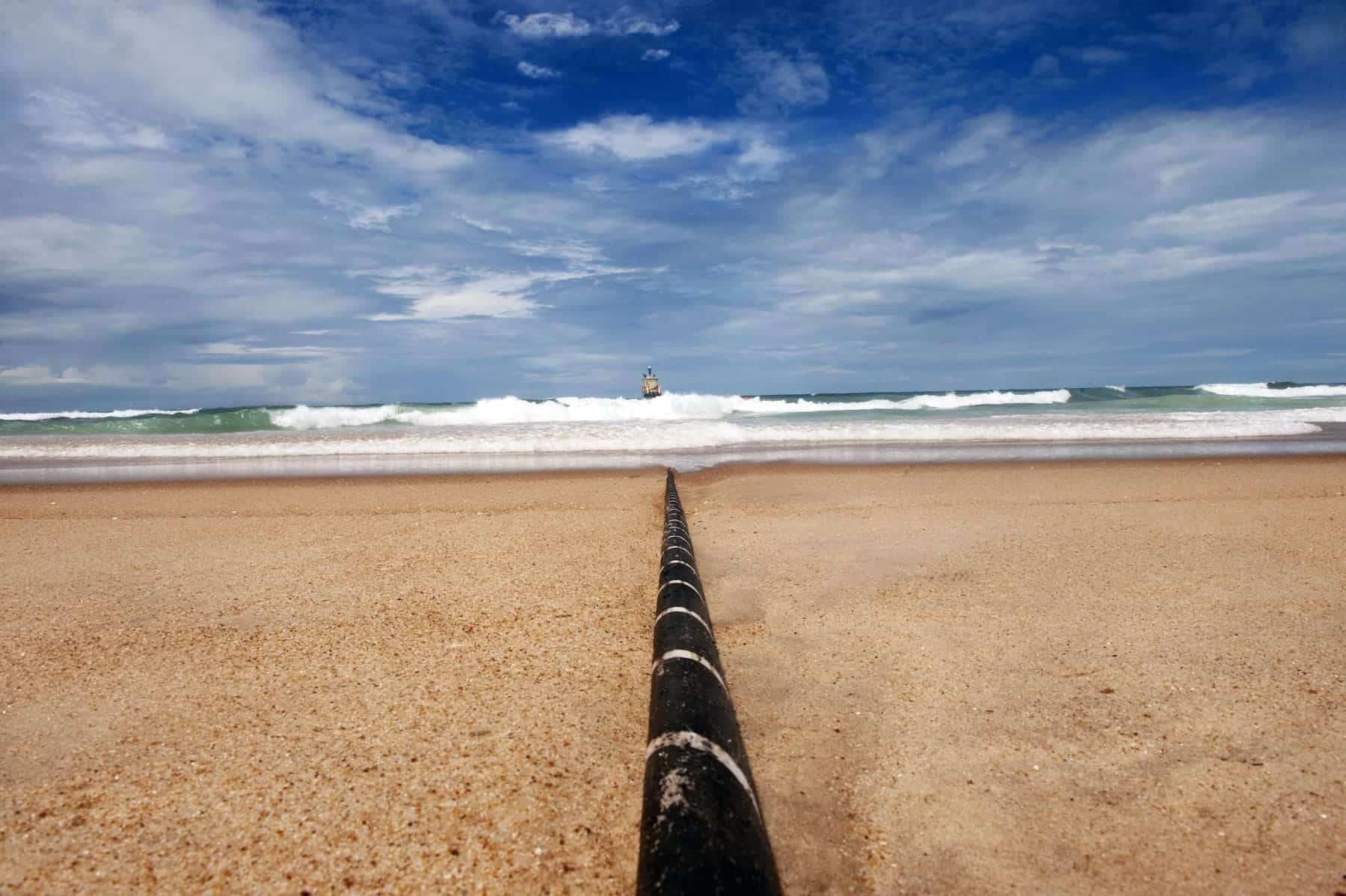
The Baltic Sea appears calm when viewed from the coast. But beneath its cold, gray surface runs one of Europe’s most delicate “highways”: the network of submarine cables that underpins much of our digital communications and, in some cases, crucial energy connections. In recent years, a string of incidents—ranging from damages attributed to difficult-to-explain “accidents” to outages occurring at the worst moments—has increased tensions in the region. Finland has decided to move from concern to establishing a permanent structure: a maritime monitoring center focused on detecting anomalous behaviors and protecting critical underwater infrastructure.
The measure comes amid a context where Nordic and Baltic countries recognize that security is no longer solely a land matter. It’s also fought in invisible routes, on the seabed, and on a battlefield where hybrid pressure—an unsettling mix of ambiguity, plausible deniability, and surgical strikes—has gained prominence. In this scenario, the activity of the so-called Russian “shadow fleet”—ships sailing with incomplete signals, turned-off transponders, or confusing identities—has become one of the most worrisome issues for regional authorities: their opacity complicates quick attribution when something goes wrong.
The Problem: “Invisible” Cables That Fall Apparent Only When They Fail
A submarine cable isn’t impressive because of its size but because of what it represents. It carries a significant portion of international Internet traffic, corporate data, and financial transactions. Its fragility isn’t in the material—designed to withstand a hostile environment—but in exposure: thousands of kilometers laid along maritime routes that see merchant ships, fishing boats, dredgers, anchors, and, in geopolitical tension scenarios, possible malicious operations.
What was once considered a remote risk is now approached as an operational hypothesis: a cut not only causes inconvenience but can degrade connectivity, increase costs for alternative routes, cause unexpected latency in critical services, and force the activation of contingency plans that many organizations haven’t sufficiently tested. The key is that damage doesn’t need to be massive to be costly—hitting a sensitive point can create uncertainty, delays, and public debate over defense capabilities.
An “Eye” Underwater and in the Sky: A New Monitoring Center
Finland’s initiative is based on a simple idea: if the risk resides at sea, the response must be maritime, sustained, and technologically advanced. The new monitoring center aims to build a common picture of what’s happening around cable routes by integrating several layers of observation:
- Maritime traffic tracking (AIS/transponders) and detection of unusual patterns: ships reducing speed near sensitive areas, erratic trajectories, or signal “blackouts” at critical points.
- Satellites and sensors for broad surveillance, useful for reconstructing movements and cross-referencing data when signals are missing.
- Real-time monitoring systems with early warning alerts, designed to react before an incident escalates.
- Drones and underwater vehicles (ROV/AUV) for inspection, verification, and, when needed, technical documentation of damage.
At its core, the goal isn’t just to “see,” but to deter. For critical infrastructures, constant surveillance shifts the calculus for actors seeking to operate covertly: increasing the likelihood of detection (or leaving a trace) raises the cost of attempted interference.
The “Shadow Fleet”: Why It Concerns Beyond the Narrative
The term “shadow fleet” describes vessels operating on the margins of regulation and with low transparency, often linked to schemes that evade controls or sanctions. In the Baltic, this label has become a warning sign precisely because opacity complicates response.
When a vessel navigates with inconsistent signals or dubious information, subsequent investigations slow down, and political reactions become complicated. In hybrid warfare, time itself becomes part of the damage: it’s not necessary to prove with absolute certainty—just enough to sow doubts, diplomatic tensions, and feelings of vulnerability.
Regional Cooperation: The Baltic Isn’t Protected Alone
Finland isn’t taking this step alone. The Baltic Sea is a shared environment, and any realistic strategy requires coordination among coast guards, navies, regulators, and private operators. Meanwhile, the European Union has urged member states to strengthen cooperation and investments to safeguard submarine cables, recognizing their systemic importance.
This translates into joint exercises, intelligence sharing, response protocols, and increasingly, a focus on rapid attribution: understanding what happened, when, and with what evidence. In an environment where incidents can appear as “accidents,” technical reconstruction capabilities are nearly as vital as repair efforts.
Real Impact for Companies: Resilience Is Not Just “Having a Backup”
Every new alert in the Baltic teaches European businesses an uncomfortable lesson: global connectivity isn’t an abstract service; it’s a physical dependency. Many organizations are revising their continuity strategies beyond just words.
To protect against cable failures (or severe network degradation), practical measures include:
- Diversifying routes and carriers: two links are not enough if they rely on the same international path.
- Multi-region cloud and infrastructure strategies: bringing services closer to users and enabling quick switching without redesigning everything during a crisis.
- Failover testing: plans that aren’t practiced won’t hold when needed most.
- Network observability: measuring latency, packet loss, and routing to detect issues before users notice.
- Clear agreements with providers: realistic SLAs, repair times, escalation procedures, and transparency during incidents.
The underlying message of Finland’s center is that security isn’t just “cyber.” It’s also infrastructure: and that infrastructure resides in hard-to-monitor places—until it becomes a national priority.
A European Symptom: Critical Infrastructures Enter the Defense Agenda
For years, discussions about submarine cables involved only operators and technicians. Now, it has become part of security discourse. Finland’s establishment of a dedicated center reflects an understanding that incidents are not isolated episodes but part of a regional pattern demanding continuous vigilance.
In the Baltic, where margins of error are small and critical infrastructure density is high, protecting the seabed is beginning to resemble a new frontier: silent, technological, and strategic. And Europe is gradually accepting that connectivity must be defended too.
Frequently Asked Questions
What happens if a submarine cable is cut, and how does it affect Internet in Europe?
It can cause capacity degradation, longer alternative routes, increased latency, and temporary saturation of links. In critical services, the impact depends on actual redundancy.
What is the “shadow fleet” and why is it associated with risks in the Baltic Sea?
It describes vessels with low operational transparency (incomplete signals, opaque identities, complex registrations), which complicate attribution and quick response near critical infrastructure.
How can companies reduce the risk of disruptions caused by submarine cable incidents?
Through genuine route and carrier diversity, multi-region setups, connectivity agreements with different providers, advanced network monitoring, and regular failover testing.
Can submarine cables be physically protected effectively?
Zero risk doesn’t exist, but combining surveillance, controlled zones, submarine vehicle inspections, regional cooperation, and quick response capabilities reduces sabotage chances and accelerates attribution.
Source: Tom’s Hardware (coverage of the monitoring center and incident context in the Baltic).
