
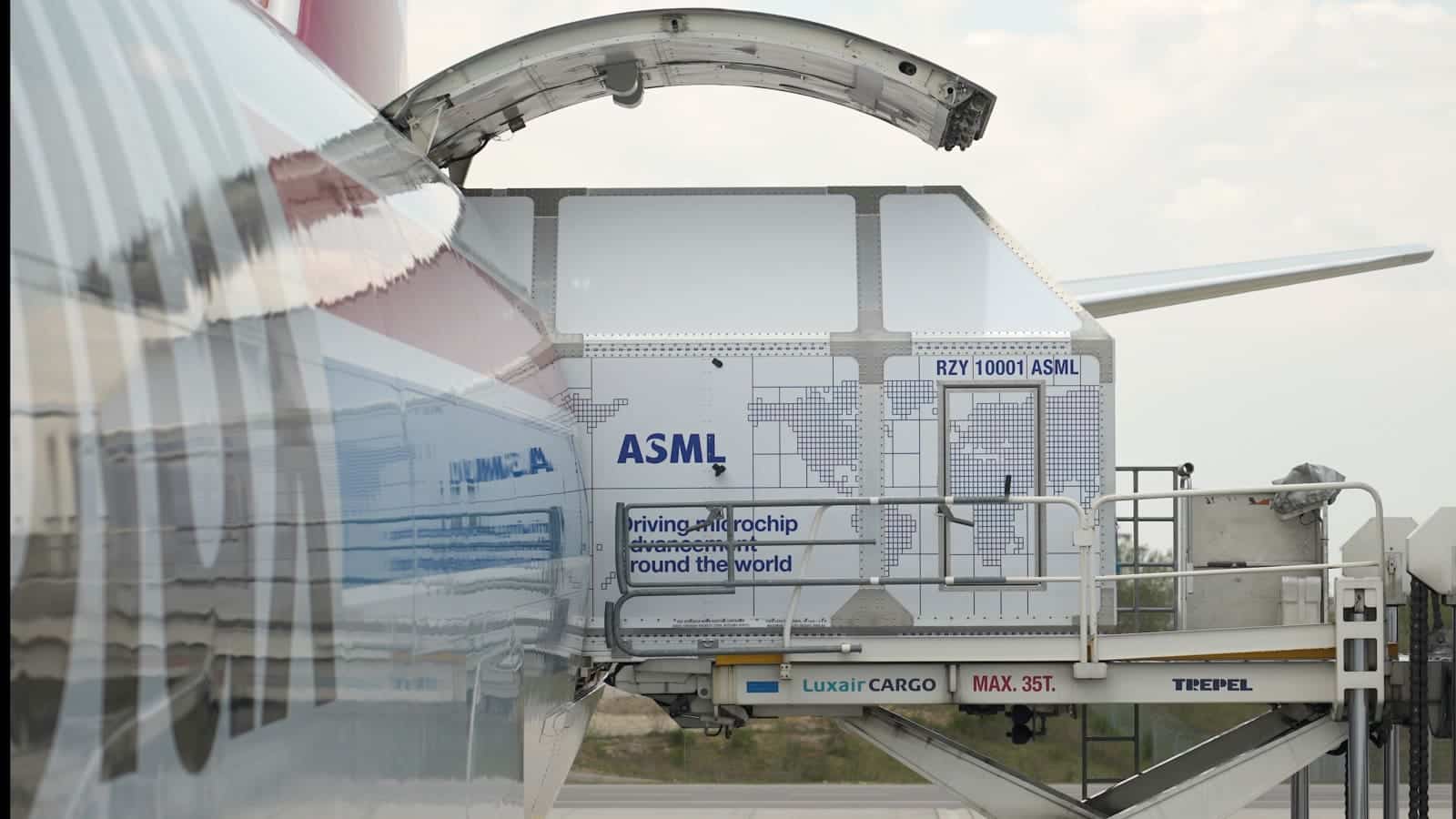
ASML, the Dutch manufacturer of the most critical lithography machines for the semiconductor industry, closed 2025 with a paradox that’s hard to ignore: orders exceeding expectations, record profits driven by demand related to Artificial Intelligence (AI), and at the same time, a plan to cut around 1,700 jobs, approximately a 4% of its workforce.
The financial snapshot explains why the market views ASML as a leading indicator of the tech cycle. The company recorded a record net profit of 9.6 billion euros in 2025, with sales of 32.7 billion euros. This occurred in an environment where major clients — chip manufacturers and their end buyers — are accelerating investments to expand AI-related production capacity.
“HyperScaler” orders: what ASML is really signaling
In ASML’s business, as important as today’s revenue is the backlog of orders for tomorrow. This is where the notable data comes in: in the fourth quarter of 2025, the company reported 13.2 billion euros in order reservations (net bookings)—a figure that represents a significant jump above usual expectations and is interpreted as a clear reactivation of manufacturing equipment spending for chips.
To grasp its significance, it helps to remember how the value chain is built: if the world wants more GPUs, NPUs, or accelerators for inference and training, someone must reserve — with years of lead time — the capacity to produce advanced wafers. And before that, semiconductor manufacturers need machinery. With its extreme ultraviolet (EUV) lithography systems, ASML sits at the heart of this equation: it is one of those suppliers whose production capacity indirectly influences the pace of global AI data center deployment.
In their earnings statement, CEO Christophe Fouquet pointed to this shift in client sentiment: a “more positive” medium-term market outlook, supported by stronger expectations for AI-related demand, reflected in more ambitious capacity plans.
Why cut jobs during a period of strength?
The second part of the headline — the 1,700 layoffs — doesn’t seem to match up with record orders at first glance. The official explanation is organizational: ASML wants to be “more agile” and efficient, and has internally communicated that the cuts aim to strengthen focus on engineering and innovation by streamlining technology and IT areas.
In other words: the implicit message is that the company isn’t cutting due to a lack of demand but is restructuring to sustain execution speed. This distinction is important in a company where deadlines and reliability are nearly as valuable as innovation. EUV machines, for example, are not “off-the-shelf” products: they are installed, calibrated, and maintained through close collaboration with clients, and internal friction (duplicated processes, management layers, poorly integrated systems) ultimately impacts delivery, service, and margins.
The geopolitical context persists (and impacts the business)
ASML’s growth also occurs despite Dutch government restrictions on exporting machinery that can be used in advanced chip manufacturing—measures seen as part of a broader framework to limit China’s access to certain technological capabilities.
This adds another layer: while the AI market is booming, regulatory limits or demand shifts between regions can reorder manufacturing priorities, schedules, and capacity. In this environment, operational discipline (and the ability to execute efficiently) becomes a competitive advantage.
2026: growth anticipated, but margins and deliveries under close watch
Looking ahead to 2026, ASML expects another year of growth, driven by demand for its EUV systems. In its guidance, the company projects net sales between 32 billion and 38 billion euros, with a gross margin of approximately 51% to 53%.
The key takeaway isn’t just the range but what it implies: demand is present and formalized in orders, yet the business will carefully balance capacity, delivery, support, and profitability. In an industry where cycles are planned years in advance, the fourth quarter of 2025 may be seen as a turning point—the moment when investment in “AI factories” moved from talk to concrete signed orders.
Frequently Asked Questions
What does it mean that ASML has record “order backlog” (net bookings), and why is this important for AI?
Order backlog reflects new contracts and commitments. In lithography, it often signals future spending by chip manufacturers; if it rises sharply, it usually indicates capacity expansion to produce more semiconductors used in AI data centers.
Why is ASML cutting 1,700 jobs if 2025 was a record-breaking year?
According to the company, the adjustment aims to simplify structures and processes (especially in technology and IT) to become more efficient and maintain a focus on engineering and innovation, not as a response to demand decline.
What’s the connection between ASML’s EUV machines and AI chips (GPUs and accelerators)?
The most advanced nodes used in many AI chips require EUV lithography. Bottlenecks in equipment capacity or deployment can delay the production expansion of advanced chips.
How do export restrictions impact ASML and the semiconductor market?
They limit which equipment can be sold to certain markets, potentially reshaping demand by region and forcing clients to adapt their capacity and supply plans based on regulatory rules.
