
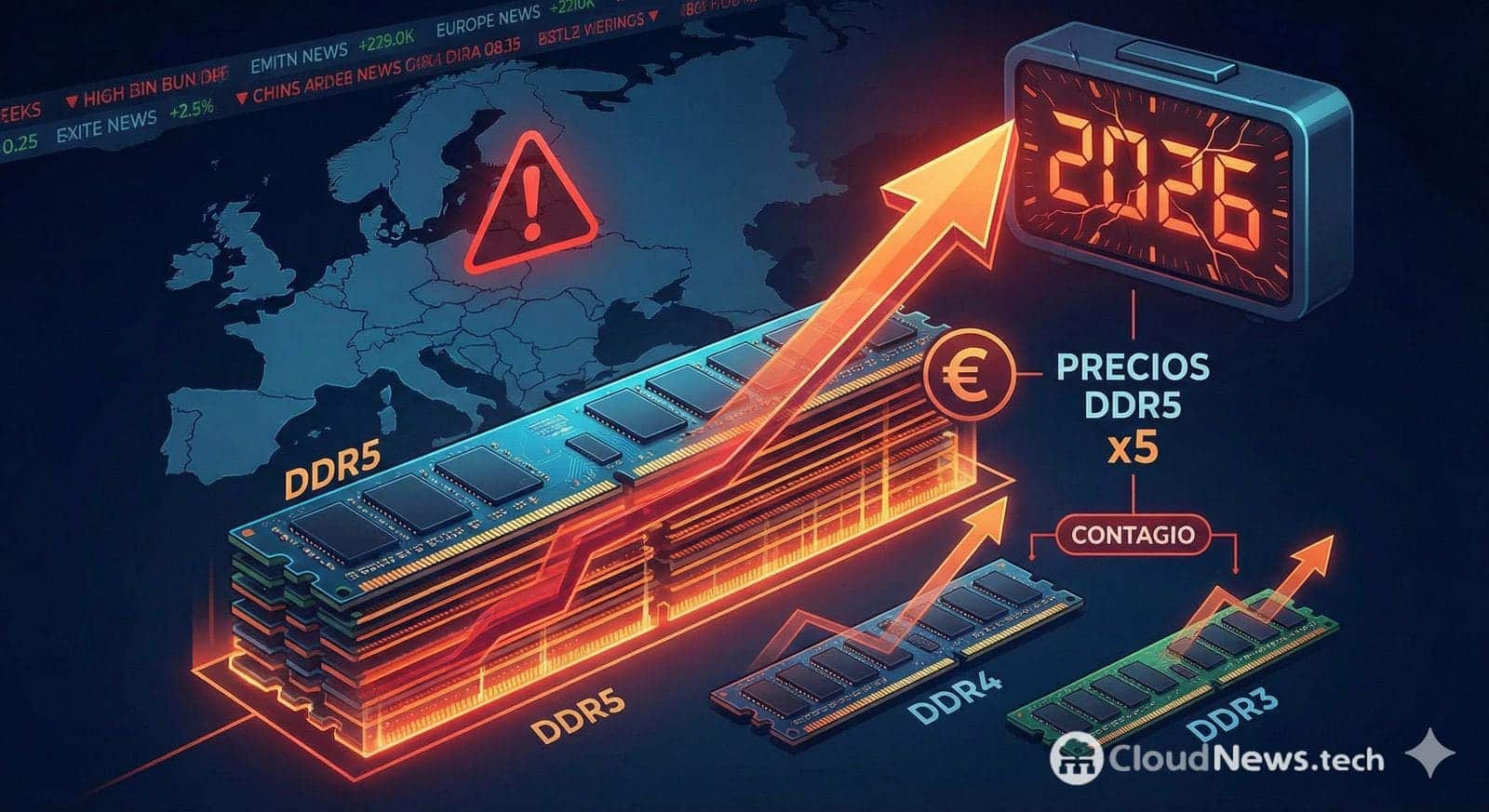
The memory industry faces 2026 with an uneasy mix of excitement and scarcity: on one hand, demand tied to artificial intelligence promises record margins; on the other, the market is beginning to accept that consumer memory—for PCs, mobiles, and consoles—will no longer be a priority. In this scenario, a political threat from Washington adds even more tension: the possibility of imposing tariffs of up to 100% on memory chip manufacturers that do not relocate production to U.S. soil.
The result is a climate that some analysts are already summing up with a term as vivid as it is concerning: “RAMpocalypse.” Not because memory will disappear, but because access to manufacturing capacity and reasonable prices is becoming a matter of financial muscle… and geopolitics.
The New Hierarchy of Memory: AI Rules (and, Above All, HBM)
In 2026, the key word is not just “DRAM,” but “HBM” (High Bandwidth Memory). This memory, stacked in 3D and tightly integrated with AI accelerators, has become a strategic component for training and deploying large-scale models. Its manufacturing relies not only on producing more wafers but also on advanced packaging and a specialized industrial chain, with long lead times and limited capacity.
In this context, the industry is shifting toward higher-margin products aimed at hyperscalers and major platforms. TrendForce describes 2026 as a “pivot year,” where large manufacturers accelerate the rollout of traditional consumer memory and prioritize more profitable lines. A clear example is the gradual phase-out of DDR4 and certain “legacy” NAND products—moves that, according to the firm, could drive bit prices to their maximums as available supply diminishes.
At the same time, signals of “capacity commitments” have normalized: executives and analysts have been warning for months that high-value memory—and, in some cases, broader DRAM and NAND capacity—is being reserved through long-term contracts to secure supply for AI infrastructure. In the tech ecosystem, the message is repeated: those needing memory for data centers cannot afford uncertainty and are willing to pay upfront to secure that security.
The Data Point Summarizing the Imbalance: Up to 70% for Data Centers
The inflection point isn’t just demand growth but its concentration. Several sector analyses suggest that data centers could absorb up to 70% of memory chip production in 2026, driven by the massive deployment of AI infrastructure. Although this percentage varies depending on memory types and methodologies, the practical effect is clear: the larger the “secured” share by big clients, the smaller the margin left for the rest of the market.
This “rest,” includes PC manufacturers, integrators, consumer electronics brands, and especially small and medium-sized enterprises that buy in less predictable cycles and with less bargaining power. In a market already strained in 2025, the result is a higher price floor and more irregular availability—particularly impacting mid-range products and volume purchases.
The Political Variable: 100% Tariffs as an Industrial Lever
This dynamic is further complicated by U.S. trade politics. In January, U.S. Secretary of Commerce Howard Lutnick raised the tone by stating that manufacturers wanting to produce memory have “two options”: pay a 100% tariff or build in the United States, framing this as “industrial policy.” Although the measure does not immediately translate into an approved and applied tariff, it introduces uncertainty into contracts, prices, and capacity planning.
For the market, harm doesn’t require the tariff to be enacted tomorrow: it’s enough for it to be credible to influence investment decisions, supply negotiations, and sourcing strategies. With memory already strained by AI demands, the mere risk of trade friction acts as a multiplier: pushing companies to secure stock earlier, sign longer-term agreements, and shift some risks into the final price.
More Investments, but No “More Memory” in the Short Term
The industry is responding with investment announcements, though with an evident limit: ramping up actual capacity takes years. Reuters, for example, reported movements to boost DRAM production in the medium term through acquisitions and industrial expansion, with new capacities expected to come online starting in 2027. Simultaneously, SK hynix announced a multi-million dollar investment in advanced packaging—an essential bottleneck for HBM—precisely to meet the demand driven by AI.
The clear takeaway: the market believes tensions won’t be resolved in months. Even as new factories and packaging plants are planned, the semiconductor industry’s timeline lags behind the commercial pace of AI innovation.
Who Foots the Bill: Consumer and SMBs as the Adjustment Variable
When supply is tight and strategic demand is inelastic, adjustments tend to fall on those with less purchasing power. Practically, this means the consumer market tends to absorb more volatility: price hikes in modules, changing specs, fewer promotions, and sometimes production cuts or redesigns to adapt to available memory.
Meanwhile, midsize companies relying on refreshes of IT infrastructure or on-premise projects face a dilemma: pay more, wait, or replan. In an environment where memory has become a “strategic resource,” efficiency and planning stop being best practices and become a competitive necessity.
Frequently Asked Questions (FAQ)
What is HBM memory and why is it so important for AI?
HBM (High Bandwidth Memory) is stacked 3D memory offering high bandwidth and energy efficiency. It’s crucial for AI accelerators because it feeds data to GPUs and specialized chips at speeds far exceeding conventional DRAM.
Why might PC RAM prices rise in 2026 if AI primarily uses HBM?
Although HBM is the focus, it shares critical industrial capacity (wafers, packaging, materials, line prioritization) and shifts investments away from “legacy” products. If supplies of traditional memory like DDR4 fall and global demand increases, module prices for PCs could face upward pressure.
Is a 100% tariff on memory already implemented or just a political threat?
For now, the market treats it as a threat and a sign of industrial policy. Even without immediate application, that risk can influence contracts, investments, and prices due to the uncertainty it introduces into the supply chain.
Which organizations are most exposed to this scarcity and rising prices scenario?
Particularly SMEs and consumer market buyers, as they tend to negotiate less in advance and in smaller volumes compared to large data center operators, who can reserve capacity through multi-year agreements.
