
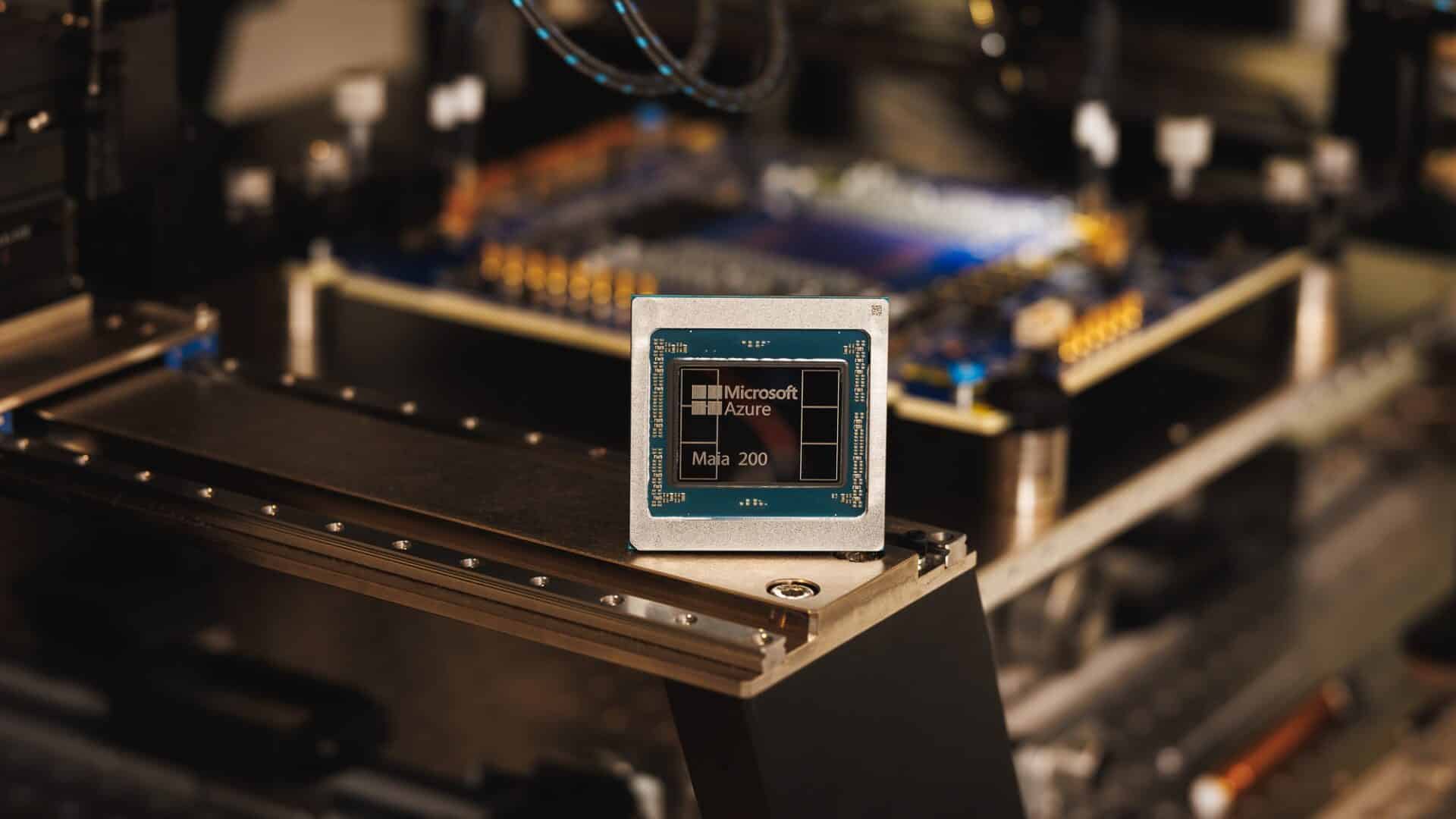
Microsoft has revealed Maia 200, its new inference (token generation) accelerator designed to significantly improve the cost and efficiency of running large-scale AI models in data centers. The company positions it as a core component of its heterogeneous infrastructure to serve multiple models — including OpenAI’s GPT-5.2 — within Microsoft Foundry and Microsoft 365 Copilot.
The announcement comes at a time when the industry is moving away from measuring leadership solely by “raw FLOPS” and is now prioritizing performance/$, memory capacity, energy efficiency, and data movement. In this landscape, Microsoft aims for two main advantages: reducing inference costs (where operational expenses spike) and controlling part of the technology stack (silicon + network + software) to gain optimization margins.
What Maia 200 Promises and Why It Is Relevant
According to Microsoft, Maia 200 is built on 3 nm process technology and optimized for low precisions (FP8/FP4), which are common in large-scale inference today. The company highlights three key pillars:
- Low-precision computation to maximize token throughput.
- Redesigned memory subsystem to feed large models without choking execution.
- Networking and transport at scale supported by Ethernet to scale dense clusters without relying on proprietary mesh networks.
Additionally, Microsoft confirms initial deployments in its US Central region (Des Moines, Iowa) and a subsequent phase in US West 3 (Phoenix, Arizona), with plans to expand to more regions.
Highlighted Specifications
Microsoft provides concrete figures, positioning the chip as a significant leap in its inference fleet:
- More than 140 billion transistors
- 216 GB of HBM3e with 7 TB/s bandwidth
- 272 MB of on-chip SRAM
- Peak performance per chip: >10 petaFLOPS in FP4 and >5 petaFLOPS in FP8
- Thermal envelope: 750 W (TDP SoC)
- Claimed ≈30% better performance per dollar compared to the latest hardware deployed in its fleet (according to Microsoft).
Furthermore, the company compares (as a proprietary claim) Maia 200’s peak performance with other hyperscale alternatives, especially in FP4/FP8 precisions.
Maia 200 Feature and Capability Table
| Area | What Maia 200 Includes | Real-world Operational Benefits |
|---|---|---|
| Manufacturing Node | 3 nm | Higher density and efficiency for sustained loads |
| Native Precision | FP8/FP4 Tensor Cores | More tokens per watt/euro in modern inference |
| Memory | 216 GB HBM3e / 7 TB/s bandwidth + 272 MB SRAM | Lower data hunger and higher accelerator utilization |
| Data Movement | Dedicated engines (DMA/NoC and optimized routes) | Reduces bottlenecks in feeding large models |
| Scaling | Two-level scale-up design over Ethernet (cloud focus) | Scale dense clusters without relying on proprietary interconnects |
| Data Center Integration | Telemetry, diagnostics, and management integrated into control plane | More predictable large-scale operation (observability and reliability) |
| Toolchain | Maia SDK (PyTorch, Triton compiler, kernel library, low-level language, simulator, cost calculator) | Faster portability and fine-tuned optimization when needed |
| Internal Use Cases | Foundry/Copilot, synthetic data generation, RL in internal teams | Aligns silicon with production pipelines and continuous improvement |
(Final availability and scope depend on the regional deployment program announced by Microsoft).
A Key Point: “Not Just FLOPS,” Also Power and Networking
In inference, the accelerator might have excess computing power… yet still perform poorly if memory and network can’t keep up with data flow. Microsoft emphasizes that Maia 200 addresses this exact issue: a memory subsystem focused on low-precision data types and a communication design for collective and scaled cluster operation.
On the development side, Microsoft also highlights the Maia SDK, with integration into PyTorch and an optimization pathway based on Triton, plus simulation tools and cost modeling to refine efficiency before deployment.
Frequently Asked Questions
What is Maia 200 for: training or inference?
Microsoft specifically presents it as an inference accelerator, optimized for serving models and generating tokens efficiently.
Why do FP4 and FP8 matter so much in 2026?
Because much of modern inference relies on low-precision data types to increase throughput and reduce energy costs, while maintaining acceptable quality through quantization techniques.
What advantage does 216 GB of HBM3e give?
It enables hosting large models (or larger portions of them) with less external memory traffic and reduces bandwidth bottlenecks, increasing the chip’s real utilization.
Is the software proprietary or compatible with common tools?
Microsoft emphasizes a “natural” pathway from PyTorch, with compilation and optimization via Triton and low-level programming options for those needing to push hardware performance further.
Source: blogs.microsoft.com
