
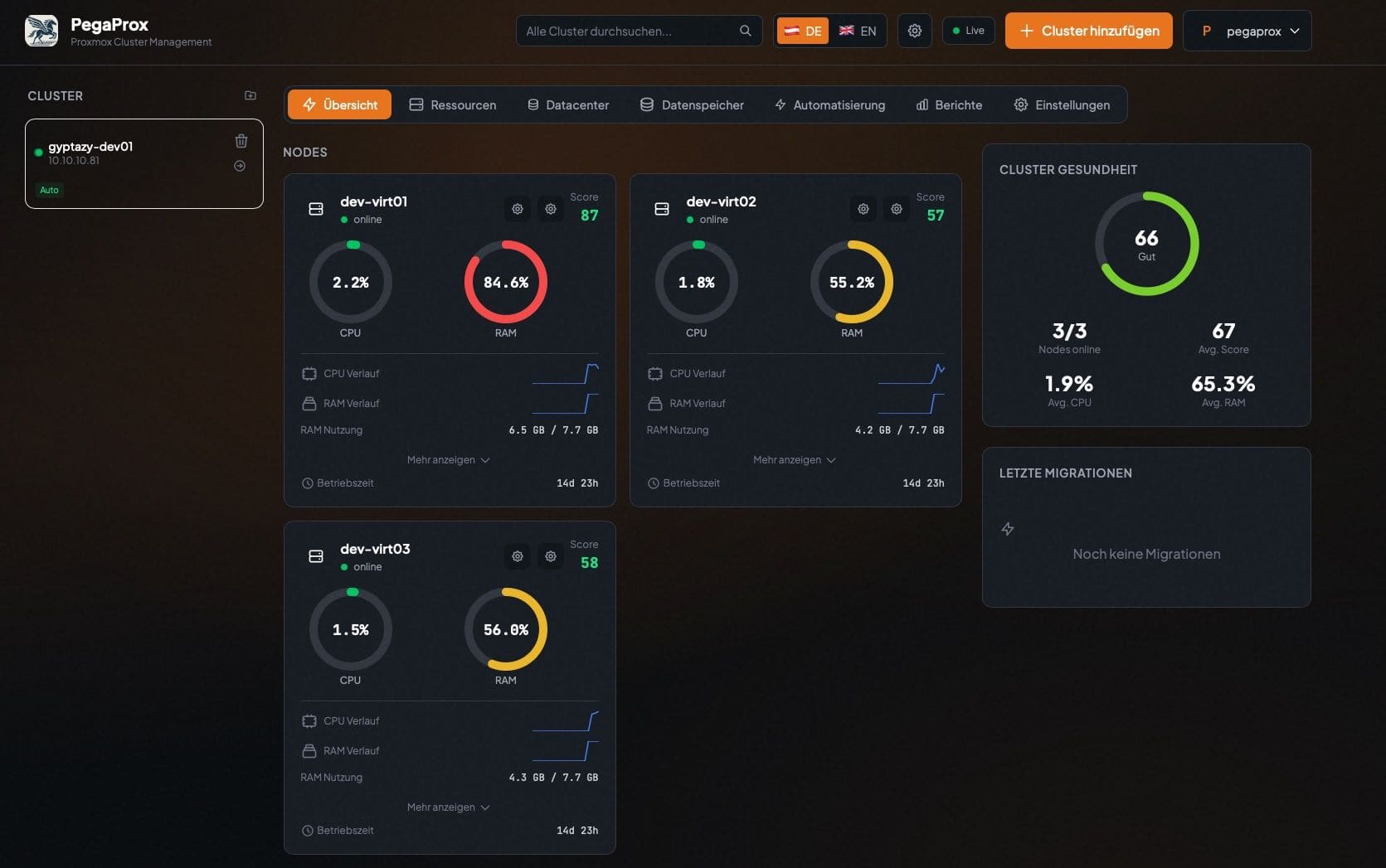
The consolidation of Proxmox VE as a genuine alternative in virtualization—especially in environments seeking more predictable costs and greater control—is reopening an old debate among system teams: how to scale operations without increasing complexity faster than the platform itself. As clusters, nodes, tenants, and pressure to meet SLAs grow, daily management tends to fragment across dashboards, scripts, auxiliary tools, and manual processes.
In this context, PegaProx begins to make a strong impression. It presents itself as a central management platform for data centers based on Proxmox. Its approach is straightforward: offer a “single point of control” to manage multiple clusters, monitor nodes and storage, orchestrate migrations, and implement operational automation, with an approach reminiscent of enterprise virtualization suites.
According to the technical description published on January 25, 2026, PegaProx aims to address those pain points that many operations start to encounter: noisy neighbors, organic VM growth that leaves nodes unbalanced, maintenance windows that become complex due to lack of visibility, or heterogeneous CPUs that turn migrations into an unnecessary risk. In other words, the daily routine of an operator when a “simple cluster” becomes a distributed platform.
A key point: operations, not just visibility
PegaProx’s focus isn’t limited to displaying metrics. It emphasizes that the platform centralizes operational tasks that in many environments are handled through manual procedures:
- Real-time monitoring of resources and cluster/node health.
- Unified management of VMs and containers and their lifecycle.
- Migrations (including inter-cluster migration) with pre-validations to reduce common failures.
- Patch management on Proxmox VE nodes from within the interface (relying on SSH access when the API lacks certain functions).
- Access control with users, groups, and “tenancies”, tailored for multi-team or multi-client scenarios.
This last point is particularly relevant: as Proxmox is used to serve several departments or clients, governance (who can see what, and who can perform which actions) ceases to be a trivial detail and becomes an essential requirement for audit and operational control.
The quiet obsession: CPU compatibility for safe migrations
One of the most interesting sections is the idea of aligning CPU compatibility within a cluster. In practice, clusters are rarely homogeneous: they expand with different generations, instruction sets change, and incompatibilities arise, especially impacting live migrations and certain workloads (including Windows VMs).
PegaProx aims to detect CPU capabilities on nodes and propose a safe baseline so that VMs can remain migratable without surprises. While technical, this feature often translates into a “stability multiplier”: when automating migrations or rebalancing, compatibility stops being a one-off setting and becomes a platform policy.
Two deployment formats, with an important nuance
Initially, PegaProx will be distributed as ready-to-import images for Proxmox, to ease installation friction. Two options are described:
- A lightweight container-based deployment, targeting low resource consumption and rapid setup.
- An appliance in a virtual machine (Ubuntu is mentioned as the base), designed for environments where the management tool itself should be migratable in real-time like any VM.
A practical detail arises here: in Proxmox, live migration of containers is limited (due to the absence of CRIU), meaning a management container cannot be “moved” as easily as a VM. Such considerations often mark the difference between “suitable for labs” and “fit for 24/7 operations”.
Highlighted features table of PegaProx
| Area | Function | Real-world operational benefit | Relevant technical notes |
|---|---|---|---|
| Multi-site management | Unified multi-cluster management | Single view across multiple environments and locations | Focused on reducing context switching |
| Observability | Node and cluster monitoring | Early detection of overloads and degradations | Real-time metrics, centralized view |
| Governance and access | Users, groups, and tenancies | Separation of responsibilities and resource-based scope control | Granular permissions per resource |
| Security/operation | Semi-automated patch management | Reduces update debt and standardizes maintenance windows | Supports SSH when APIs lack endpoints |
| Mobility | Inter-cluster migration | Maintenance and load balancing without “rebuilding” services | Designed for operational-scale migrations |
| Secure mobility | Pre-migration validations | Fewer failures due to mounted ISOs, inaccessible storage, etc. | Prevents issues before executing tasks |
| Computing | CPU alignment for migrations | Minimizes hardware heterogeneity risks | Defines a compatible baseline on nodes |
| Capacity | Intelligent VM balancing | Reduces “hot” nodes and improves overall utilization | Based on load policies and data |
| Storage | Smart storage balancing | Prevents bottlenecks and I/O imbalance | Designed for continuous operation |
| High availability | HA and failover | Maintains service continuity during failures or maintenance | Integrated into operator workflows |
| Workload management | VM and container management | Centralized resource lifecycle | Focuses on consistency across clusters |
| User experience | Theming | Ergonomic and visual consistency for teams | Non-functional, but useful for intensive use |
A shifting market: Proxmox also pushes its control layer
The rise of PegaProx coincides with the Proxmox ecosystem accelerating management tools on a large scale. Proxmox already offers Proxmox Datacenter Manager as a centralized solution to monitor and operate multiple clusters, emphasizing global visibility, migrations, and update management, with the latest downloads released in December 2025.
This places PegaProx in an environment demanding more than just “showing”: tools that shape how operations are performed. Success will depend on the level of automation, the robustness of validation, and how well it integrates into existing processes (changes, auditing, maintenance, segregation of duties, and risk management).
Frequently Asked Questions
Who benefits most from a platform like PegaProx?
Proxmox infrastructures that grow across multiple clusters (or locations) and require operation standardization: balancing, migrations, centralized visibility, and access control by teams or clients.
What problem does CPU alignment address in Proxmox?
It reduces the risk of a VM being unable to migrate live between nodes due to instruction set differences across CPUs, which is common when expanding a cluster with different hardware generations.
Does centralized patch management add real value?
Yes, it transforms a manual or scattered task into a more repeatable process, with better visibility of update status and less likelihood of “forgotten nodes” in production.
What do teams consider before adopting multi-cluster management tools?
Three main points: security (RBAC/tenancy), operational reliability (validation and change control), and scalability without turning each maintenance event into a project.
