
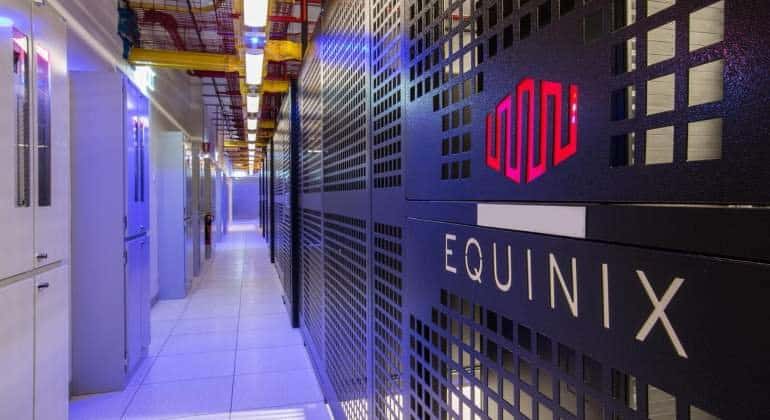
The race for digital infrastructure is not just happening in the public cloud. Behind the scenes — where data centers, energy, cooling, and especially interconnection reside — the market continues to grow “steadily,” driven by demand from enterprises, hyperscalers, cloud providers, and network operators. In this context, IDC has published its global data center service provider assessment for 2023, placing Equinix in the “Leaders” category according to its IDC MarketScape methodology.
While these reports are often read as “rankings,” the key is understanding what IDC is measuring: colocation and interconnection services (third-party facilities where clients host their infrastructure and connect to network, cloud, and digital ecosystems), rather than cloud as software.
What IDC MarketScape Evaluates (and How to Interpret the Chart)
IDC MarketScape divides the assessment along two axes:
- Capabilities (Y-axis): what the provider can deliver “today,” its actual catalog, and alignment with current needs.
- Strategy (X-axis): how well its 3–5-year plan matches what clients will demand.
Additionally, the size of the icon represents market share within the evaluated segment. In the report’s figure, Equinix appears in the “Leaders” area alongside other key sector names like Digital Realty and NTT.
This interpretation matters: a provider can stand out for current capabilities, strategic vision, or both. IDC aims to reflect that balance, not just “who is bigger.”
Why Equinix Is Positioned Stronger: Global Footprint and Ecosystem Density
In the provider’s summary profile, IDC describes Equinix as an established player in digital infrastructure, with a network spanning six continents and presence in 71 metropolitan areas across 32 countries. As of June 2023, the company operates 248 data centers (including xScale for wholesale/hyperscale segments), with over 10,000 customers and approximately 452,000 interconnections globally.
Apart from the numbers, the nuance lies in ecosystem “density”: IDC highlights that Equinix maintains a customer base including thousands of networks and cloud/IT providers, alongside a significant share of large corporations and digital players. Practically, this translates into an operational advantage: the closer networks, clouds, and services are to each other, the easier it is to build hybrid and multi-cloud architectures with low latency and less contractual complexity.
Three Layers of Offering: Data Centers, Interconnection, and Digital Services
IDC structures Equinix’s offerings into layers within “Platform Equinix”:
1) Data Center Services (retail and wholesale colocation)
The report details typical colocation capabilities (security, monitoring, remote services, cages, and customized options) and mentions initiatives like xScale, aimed at hyperscale and wholesale markets, with large-scale capacity plans.
2) Interconnection as a Backbone
IDC highlights Equinix Fabric as a software-defined interconnection network available in dozens of metropolitan areas, providing Layer 2 and Layer 3 connectivity with high-capacity port support, as well as inter- and inter-center exchange services. The message is clear: value isn’t just about “renting space,” but about interconnecting efficiently and flexibly.
3) Digital Services for Running Hybrid Networks and Workloads
The document also cites offerings like Network Edge (on-demand virtual network functions supported by partners) and Equinix Metal (bare-metal as a service), signaling an evolution toward more automated, consumable infrastructure on demand.
The AI Pressure Changes Everything: Density, Power, and Cooling
IDC’s report goes beyond market snapshot; it points to a trend that, by 2026, is now a common topic: generative AI and high-density workloads are reshaping the physical requirements of data centers.
IDC suggests providers need to accelerate “regional hubs” capable of moving from typical densities of 10–20 kW per rack to scenarios reaching 70 kW per rack and even 200–300 kW per rack, depending on the use case, demanding advanced cooling, better thermal dissipation, and a serious focus on energy.
Simultaneously, IDC emphasizes that sustainability is no longer just a slogan but a matter of metrics and timelines: reducing water consumption, building more efficient facilities, and increasing renewable energy use. Within this framework, the report notes that Equinix achieved a 96% global renewable energy coverage at its data centers (a figure mentioned within the report itself).
Is There “Small Print”? Yes: Being Global Isn’t Always What’s Needed
IDC also offers an important counterpoint: no matter how solid a global footprint is, some organizations do not require such distribution or ecosystem density, preferring a local regional provider. Nonetheless, its recommendation on “when to choose Equinix” points towards specific profiles: medium and large enterprises, cloud-oriented IT platforms, and network operators seeking to optimize digital infrastructure and connect with a broad partner and service ecosystem.
In other words: leadership isn’t about being “better for everyone,” but about being “better for those who need to operate at scale, with hybrid connectivity and a dense interconnection fabric.”
Frequently Asked Questions
What is IDC MarketScape, and why do so many companies use it to compare providers?
IDC MarketScape is an evaluation methodology that positions providers based on current capabilities and strategy over 3–5 years, combining qualitative and quantitative criteria, with a chart that makes comparing approaches and fit with needs easier.
What is the difference between retail and wholesale colocation?
Retail colocation usually involves renting racks or cages with shorter contracts and assigned power; wholesale entails full suites or buildings, more customization, and clients like hyperscalers, content providers, or large operators, focusing on large-scale deployments.
Why is interconnection so crucial in hybrid multi-cloud strategies?
Because it reduces friction: it enables connecting networks, clouds, and services with lower latency, more control, and often better costs and governance than relying solely on public Internet and “long” architectures.
What does generative AI demand from a data center in terms of power and cooling?
IDC points to a leap in density that can go well beyond traditional ranges, requiring advanced cooling, improved heat dissipation, and energy planning; in some cases, needs can scale to levels much higher than those of a traditional enterprise data center.
via: equinix
